
Read the original · Check the transcription
Gibbs Family Papers, Reel 3, frame 28 (thumbnail)
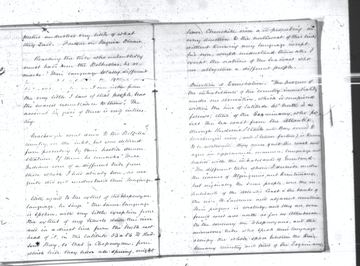
Preserved transcription
Transcription matched to this Wisconsin microfilm frame. Preserved from the supplied frame transcription; compare uncertain readings with the scan.
preters understood very little of what
they said. Farther on Nequia Dinais.
Reaching the tribe who undoubtedly
must have been the Belhoolas, he re-
marks: "Their language totally different
[illegible, ~4 words] the Atnah or
[illegible, ~2 words] as far[?] as I can judge from
the very little I saw of that people, bear
the nearest resemblance to them". The
account he gives of them is very interes-
ting.
Mackenzie went down to the Belbella
country, on the inlet, but was deterred
from proceeding by their hostile demon-
strations. Of them he remarks " These
Indians were of a different tribe from
those which I had already seen, as our
guide did not understand their language.
With regard to the extent of the Chepewyan
language, he says, " the same language
is spoken, with very little exception from
the extent of my travels down this river
and in a direct line from the North east
head of it, in the latitude 53 a 54 to Hud-
son's Bay, so that a Chepewyan, from
which tribe they have all sprung, might
leave Churchill river and proceeding in
every direction to the northwest of this line,
without knowing any language except
his own, would understand them all. I
except the natives of the sea coast who
are altogether a different people.
Direction of Emigration. "The progress of
the inhabitants of the country immediately
under our observation, which is comprised
within the line of latitude 45[?] north is as
follows: those of the Esquimaux, who pos-
sess the sea coast from the Atlantic
through Hudson's Straits and Bay round to
Mackenzie's river (and I believe farther) is known
to be westward: they never quit the coast and
agree in appearance, manners, language and
habits with the inhabitants of Greenland.
"The different tribes whom I describe under
the names of Algonquins and Knisteneaux[?],
but originally the same people, were the in-
habitants of the Atlantic Coast & the banks of
the river St Lawrence and adjacent countries.
Their progress is westerly, and they are even
found west and north as far as Athabasca.
On the contrary the Chepewyans, and the
numerous tribes who speak their language
occupy the whole space between the Knis-
teneaux country and that of the Esquimaux,
Wisconsin Historical Society · WHS-R3-28 · Letter from George Gibbs (reading notes) to notebook
Open the complete archive frame record →