
Read the original · Check the transcription
Gibbs Family Papers, Reel 3, frame 17 (thumbnail)
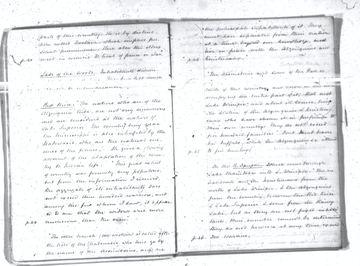
Preserved transcription
Transcription matched to this Wisconsin microfilm frame. Preserved from the supplied frame transcription; compare uncertain readings with the scan.
[left-hand page]
parts of this country. He is by distinc-
tion called Mectain[?] which implies per-
sonal preeminence. Here also the elders
p.40 meet in council to treat of peace or war.
Lake of the Woods. Inhabitants dimin-
[illegible, ~4 words] Drink[?] has left much[?]
p.4[illegible] [illegible] to insignificance.
Red River. "The natives who are of the
Algonquin tribe, are not very numerous
and are considered as the natives of
Lake Superior. The country being near
the Mississippi is also inhabited by the
Nadowasis, who are the natural ene-
mies of the former". He gives a glowing
account of the adaptation of the coun-
try to Indian life. "This great extent
of country was formerly very populous,
but from the information I received,
the aggregate of its inhabitants does
not exceed three hundred warriors, and
among the few whom I saw, it appear-
ed to me that the widows were more
p.44 numerous than the men".
"The other branch (the western) is called after
the tribe of the Nadowasis, who here go by
the name of the Assiniboins, and are
[right-hand page]
the principal inhabitants of it. They
must have separated from their nation
at a time beyond our knowledge, and
live in peace with the Algonquins and
p.44 Knisteneaux."
"The Assiniboins and some of the Fall or
[illegible, ~1 line]
lands of this country, and those on the [illegible]
occupying the centre part of it; that next
Lake Winipic, and about its source, being
the station of the Algonquins & Kniste-
neaux who have chosen it in preference to
their own country. They do not exceed
five hundred families". Dont hunt beaver
but buffalo, while the Algonquins &c attend
p.45 to fur hunting!
On the R. Dauphin[?] which runs through
Lake Manitoba into L. Winipic." the in-
habitants are the Knisteneaux from the
north of Lake Winipic, & the Algonquins
from the country between the Red River
& Lake Superior & some from the Rainy
Lake, but as they are not fixed inhabi-
tants, their number cannot be determined
they do not however at any time exceed
p.46. 200 warriors.
Wisconsin Historical Society · WHS-R3-17 · Letter from George Gibbs (reading notes) to notebook
Open the complete archive frame record →