
Read the original · Check the transcription
Gibbs Family Papers, Reel 3, frame 16 (thumbnail)
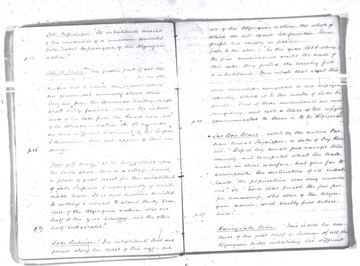
Preserved transcription
Transcription matched to this Wisconsin microfilm frame. Preserved from the supplied frame transcription; compare uncertain readings with the scan.
Lak. Nepisingui. "Its inhabitants consist
of the remainder of a numerous converted[?]
tribe, called Nepisinguis, of the Algonquin
p.25. nation."
Isle St. Joseph. "The greater part if not the
[illegible, ~7 words] for no other
purpose but to receive the presents which
our government continually[?] allows them.
They are from the American territory, except
about thirty families, who are the inhabi-
tants of the lake from the French river, and
of the Algonquin nation," &c. He remarks
on their different sentiment[?] by the English
& Americans. Does not approve of their own
p.26 policy.
Falls of St Mary, "at the foot of which upon
the South shore, there is a village, formerly
a place of great resort for the inhabitants
of Lake Superior, & consequently of consid-
erable trade. It is now however dwindled
to nothing, & reduced to about thirty fam-
ilies, of the Algonquin nation, who are
half of the year starving, and the other
p.27 half intoxicated."
Lake Superior. "The inhabitants that are
found along the coast of this water are
all of the Algonquin nation, the whole of
which do not exceed 150 families. These
people live chiefly on fish." [illegible]
(note to the above) "In the year 1668, when
the first missionaries visited the south of
this lake, they found the country full
of inhabitants. They relate that about this
[illegible] a band of the Nepisingues[?], who
were converted, emigrated to the Nipigon
country, which is to the north of Lake Su-
perior. Few of their descendants are now
remaining, and not a trace of the religion
p.30 communicated to them is to be discovered."
* Lac Bois Blanc, called by the natives Pas-
seau Minac Sagaigan, or Lake of Dry Ber-
ries. "Before the small pox ravaged this
country, and completed what the Nado-
wasis, in their warfare, had gone far to
accomplish, the destruction of its inhabi-
tants, the population was very numer-
ous," &c. "Since that period, the few peo-
ple remaining, who were of the Algon-
quin nation, could hardly find subsis-
p.37 tence."
Rainy Lake River. "This is also the resi-
dence of the first chief, or Sachem of all the
Algonquin tribes inhabiting the different
Wisconsin Historical Society · WHS-R3-16 · Letter from George Gibbs (reading notes) to notebook
Open the complete archive frame record →