
Read the original · Check the transcription
Gibbs Family Papers, Reel 3, frame 619
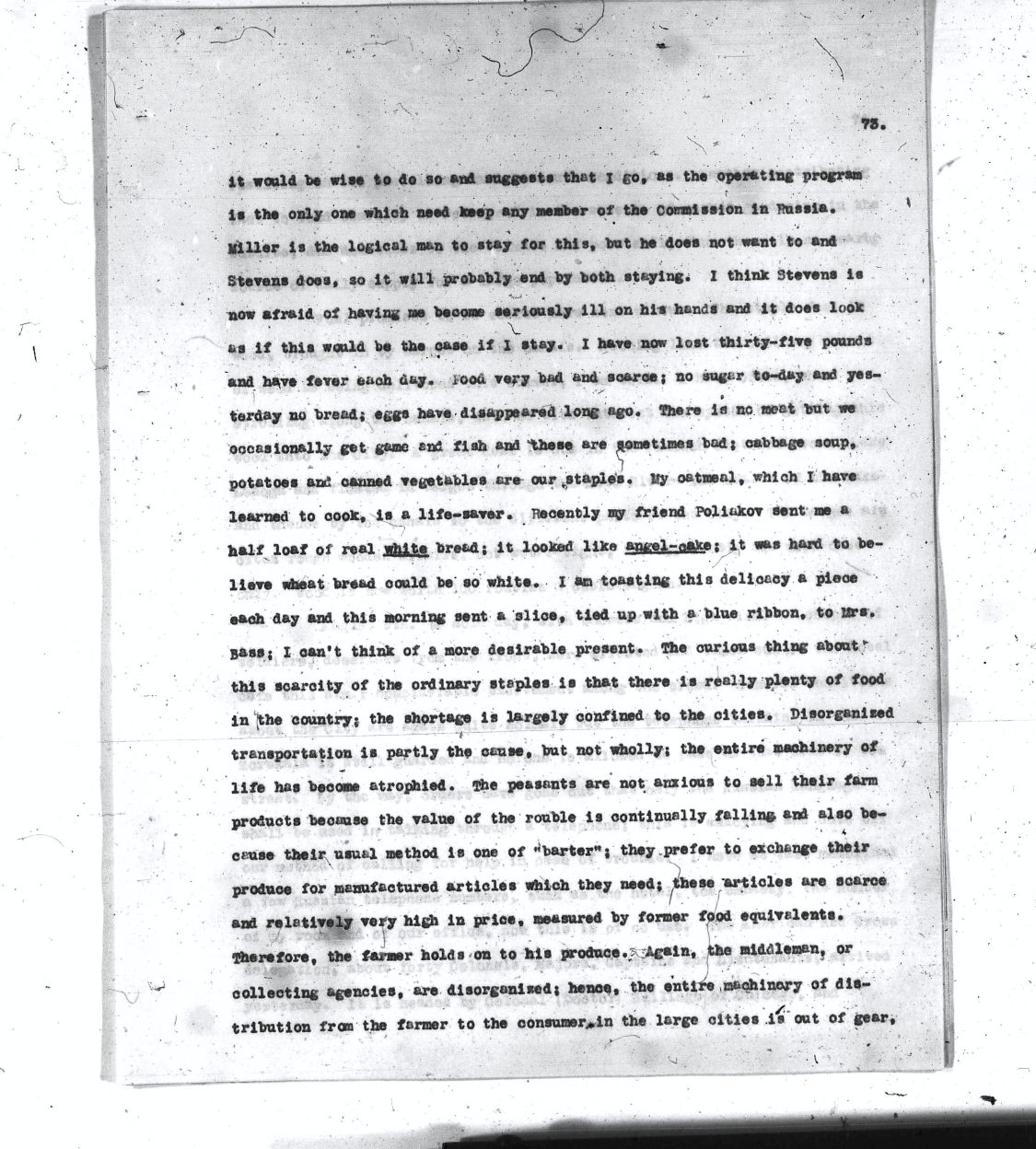
Preserved transcription
Transcription matched to this Wisconsin microfilm frame. Preserved from the supplied frame transcription; compare uncertain readings with the scan.
[printed: 73.]
it would be wise to do so and suggests that I go, as the operating program
is the only one which need keep any member of the Commission in Russia.
Miller is the logical man to stay for this, but he does not want to and
Stevens does, so it will probably end by both staying. I think Stevens is
now afraid of having me become seriously ill on his hands and it does look
as if this would be the case if I stay. I have now lost thirty-five pounds
and have fever each day. Food very bad and scarce; no sugar to-day and yes-
terday no bread; eggs have disappeared long ago. There is no meat but we
occasionally get game and fish and these are sometimes bad; cabbage soup,
potatoes and canned vegetables are our staples. My oatmeal, which I have
learned to cook, is a life-saver. Recently my friend Poliakov sent me a
half loaf of real [underlined: white] bread; it looked like [underlined: angel-cake]; it was hard to be-
lieve wheat bread could be so white. I am toasting this delicacy a piece
each day and this morning sent a slice, tied up with a blue ribbon, to Mrs.
Bass; I can't think of a more desirable present. The curious thing about
this scarcity of the ordinary staples is that there is really plenty of food
in the country; the shortage is largely confined to the cities. Disorganized
transportation is partly the cause, but not wholly; the entire machinery of
life has become atrophied. The peasants are not anxious to sell their farm
products becasue[?] the value of the rouble is continually falling and also be-
cause their usual method is one of "barter"; they prefer to exchange their
produce for manufactured articles which they need; these articles are scarce
and relatively very high in price, measured by former food equivalents.
Therefore, the farmer holds on to his produce. Again, the middleman, or
collecting agencies, are disorganized; hence, the entire machinery of dis-
tribution from the farmer to the consumer in the large cities is out of gear,
Wisconsin Historical Society · WHS-R3-619 · DUPLICATE microfilm exposure of frame 616 (document), (cont.)
Open the complete archive frame record →