
Read the original · Check the transcription
Gibbs Family Papers, Reel 3, frame 566
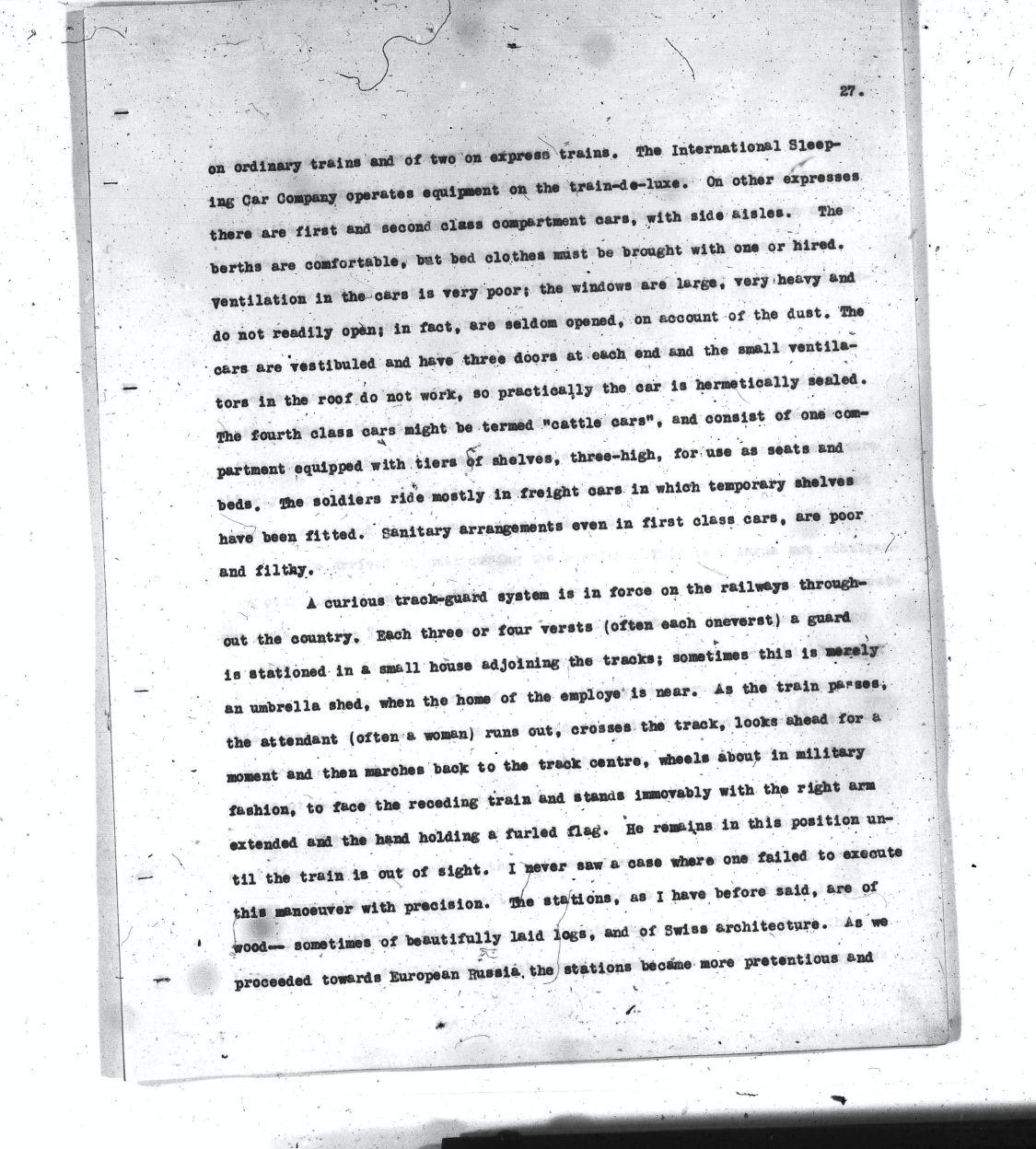
Preserved transcription
Transcription matched to this Wisconsin microfilm frame. Preserved from the supplied frame transcription; compare uncertain readings with the scan.
27.
on ordinary trains and of two on express trains. The International Sleep-
ing Car Company operates equipment on the train-de-luxe. On other expresses
there are first and second class compartment cars, with side aisles. The
berths are comfortable, but bed clothes must be brought with one or hired.
Ventilation in the cars is very poor; the windows are large, very heavy and
do not readily open; in fact, are seldom opened, on account of the dust. The
cars are vestibuled and have three doors at each end and the small ventila-
tors in the roof do not work, so practically the car is hermetically sealed.
The fourth class cars might be termed "cattle cars", and consist of one com-
partment equipped with tiers of shelves, three-high, for use as seats and
beds. The soldiers ride mostly in freight cars in which temporary shelves
have been fitted. Sanitary arrangements even in first class cars, are poor
and filthy.
A curious track-guard system is in force on the railways through-
out the country. Each three or four versts (often each oneverst) a guard
is stationed in a small house adjoining the tracks; sometimes this is merely
an umbrella shed, when the home of the employe is near. As the train passes,
the attendant (often a woman) runs out, crosses the track, looks ahead for a
moment and then marches back to the track centre, wheels about in military
fashion, to face the receding train and stands immovably with the right arm
extended and the hand holding a furled flag. He remains in this position un-
til the train is out of sight. I never saw a case where one failed to execute
this manoeuver with precision. The stations, as I have before said, are of
wood-- sometimes of beautifully laid logs, and of Swiss architecture. As we
proceeded towards European Russia, the stations became more pretentious and
Wisconsin Historical Society · WHS-R3-566 · DUPLICATE microfilm exposure of frame 557 (document), (cont.)
Open the complete archive frame record →