
Read the original · Check the transcription
Gibbs Family Papers, Reel 3, frame 559
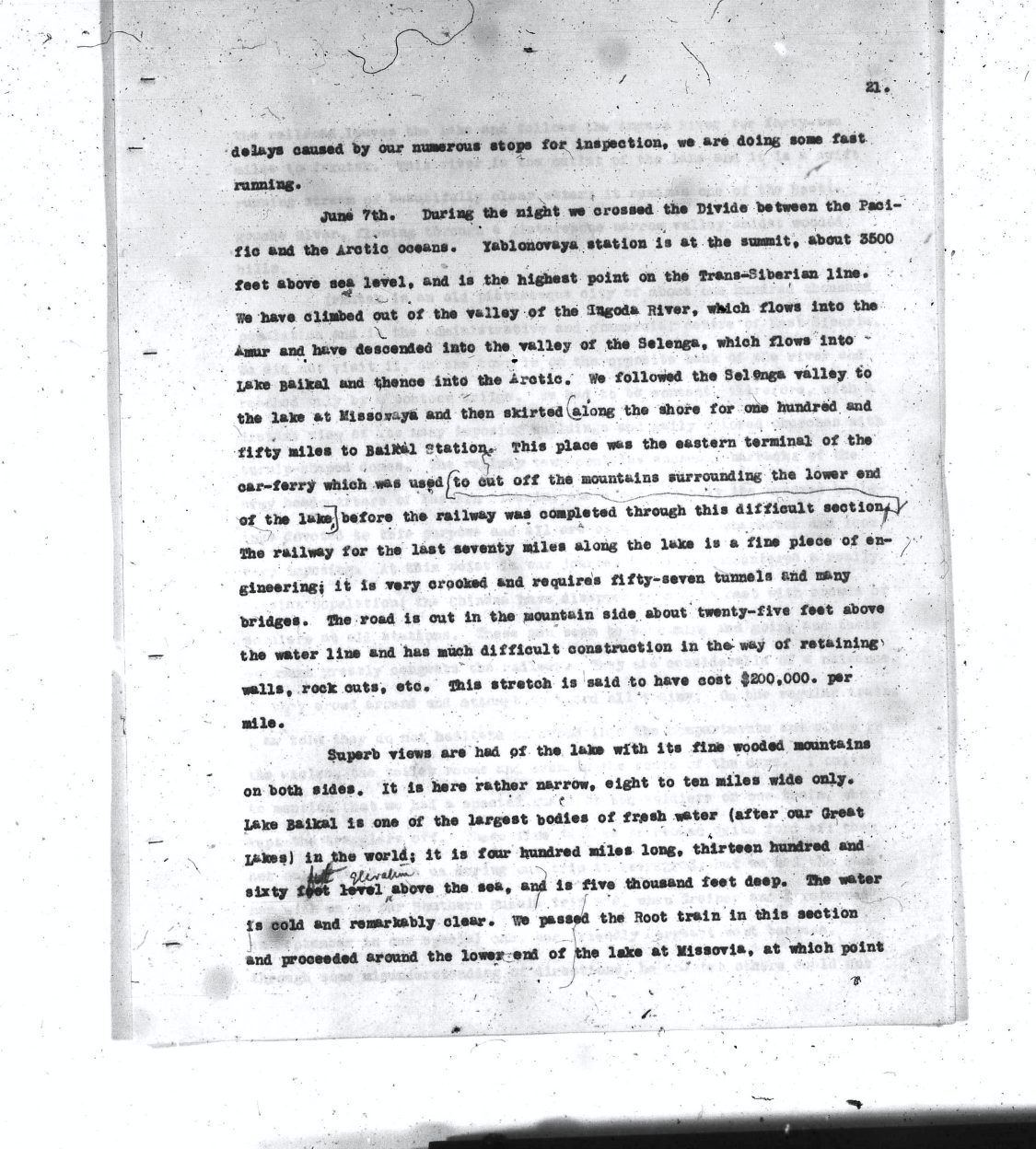
Preserved transcription
Transcription matched to this Wisconsin microfilm frame. Preserved from the supplied frame transcription; compare uncertain readings with the scan.
21.
delays caused by our numerous stops for inspection, we are doing some fast
running.
June 7th. During the night we crossed the Divide between the Paci-
fic and the Arctic oceans. Yablonovaya station is at the summit, about 3500
feet above sea level, and is the highest point on the Trans-Siberian line.
We have climbed out of the valley of the Ingoda River, which flows into the
Amur and have descended into the valley of the Selenga, which flows into
Lake Baikal and thence into the Arctic. We followed the Selenga valley to
the lake at Missovaya and then skirted along the shore for one hundred and
fifty miles to Baikal Station. This place was the eastern terminal of the
car-ferry which was used to cut off the mountains surrounding the lower end
of the lake before the railway was completed through this difficult section.
The railway for the last seventy miles along the lake is a fine piece of en-
gineering; it is very crooked and requires fifty-seven tunnels and many
bridges. The road is cut in the mountain side about twenty-five feet above
the water line and has much difficult construction in the way of retaining
walls, rock cuts, etc. This stretch is said to have cost $200,000. per
mile.
Superb views are had of the lake with its fine wooded mountains
on both sides. It is here rather narrow, eight to ten miles wide only.
Lake Baikal is one of the largest bodies of fresh water (after our Great
Lakes) in the world; it is four hundred miles long, thirteen hundred and
sixty [struck: foot] [inserted: feet] level [inserted: elevation] above the sea, and is five thousand feet deep. The water
is cold and remarkably clear. We passed the Root train in this section
and proceeded around the lower end of the lake at Missovia, at which point
Wisconsin Historical Society · WHS-R3-559 · DUPLICATE microfilm exposure of frame 557 (document), (cont.)
Open the complete archive frame record →