
Read the original · Check the transcription
Gibbs Family Papers, Reel 3, frame 551
Preserved transcription
Transcription matched to this Wisconsin microfilm frame. Preserved from the supplied frame transcription; compare uncertain readings with the scan.
14.
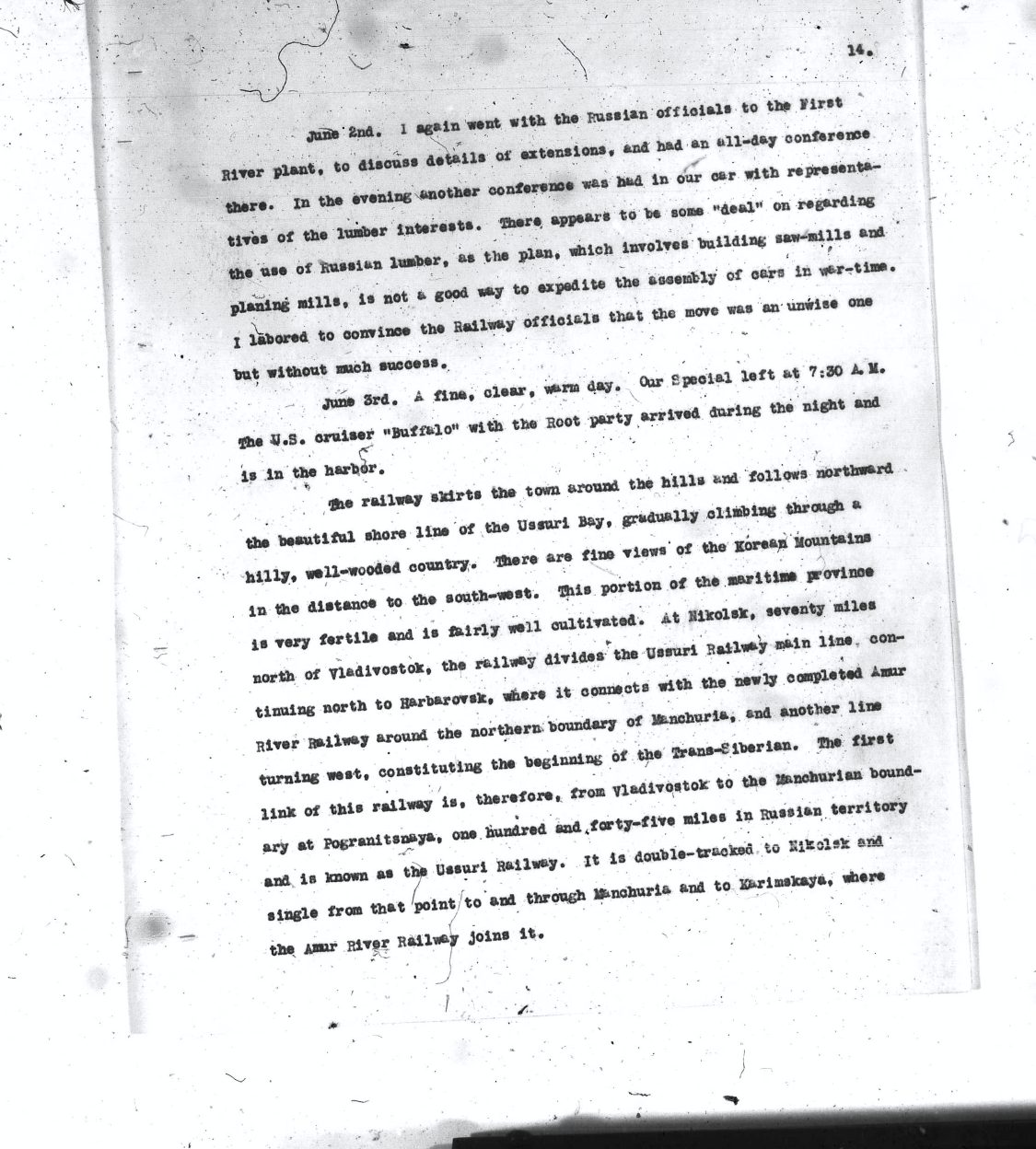
June 2nd. I again went with the Russian officials to the First
River plant, to discuss details of extensions, and had an all-day conference
there. In the evening another conference was had in our car with representa-
tives of the lumber interests. There appears to be some "deal" on regarding
the use of Russian lumber, as the plan, which involves building saw-mills and
planing mills, is not a good way to expedite the assembly of cars in war-time.
I labored to convince the Railway officials that the move was an unwise one
but without much success.
June 3rd. A fine, clear, warm day. Our Special left at 7:30 A.M.
The U.S. cruiser "Buffalo" with the Root party arrived during the night and
is in the harbor.
The railway skirts the town around the hills and follows northward
the beautiful shore line of the Ussuri Bay, gradually climbing through a
hilly, well-wooded country. There are fine views of the Korean Mountains
in the distance to the south-west. This portion of the maritime province
is very fertile and is fairly well cultivated. At Nikolsk, seventy miles
north of Vladivostok, the railway divides the Ussuri Railway main line, con-
tinuing north to Harbarovsk, where it connects with the newly completed Amur
River Railway around the northern boundary of Manchuria, and another line
turning west, constituting the beginning of the Trans-Siberian. The first
link of this railway is, therefore, from Vladivostok to the Manchurian bound-
ary at Pogranitsnaya, one hundred and forty-five miles in Russian territory
and is known as the Ussuri Railway. It is double-tracked to Nikolsk and
single from that point to and through Manchuria and to Karimskaya, where
the Amur River Railway joins it.
Wisconsin Historical Society · WHS-R3-551 · DUPLICATE microfilm exposure of frame 541 (document), (cont.)
Open the complete archive frame record →