
Read the original · Check the transcription
Gibbs Family Papers, Reel 3, frame 549
Preserved transcription
Transcription matched to this Wisconsin microfilm frame. Preserved from the supplied frame transcription; compare uncertain readings with the scan.
[page number, typed:] 11.
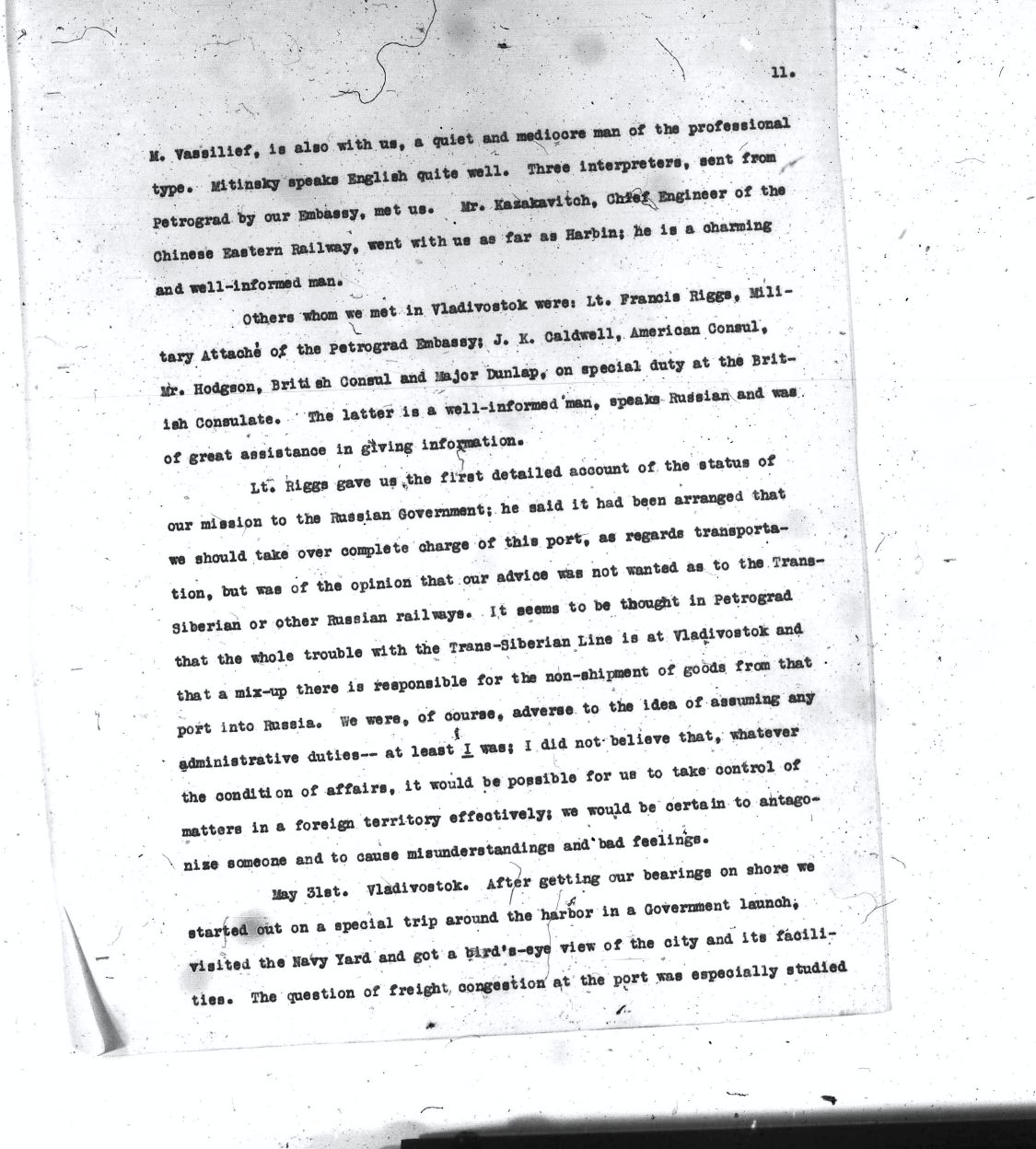
M. Vassilief, is also with us, a quiet and mediocre man of the professional
type. Mitinsky speaks English quite well. Three interpreters, sent from
Petrograd by our Embassy, met us. Mr. Kazakavitch, Chief Engineer of the
Chinese Eastern Railway, went with us as far as Harbin; he is a charming
and well-informed man.
Others whom we met in Vladivostok were: Lt. Francis Riggs, Mili-
tary Attaché of the Petrograd Embassy; J. K. Caldwell, American Consul,
Mr. Hodgson, British Consul and Major Dunlap, on special duty at the Brit-
ish Consulate. The latter is a well-informed man, speaks Russian and was
of great assistance in giving information.
Lt. Riggs gave us the first detailed account of the status of
our mission to the Russian Government; he said it had been arranged that
we should take over complete charge of this port, as regards transporta-
tion, but was of the opinion that our advice was not wanted as to the Trans-
Siberian or other Russian railways. It seems to be thought in Petrograd
that the whole trouble with the Trans-Siberian Line is at Vladivostok and
that a mix-up there is responsible for the non-shipment of goods from that
port into Russia. We were, of course, adverse to the idea of assuming any
administrative duties-- at least I [underlined] was; I did not believe that, whatever
the condition of affairs, it would be possible for us to take control of
matters in a foreign territory effectively; we would be certain to antago-
nize someone and to cause misunderstandings and bad feelings.
May 31st. Vladivostok. After getting our bearings on shore we
started out on a special trip around the harbor in a Government launch,
visited the Navy Yard and got a bird's-eye view of the city and its facili-
ties. The question of freight congestion at the port was especially studied
Wisconsin Historical Society · WHS-R3-549 · DUPLICATE microfilm exposure of frame 541 (document), (cont.)
Open the complete archive frame record →