
Read the original · Check the transcription
Gibbs Family Papers, Reel 3, frame 523
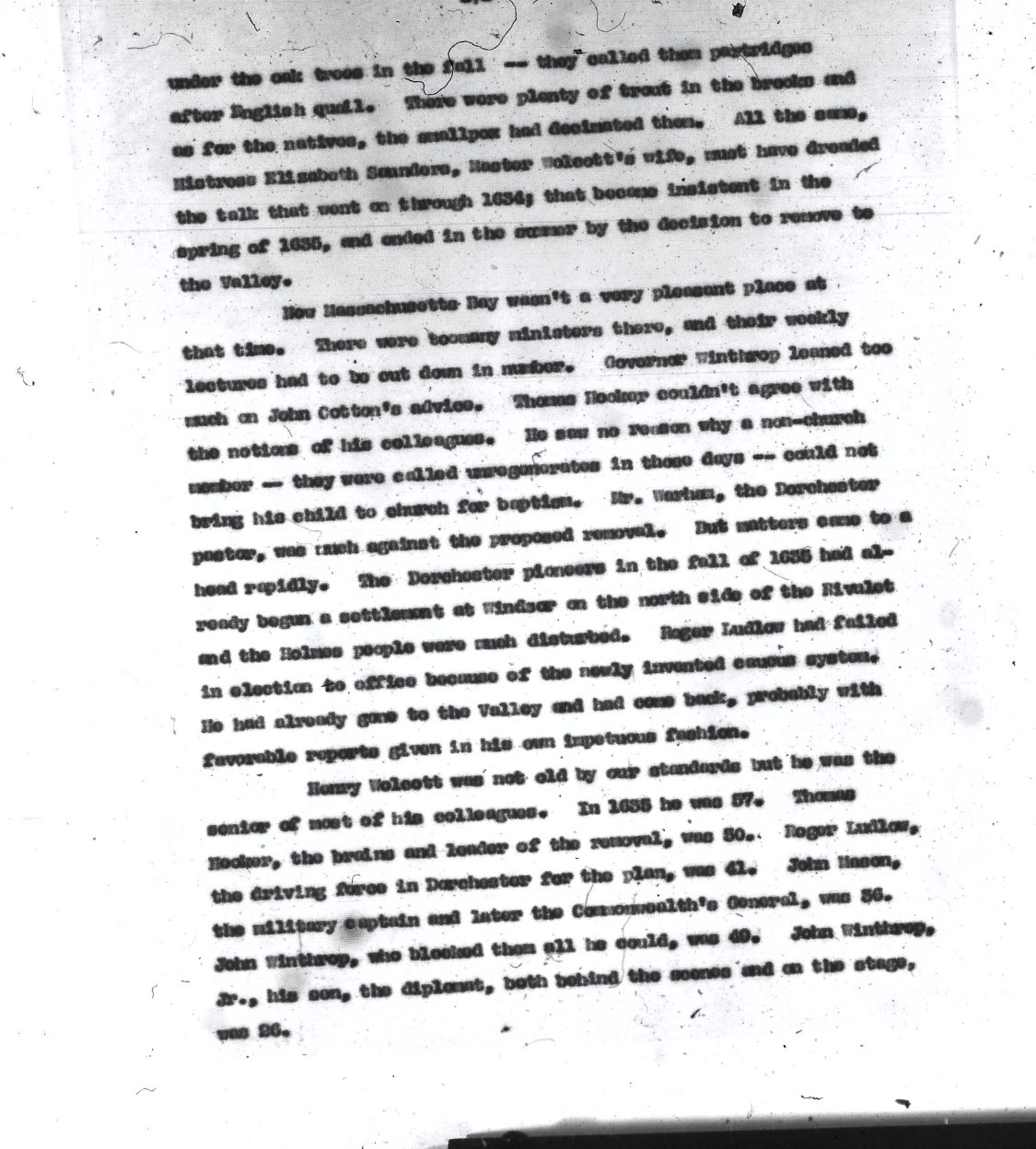
Preserved transcription
Transcription matched to this Wisconsin microfilm frame. Preserved from the supplied frame transcription; compare uncertain readings with the scan.
[top edge: page number partly cut off; reads like "3" or "-3-" [?]]
under the oak trees in the fall -- they called them partridges
after English quail. There were plenty of trout in the brooks and
as for the natives, the smallpox had decimated them. All the same,
Mistress Elizabeth Saunders, Master Wolcott's wife, must have dreaded
the talk that went on through 1634; that became insistent in the
spring of 1635, and ended in the summer by the decision to remove to
the Valley.
Now Massachusetts Bay wasn't a very pleasant place at
that time. There were toomany ministers there, and their weekly
lectures had to be cut down in number. Governor Winthrop leaned too
much on John Cotton's advice. Thomas Hooker couldn't agree with
the notions of his colleagues. He saw no reason why a non-church
member -- they were called unregenerates in those days -- could not
bring his child to church for baptism. Mr. Warham, the Dorchester
pastor, was much against the proposed removal. But matters came to a
head rapidly. The Dorchester pioneers in the fall of 1635[?] had al-
ready begun a settlement at Windsor on the north side of the Rivulet
and the Holmes people were much disturbed. Roger Ludlow had failed
in election to office because of the newly invented census[?] system.
He had already gone to the Valley and had come back, probably with
favorable reports given in his own impetuous fashion.
Henry Wolcott was not old by our standards but he was the
senior of most of his colleagues. In 1635[?] he was 57. Thomas
Hooker, the brains and leader of the removal, was 50. Roger Ludlow,
the driving force in Dorchester for the plan, was 41[?]. John Mason,
the military captain and later the Commonwealth's General, was 36[?].
John Winthrop, who blocked them all he could, was 49[?]. John Winthrop,
Jr., his son, the diplomat, both behind the scenes and on the stage,
was 26[?].
Wisconsin Historical Society · WHS-R3-523 · Letter from Mr. Shipman (Hartford) to Society of Descendants of Henry Wolcott, n.d. (enclosure)
Open the complete archive frame record →