
Read the original · Check the transcription
Gibbs Family Papers, Reel 3, frame 507
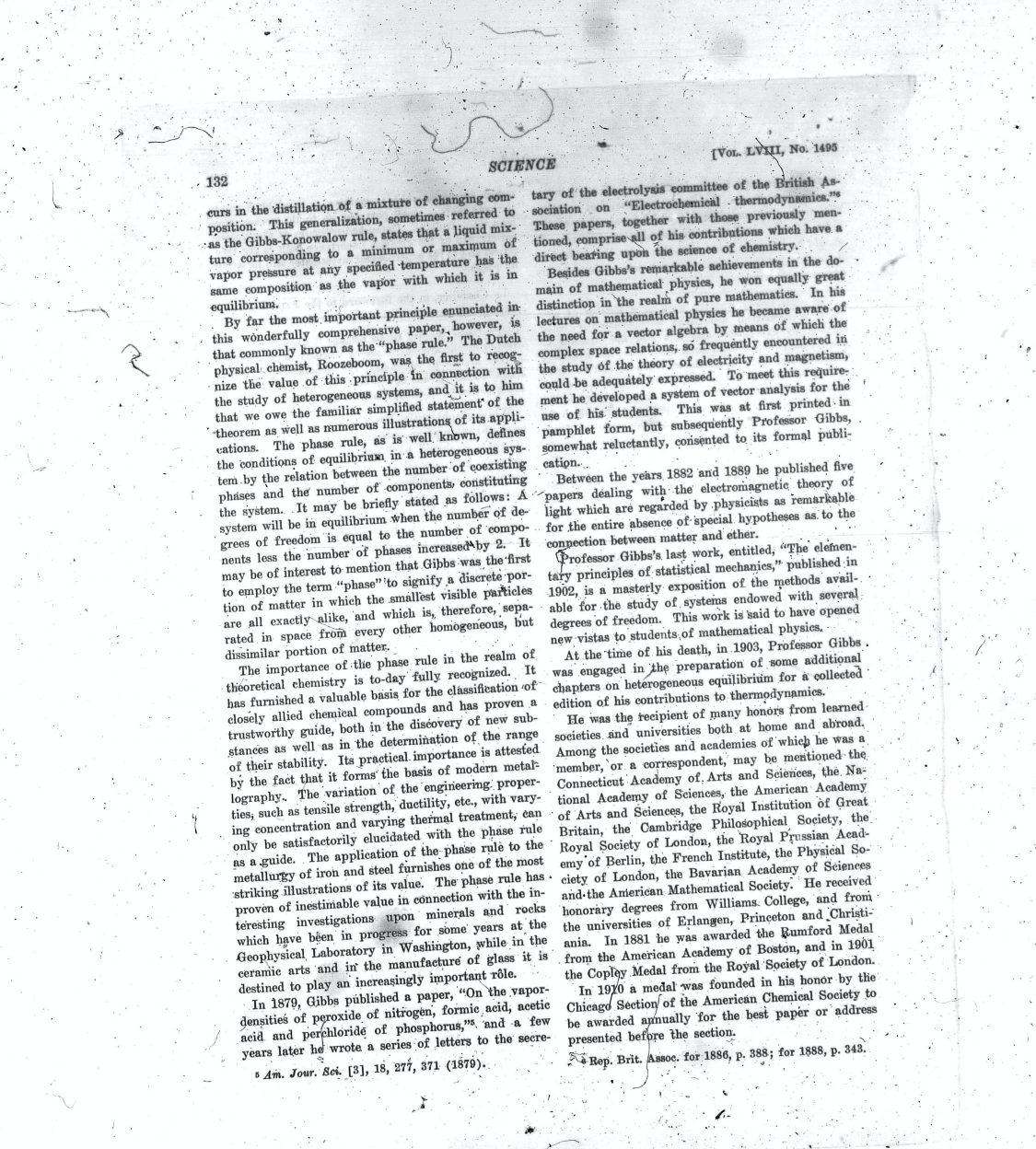
Preserved transcription
Transcription matched to this Wisconsin microfilm frame. Preserved from the supplied frame transcription; compare uncertain readings with the scan.
[printed: 132 SCIENCE [Vol. LVIII, No. 1495]
[printed, left column:]
curs in the distillation of a mixture of changing com-
position. This generalization, sometimes referred to
as the Gibbs-Konowalow rule, states that a liquid mix-
ture corresponding to a minimum or maximum of
vapor pressure at any specified temperature has the
same composition as the vapor with which it is in
equilibrium.
By far the most important principle enunciated in
this wonderfully comprehensive paper, however, is
that commonly known as the “phase rule.” The Dutch
physical chemist, Roozeboom, was the first to recog-
nize the value of this principle in connection with
the study of heterogeneous systems, and it is to him
that we owe the familiar simplified statement of the
theorem as well as numerous illustrations of its appli-
cations. The phase rule, as is well known, defines
the conditions of equilibrium in a heterogeneous sys-
tem by the relation between the number of coexisting
phases and the number of components constituting
the system. It may be briefly stated as follows: A
system will be in equilibrium when the number of de-
grees of freedom is equal to the number of compo-
nents less the number of phases increased by 2. It
may be of interest to mention that Gibbs was the first
to employ the term “phase” to signify a discrete por-
tion of matter in which the smallest visible particles
are all exactly alike, and which is, therefore, sepa-
rated in space from every other homogeneous, but
dissimilar portion of matter.
The importance of the phase rule in the realm of
theoretical chemistry is to-day fully recognized. It
has furnished a valuable basis for the classification of
closely allied chemical compounds and has proven a
trustworthy guide, both in the discovery of new sub-
stances as well as in the determination of the range
of their stability. Its practical importance is attested
by the fact that it forms the basis of modern metal-
lography. The variation of the engineering proper-
ties, such as tensile strength, ductility, etc., with vary-
ing concentration and varying thermal treatment, can
only be satisfactorily elucidated with the phase rule
as a guide. The application of the phase rule to the
metallurgy of iron and steel furnishes one of the most
striking illustrations of its value. The phase rule has
proven of inestimable value in connection with the in-
teresting investigations upon minerals and rocks
which have been in progress for some years at the
Geophysical Laboratory in Washington, while in the
ceramic arts and in the manufacture of glass it is
destined to play an increasingly important rôle.
In 1879, Gibbs published a paper, “On the vapor-
densities of peroxide of nitrogen, formic acid, acetic
acid and perchloride of phosphorus,”⁵ and a few
years later he wrote a series of letters to the secre-
⁵ Am. Jour. Sci. [3], 18, 277, 371 (1879).
[printed, right column:]
tary of the electrolysis committee of the British As-
sociation on “Electrochemical thermodynamics.”⁶
These papers, together with those previously men-
tioned, comprise all of his contributions which have a
direct bearing upon the science of chemistry.
Besides Gibbs's remarkable achievements in the do-
main of mathematical physics, he won equally great
distinction in the realm of pure mathematics. In his
lectures on mathematical physics he became aware of
the need for a vector algebra by means of which the
complex space relations, so frequently encountered in
the study of the theory of electricity and magnetism,
could be adequately expressed. To meet this require-
ment he developed a system of vector analysis for the
use of his students. This was at first printed in
pamphlet form, but subsequently Professor Gibbs,
somewhat reluctantly, consented to its formal publi-
cation.
Between the years 1882 and 1889 he published five
papers dealing with the electromagnetic theory of
light which are regarded by physicists as remarkable
for the entire absence of special hypotheses as to the
connection between matter and ether.
Professor Gibbs's last work, entitled, “The elemen-
tary principles of statistical mechanics,” published in
1902, is a masterly exposition of the methods avail-
able for the study of systems endowed with several
degrees of freedom. This work is said to have opened
new vistas to students of mathematical physics.
At the time of his death, in 1903, Professor Gibbs
was engaged in the preparation of some additional
chapters on heterogeneous equilibrium for a collected
edition of his contributions to thermodynamics.
He was the recipient of many honors from learned
societies and universities both at home and abroad.
Among the societies and academies of which he was a
member, or a correspondent, may be mentioned the
Connecticut Academy of Arts and Sciences, the Na-
tional Academy of Sciences, the American Academy
of Arts and Sciences, the Royal Institution of Great
Britain, the Cambridge Philosophical Society, the
Royal Society of London, the Royal Prussian Acad-
emy of Berlin, the French Institute, the Physical So-
ciety of London, the Bavarian Academy of Sciences
and the American Mathematical Society. He received
honorary degrees from Williams College, and from
the universities of Erlangen, Princeton and Christi-
ania. In 1881 he was awarded the Rumford Medal
from the American Academy of Boston, and in 1901
the Copley Medal from the Royal Society of London.
In 1910 a medal was founded in his honor by the
Chicago Section of the American Chemical Society to
be awarded annually for the best paper or address
presented before the section.
⁶ Rep. Brit. Assoc. for 1886, p. 388; for 1888, p. 343.]
Wisconsin Historical Society · WHS-R3-507 · PRINTED JOURNAL, Science Vol. LVIII No. 1495, 1923-08-24
Open the complete archive frame record →