
Read the original · Check the transcription
Gibbs Family Papers, Reel 3, frame 452
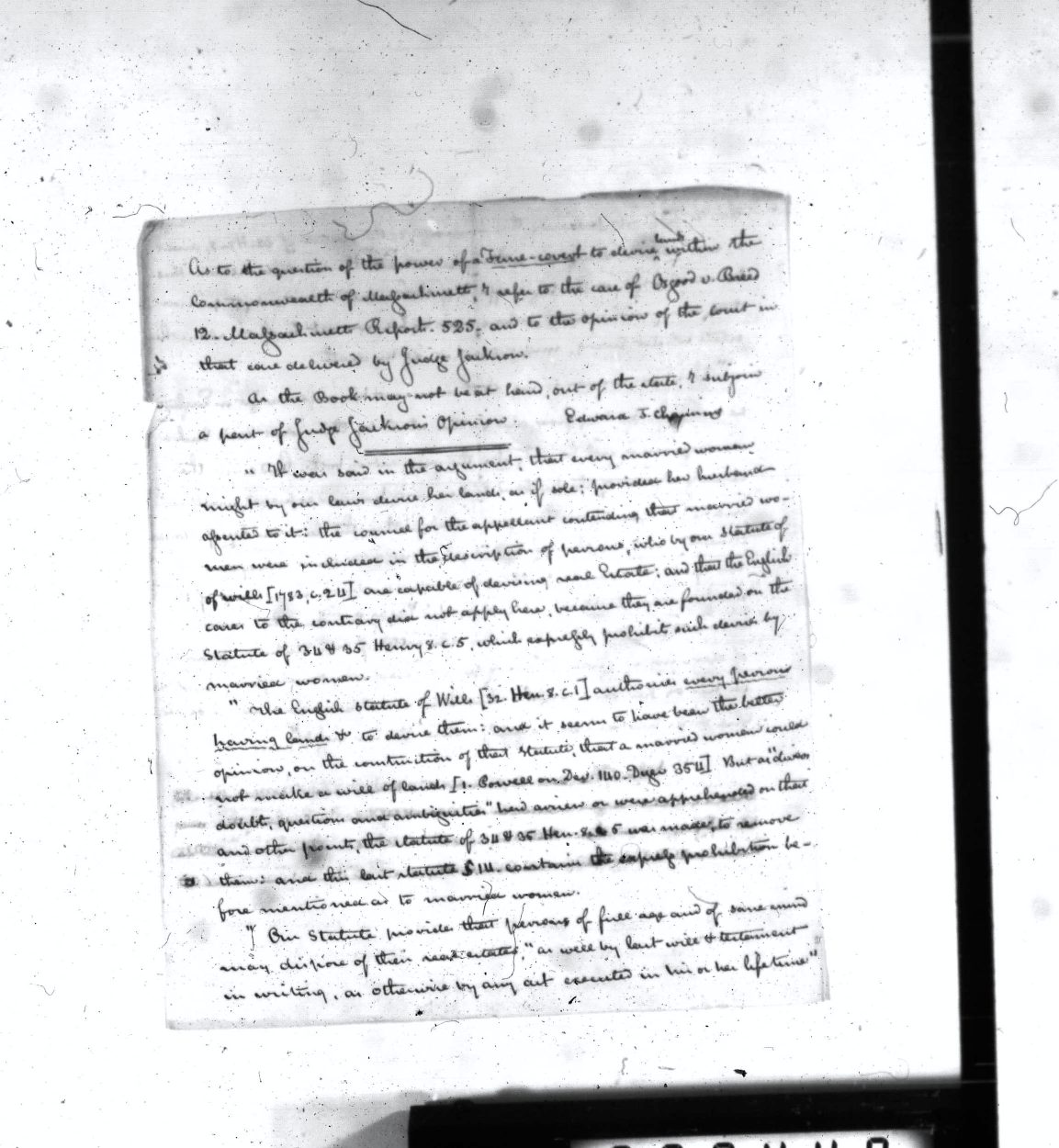
Preserved transcription
Transcription matched to this Wisconsin microfilm frame. Preserved from the supplied frame transcription; compare uncertain readings with the scan.
As to the question of the power of a Feme-covert to devise [inserted: land] within the
Commonwealth of Massachusetts, I refer to the case of Osgood v. Breed
12. Massachusetts Report. 525, and to the opinion of the Court in
that case delivered by Judge Jackson.
As the Book may not be at hand, out of the state, I subjoin
a part of Judge Jackson's Opinion. Edward T.[?] Chipman[?]
" It was said in the argument, that every married woman
might by our laws devise her lands, as if sole; provided her husband
assented to it: the counsel for the appellant contending that married wo-
men were included in the description of persons, who by our Statute of
wills [1783, c. 24] are capable of devising real Estate; and that the English
cases to the contrary did not apply here, because they are founded on the
Statute of 34 & 35 Henry 8. c. 5, which expressly prohibits such devise by
married women.
" The English Statute of Wills [32. Hen. 8. c. 1] authorises every person
having lands &c to devise them: and it seems to have been the better
opinion, on the construction of that Statute, that a married woman could
not make a will of lands [1. Powell[?] on Dev. 110. Dyer[?] 354]. But as divers
doubts, questions and ambiguities" had arisen or were apprehended on that
and other points, the statute of 34 & 35 Hen. 8. c. 5 was made, to remove
them: and the last statute § 14. contains the express prohibition be-
fore mentioned as to married women.
" Our Statute provide that persons of full age and of sane mind
may dispose of their real estates, " as well by last will & testament
in writing, as otherwise by any act executed in his or her lifetime"
Wisconsin Historical Society · WHS-R3-452 · Letter from Edward T. Chipman? to unnamed
Open the complete archive frame record →