
Read the original · Check the transcription
Gibbs Family Papers, Reel 3, frame 33
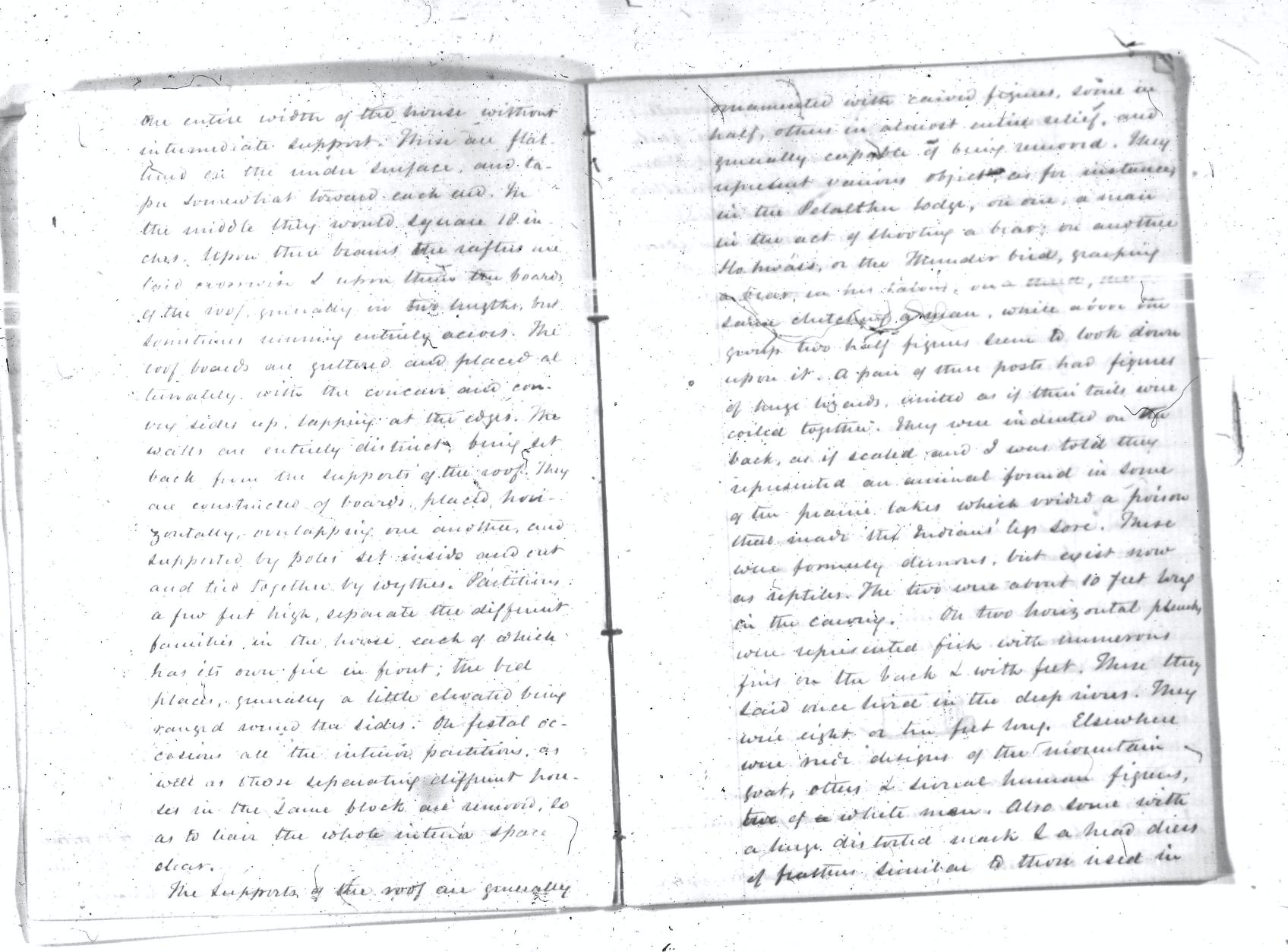
Preserved transcription
Transcription matched to this Wisconsin microfilm frame. Preserved from the supplied frame transcription; compare uncertain readings with the scan.
the entire width of the house without
intermediate support. These are flat-
tened on the under surface, and ta-
per somewhat toward each end. In
the middle they would square 18 in-
ches. Upon these beams the rafters are
laid crosswise & upon these the boards
of the roof, generally in two lengths, but
sometimes running entirely across. The
roof boards are guttered and placed al-
ternately with the concave and con-
vex sides up, lapping at the edges. The
walls are entirely distinct, being set
back from the supports of the roof. They
are constructed of boards, placed hori-
zontally, overlapping one another, and
supported by poles set inside and out
and tied together by wythes[?]. Partitions,
a few feet high, separate the different
families in the house, each of which
has its own fire in front; the bed
places, generally a little elevated being
ranged round the sides. On festal oc-
casions all the interior partitions, as
well as those separating different hou-
ses in the same block are removed, so
as to leave the whole interior space
clear.
The supports of the roof are generally
ornamented with carved figures, some in
half, others in almost entire relief, and
generally capable of being removed. They
represent various objects, as for instance
in the Pelalthu lodge, on one, a man
in the act of shooting a bear; on another
Hahwáis[?], or the Thunder bird, grasping
a bear in his talons, on a third[?], the[?]
same clutching a man, while above the
group two half figures seem to look down
upon it. A pair of these posts had figures
of huge lizards, united as if their tails were
coiled together. They were indented on the
back, as if scaled, and I was told they
represented an animal found in some
of the prairie lakes which voided a poison
that made the Indians' legs sore. These
were formerly demons, but exist now
as reptiles. The two were about 10 feet long
in the carving. On two horizontal planks
were represented fish with numerous
fins on the back & with feet. These they
said once lived in the deep rivers. They
were eight or ten feet long. Elsewhere
were rude designs of the mountain
goat, otters[?] & several human figures,
two of a white man. Also some with
a large distorted mask & a head dress
of feathers similar to those used in
Wisconsin Historical Society · WHS-R3-33 · George Gibbs IV (field notebook) (document)
Open the complete archive frame record →