
Wisconsin manuscript
George Gibbs IV (notebook essay) · n.d.
Essay on "material pantheism" of the Indian tribes; the "Elip tilicum" belief of the Pacific coast; invocation of a tutelary genius among the Chippewas identical with "tamahnous" of the Pacific tribes; rejects Bancroft's derivation of the Indians from the Mongols via Behring Straits on grounds of physical dissimilarity
Wisconsin Historical Society, Gibbs Family Papers, U.S. Mss Y, Micro 1117
Reel 3, frames 31
Reel 3, frame 31
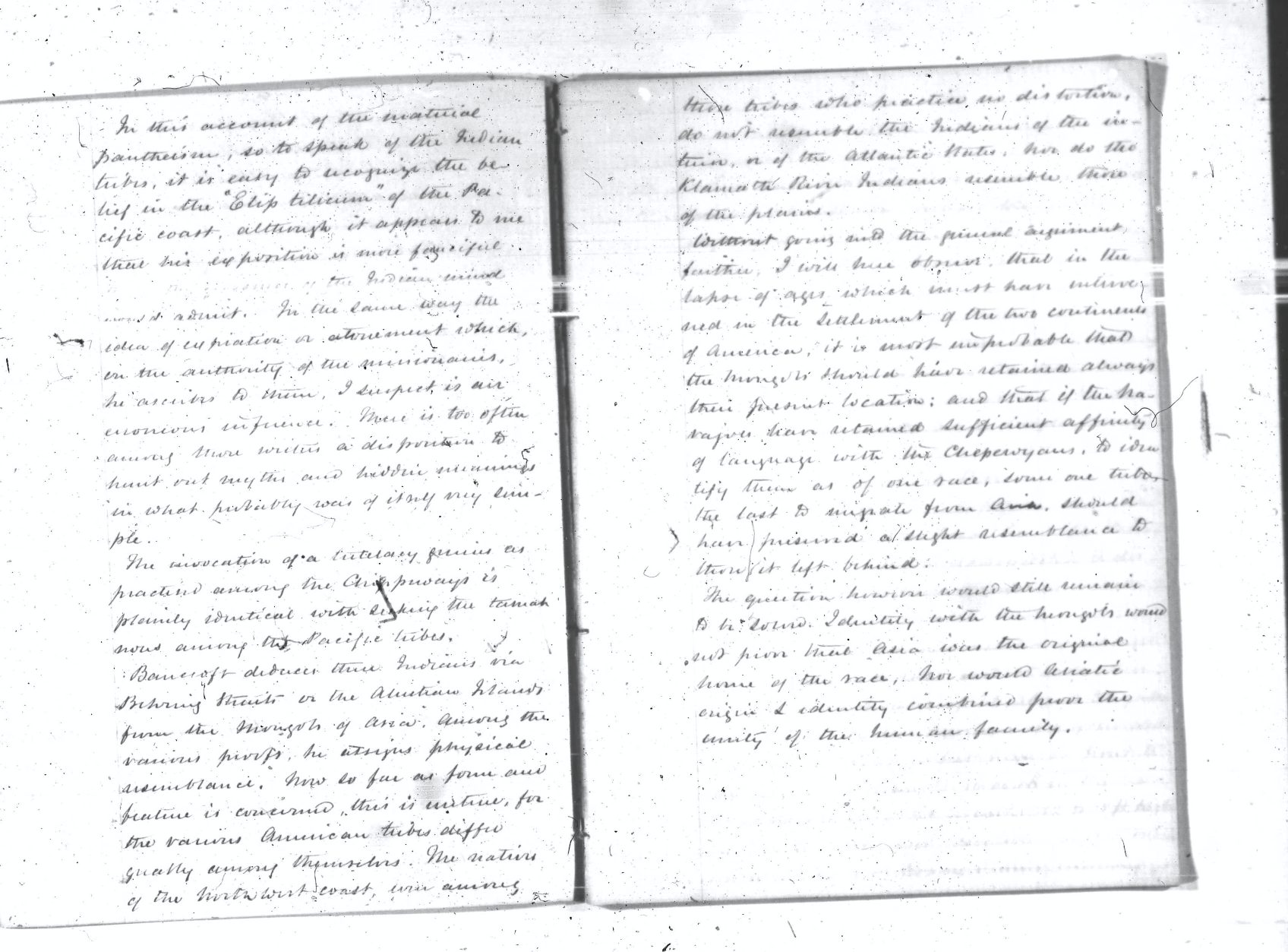
Read beside the scan
AI first transcription from the evidence pack; not independently verified. Compare with the scan.
pantheism, so to speak of the Indian
tribes, it is easy to recognize the be-
lief in the "Elip tilicum" of the Pa-
cific coast, although it appears to me
that his exposition is more fanciful[?]
than[?] the genius[?] of the Indian mind
would admit. In the same way the
idea of expiation or atonement which,
on the authority of the missionaries,
he ascribes to them, I suspect, is an
erroneous inference. There is too often
among these writers a disposition to
hunt out myths and hidden meanings
in what probably was of itself very sim-
ple.
The invocation of a tutelary genius as
practised among the Chippeways is
plainly identical with seeking the tamah
nous among the Pacific tribes.
Bancroft deduces these Indians via
Behring Straits or the Aleutian Islands
from the Mongols of Asia. Among the
various proofs, he assigns physical
resemblance. Now so far as form and
feature is concerned, this is untrue, for
the various American tribes differ
greatly among themselves. The natives
of the Northwest coast, even among
those tribes who practice no distortion,
do not resemble the Indians of the in-
terior, or of the Atlantic States, nor do the
Klamath River Indians resemble those
of the plains.
Without going into the general argument
further, I will here observe, that in the
lapse of ages which must have interve-
ned in the settlement of the two continents
of America, it is most improbable that
the Mongols should have retained always
their present location; and that if the Na-
vajoes have retained sufficient affinity
of language with the Chepewyans, to iden-
tify them as of one race, some one tribe,
the last to migrate from Asia, should
have preserved a slight resemblance to
those it left behind.
The question however would still remain
to be solved. Identity with the Mongols would
not prove that Asia was the original
home of the race, nor would Asiatic
origin & identity combined prove the
unity of the human family.
Citation and provenance
[George Gibbs IV (notebook essay)]. (n.d.). Gibbs Family Papers, 1763-1918 (U.S. Mss Y, Micro 1117, Reel 3, frame 31). Wisconsin Historical Society Archives, Madison, WI, United States.
Historical sources retain their individual rights and credits. A scan’s presence here does not establish unrestricted reuse.
People identified in the source catalog
These are catalog labels. Individual identities and relationships have not all been reviewed.
Where the book uses this document
No quotation has yet been assigned directly to this catalog record. Its individual frames may have separate connections.