
Wisconsin manuscript
George Gibbs IV (manuscript volume, n.p.) · 1856 (Olympia) and later additions
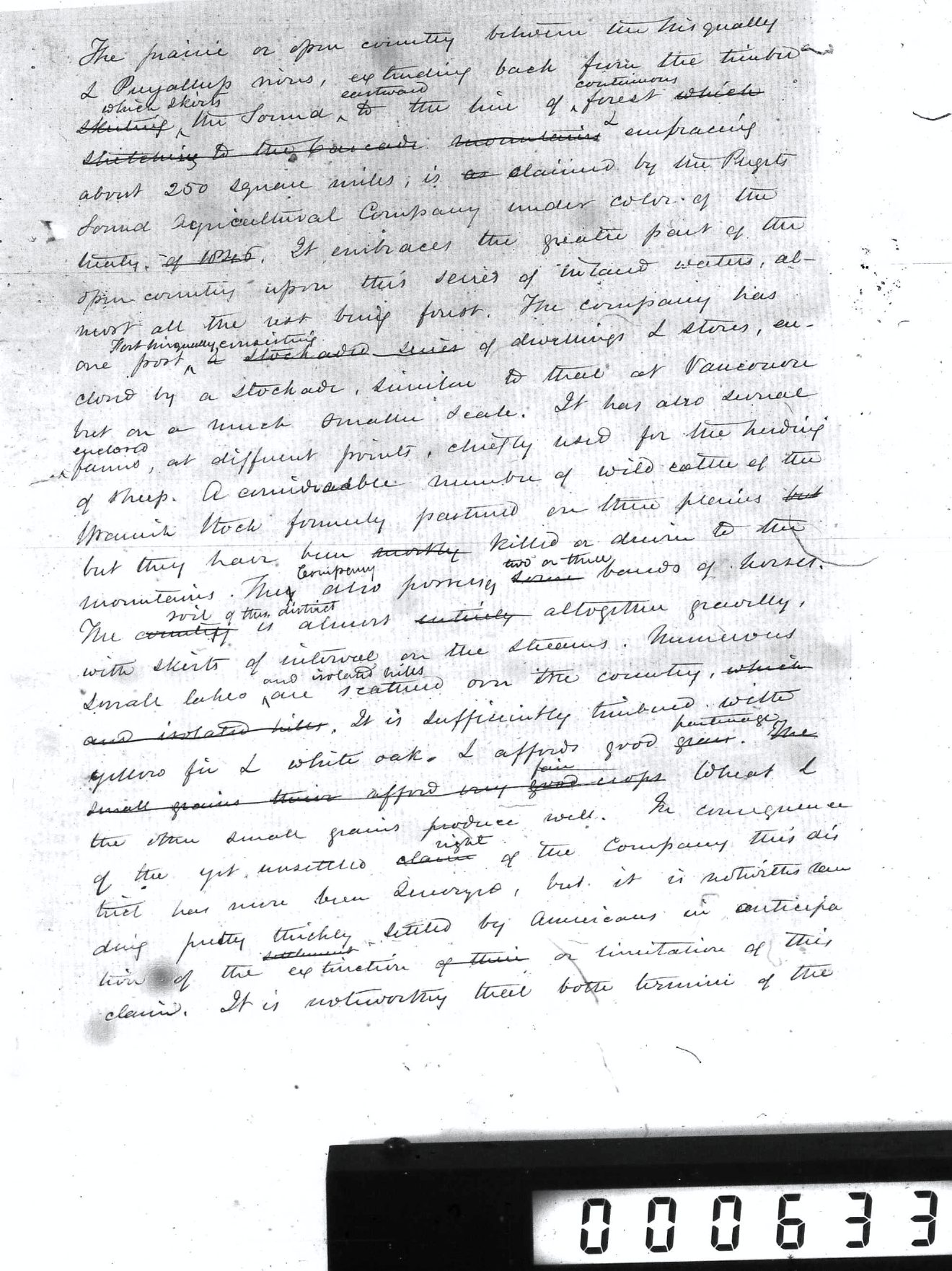
The Puget Sound Agricultural Company claim between the Nisqually and Puyallup; soil, timber, stock, settlement. "The prairie or open country between the Nisqually & Puyallup rivers, extending back from the timber which skirts the Sound eastward to the line of continuous forest and embracing about 250 square miles, is claimed by the Pugets Sound Agricultural Company under color of the treaty of 1846. It embraces the greater part of the open country upon this series of inland waters, almost all the rest being forest." "The company has one post, Fort Nisqually, consisting of a series of dwellings & stores, enclosed by a stockade, similar to that at Vancouver but on a much smaller scale. It has also several enclosed farms, at different points, chiefly used for the herding of sheep. A considerable number of wild cattle of the Spanish stock formerly pastured on these plains but they have been killed or driven to the mountains. The Company also possess two or three bands of horses." "The soil of this district is almost altogether gravelly, with skirts of interval on the streams. Numerous small lakes and isolated hills are scattered over the country. It is sufficiently timbered with yellow fir & white oak, & affords good pasturage. Wheat & the other small grains produce well." "In consequence of the yet unsettled right of the Company this district has never been surveyed, but it is nevertheless now being pretty thickly settled by Americans in anticipation of the extinction or limitation of this claim." Closes: "It is noteworthy that both termini of the" [continues on frames 3985/3986].
Wisconsin Historical Society, Gibbs Family Papers, U.S. Mss Y, Micro 1117
Reel 2, frames 3984
Reel 2, frame 3984
Read beside the scan
AI first transcription from the evidence pack; not independently verified. Compare with the scan.
& Puyallup rivers, extending back from the timber[?]
[struck: skirting] [inserted: which skirts] the Sound [inserted: eastward] to the line of [inserted: continuous] forest [struck: which]
[struck: stretching to the Cascade] [struck: mountains] [inserted: &] embracing
about 250 square miles; is [struck: as] claimed by the Puget
Sound Agricultural Company under color of the
treaty [struck: of 1846]. It embraces the greater part of the
open country upon this series of inland waters, al-
most all the rest being forest. The company has
one post [inserted: Fort Nisqually consisting] [struck: a stockade series] of dwellings & stores, en-
closed by a stockade, similar to that at Vancouver
but on a much smaller scale. It has also several
[inserted: enclosed] farms, at different points, chiefly used for the herding
of sheep. A considerable number of wild cattle of the
Spanish stock formerly pastured on these plains [struck: but]
but they have been [struck: mostly] killed or driven to the
mountains. They [inserted: Company] also possess [inserted: two or three] [struck: some] bands of horses.
The [struck: country] [inserted: soil of this district] is almost [struck: entirely] altogether gravelly,
with skirts of interval on the streams. Numerous
small lakes [inserted: and isolated hills] are scattered over the country, [struck: which]
[struck: and isolated hills]. It is sufficiently timbered with
yellow fir & white oak. & affords good [inserted: pasturage] [struck: grass]. [struck: The]
[struck: small grains there afford very [inserted: fair] good crops] Wheat &
the other small grains produce well. In consequence
of the yet unsettled [struck: claim] [inserted: right] of the Company this dis
trict has never been surveyed, but it is notwithstan
ding pretty thickly settled by Americans in anticipa
tion of the [inserted: settlement][?] extinction [struck: of their] or limitation of this
claim. It is noteworthy that both termini of the
Citation and provenance
Gibbs, G., IV. (1856). [Manuscript volume, n.p.]. Gibbs Family Papers, 1763-1918 (U.S. Mss Y, Micro 1117, Reel 2, frame 3984). Wisconsin Historical Society Archives, Madison, WI, United States.
Citation details need editorial review.
Historical sources retain their individual rights and credits. A scan’s presence here does not establish unrestricted reuse.
People identified in the source catalog
These are catalog labels. Individual identities and relationships have not all been reviewed.
Where the book uses this document
No quotation has yet been assigned directly to this catalog record. Its individual frames may have separate connections.