
Wisconsin manuscript
George Gibbs IV (manuscript volume, ms p. 6) · 1856 (Olympia) and later additions
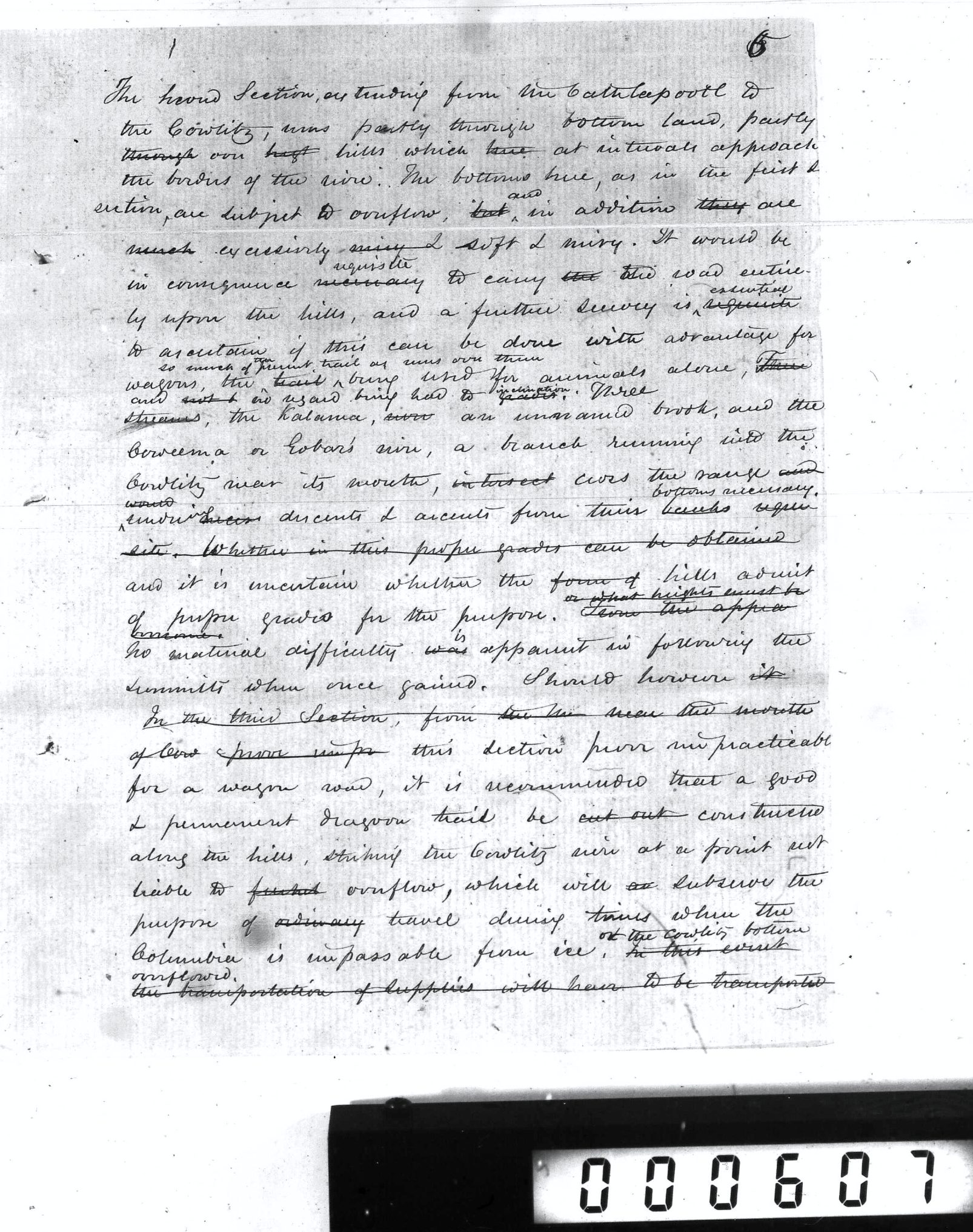
Memoir p. 6 (exposure 000607); Second Section and the opening of the Third. "The Second Section, extending from the Cathlepootl to the Cowlitz, runs partly through bottom land, partly over hills which at intervals approach the borders of the river." Bottoms subject to overflow and "excessively soft & miry"; requisite to carry the road entirely upon the hills, "and a further survey is essential to ascertain if this can be done with advantage for wagons, so much of the present trail as runs over them being used for animals alone." "Three streams, the Kalama, an unnamed brook, and the Coweema(?) or Cobar's(?) river, a branch running into the Cowlitz near its mouth, cross the range" and require descents and ascents from their bottoms; "it is uncertain whether the hills admit of proper grades for the purpose. No material difficulty is apparent in following the summits when once gained." Third Section: this section proving impracticable for a wagon road, "it is recommended that a good & permanent dragoon trail be constructed along the hills, striking the Cowlitz river at a point not liable to overflow, which will subserve the purpose of travel during times when the Columbia is impassable from ice, or the Cowlitz bottom overflowed."
Wisconsin Historical Society, Gibbs Family Papers, U.S. Mss Y, Micro 1117
Reel 2, frames 3958
Reel 2, frame 3958
Read beside the scan
AI first transcription from the evidence pack; not independently verified. Compare with the scan.
The second Section, extending from the Cathlapootl to
the Cowlitz, runs partly through bottom land, partly
[struck: through] over [struck: high] hills which [struck: here[?]] at intervals approach
the borders of the river. The bottoms here, as in the first &
section, are subject to overflow, [struck: but] [inserted: and] in addition [struck: they] are
[struck: much] excessively [struck: miry &] soft & miry. It would be
in consequence [struck: necessary] [inserted: requisite] to carry [struck: the] the road entire-
ly upon the hills, and a further survey is [inserted: essential] [struck: requisite]
to ascertain if this can be done with advantage for
wagons, the [struck: trail] [inserted: so much of the present trail as runs over them] being used for animals alone, [struck: Three]
and [struck: not] no regard being had to [struck: grades] [inserted: inclination]. Three
[struck: streams], the Kalama, [struck: river] an unnamed brook, and the
Coweema or Lobar's[?] river, a branch running into the
Cowlitz near its mouth, [struck: intersect] cross the range [struck: and]
[inserted: would] render [struck: necess] descents & ascents from their [struck: banks] [inserted: bottoms necessary.] [struck: requi-
site. Whether in this proper grades can be obtained]
and it is uncertain whether the [struck: form of] hills admit [inserted: [struck: or what heights must be]]
of proper grades for the purpose. [struck: From the appea-
rance]
No material difficulty [struck: was] [inserted: is] apparent in following the
summits when once gained. Should however [struck: it]
[struck: In the third Section, from the the[?] near the mouth
of Cow] [struck: prove impr] this section prove impracticable
for a wagon road, it is recommended that a good
& permanent dragoon trail be [struck: cut out] constructed
along the hills, striking the Cowlitz river at a point not
liable to [struck: frequent[?]] overflow, which will [struck: so[?]] subserve the
purpose of [struck: ordinary] travel during times when the
Columbia is impassable from ice, [inserted: or the Cowlitz bottom
overflowed.] [struck: In this event
the transportation of supplies will have to be transported]
Citation and provenance
Gibbs, G., IV. (1856). [Manuscript volume, ms p. 6]. Gibbs Family Papers, 1763-1918 (U.S. Mss Y, Micro 1117, Reel 2, frame 3958). Wisconsin Historical Society Archives, Madison, WI, United States.
Citation details need editorial review.
Historical sources retain their individual rights and credits. A scan’s presence here does not establish unrestricted reuse.
People identified in the source catalog
These are catalog labels. Individual identities and relationships have not all been reviewed.
Where the book uses this document
No quotation has yet been assigned directly to this catalog record. Its individual frames may have separate connections.