
Wisconsin manuscript
George Gibbs IV (manuscript volume, ms p. n.p. (story "No 6")) · 1856 (Olympia) and later additions
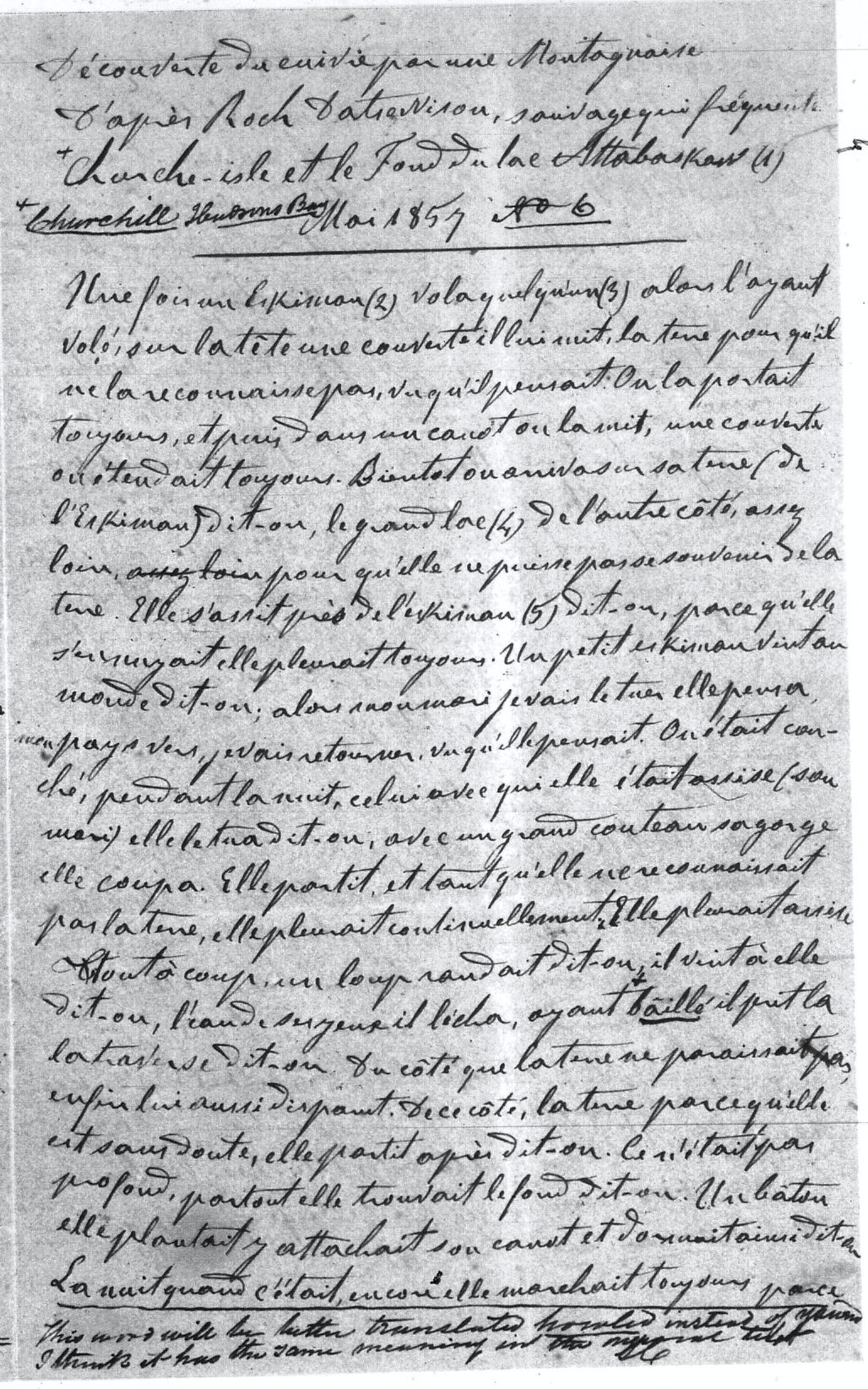
French original of the copper-discovery tale. Heading with interlined corrections: "Decouverte du cuivre par une Montagnaise / d'apres Roch Datsiwison (?), sauvage qui frequente + Charche-isle [corrected in margin to "Churchill Hudsons Bay"] et le Fond du lac Attabaskaw (1) / Mai 1857 No 6". French text corresponding to the English on frame 3922: the Eskimau steals her, a blanket over her head "la terre pour qu'il ne la reconnaisse pas"; the great lake; she kills her husband "avec un grand couteau sa gorge elle coupa"; the wolf licks the water from her eyes; she plants a stake and ties her canoe to it. Note in English across the foot of the sheet in a second hand: "This word will be better translated howled instead of yawned; I think it has the same meaning in the [illegible] text"
Wisconsin Historical Society, Gibbs Family Papers, U.S. Mss Y, Micro 1117
Reel 2, frames 3938
Reel 2, frame 3938
Read beside the scan
AI first transcription from the evidence pack; not independently verified. Compare with the scan.
d'après Roch Datiewison[?], sauvage qui fréquente
+Croche[?]-isle et le Fond du lac Attabaskaw (1)
+Churchill Hudsons Bay Mai 1857[?] No 6
Une fois un Eskiman (2) vola quelqu'un (3) alors l'ayant
volé, sur la tête une couverte il lui mit, la terre pour qu'il
ne la reconnaisse pas, vu qu'il pensait. On la portait
toujours, et puis dans un canot on la mit, une couverte
on étendait toujours. Bientot on arriva sur sa terre (de
l'Eskiman) dit-on, le grand lac (4) de l'autre côté, assez
loin, [struck: assez loin] pour qu'elle ne puisse pas se souvenir de la
terre. Elle s'assit près de l'eskiman (5) dit-on, parce qu'elle
s'ennuyait elle pleurait toujours. Un petit eskiman vint au
monde dit-on; alors mon mari je vais le tuer elle pensa,
mon pays vers, je vais retourner, vu qu'elle pensait. On était cou-
ché, pendant la nuit, celui avec qui elle était assise (son
mari) elle le tua dit-on, avec un grand couteau sa gorge
elle coupa. Elle partit, et tant qu'elle ne reconnaissait
pas la terre, elle pleurait continuellement. Elle pleurait assise
Tout à coup, un loup randait[?] dit-on, il vint à elle
dit-on, l'eau de ses yeux il lécha, ayant + bâillé il prit la
la traverse dit-on du côté que la terre ne paraissait pas,
enfin lui aussi disparut. De ce côté, la terre parce qu'elle
est sans doute, elle partit après dit-on. Ce n'était pas
profond, partout elle trouvait le fond dit-on. Un bâton
elle plantait y attachait son canot et dormait ainsi dit-on
La nuit quand c'était, encore elle marchait toujours parce
___
+ This word will be better translated howled instead of yawn[ed?]
I think it has the same meaning in the original[?] text[?] [illegible]
Citation and provenance
[George Gibbs IV (manuscript volume, ms p. n.p. (story "No 6"))]. (1856). Gibbs Family Papers, 1763-1918 (U.S. Mss Y, Micro 1117, Reel 2, frame 3938). Wisconsin Historical Society Archives, Madison, WI, United States.
Citation details need editorial review.
Historical sources retain their individual rights and credits. A scan’s presence here does not establish unrestricted reuse.
People identified in the source catalog
These are catalog labels. Individual identities and relationships have not all been reviewed.
Where the book uses this document
No quotation has yet been assigned directly to this catalog record. Its individual frames may have separate connections.