
Wisconsin manuscript
George Gibbs IV (manuscript volume, n.p.) · 1856 (Olympia) and later additions
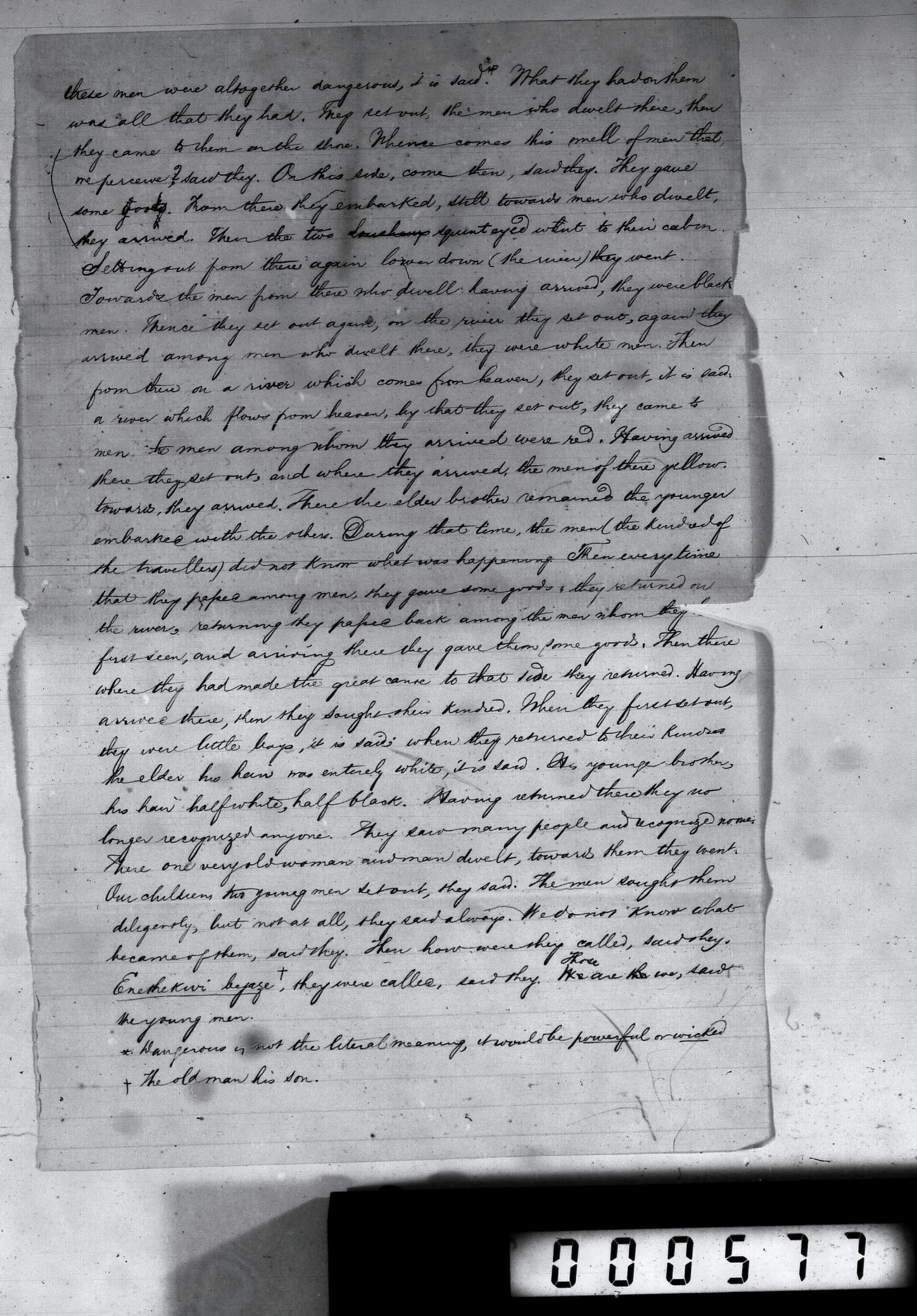
Story VIII (Jerome Sak'anetta) continued and concluded. Voyage of the two squint-eyed Loucheux down the river past successive peoples: men "altogether dangerous"; "Whence comes this smell of men that we perceive?"; then "they were black men", then "white men"; then "on a river which comes from heaven"; then men "red", then "yellow"; the elder brother stays, the younger embarks; goods given at each people; on return "the elder his hair was entirely white... his younger brother, his hair half white, half black"; they are named "Enethekwi bezaze" (underlined); footnotes: "Dangerous is not the literal meaning, it would be powerful or wicked" and "The old man his son."
Wisconsin Historical Society, Gibbs Family Papers, U.S. Mss Y, Micro 1117
Reel 2, frames 3926, 3927, 3928
Reel 2, frame 3926
Read beside the scan
AI first transcription from the evidence pack; not independently verified. Compare with the scan.
was all that they had. They set out, the men who dwelt there, then
they came to them on the shore. Whence comes this smell of men that
we perceive? said they. On this side, come then, said they. They gave
some goods[?]. From there they embarked, still towards men who dwelt,
they arrived. Then the two [struck: [illegible]] squint eyed went to their cabin.
Setting out from there again lower down (the river) they went.
Towards the men from there who dwell. having arrived, they were black
men. Thence they set out again, on the river they set out, again they
arrived among men who dwelt there, they were white men. Then
from there on a river which comes from heaven, they set out, it is said.
a river which flows from heaven, by that they set out, they came to
men. The[?] men among whom they arrived were red. Having arrived
there they set out, and where they arrived, the men of there yellow.
towards, they arrived. There the elder brother remained the younger
embarked with the others. During that time, the men (the kindred of
the travellers) did not know what was happening. Then every time
that they passed among men, they gave some goods; they returned on
the river, returning they passed back among the men whom they h[torn]
first seen, and arriving there they gave them some goods. Then there
where they had made the great canoe to that side they returned. Having
arrived there, then they sought their kindred. When they first set out,
they were little boys, it is said; when they returned to their kindred
the elder his hair was entirely white, it is said. His younger brother
his hair half white, half black. Having returned there they no
longer recognized anyone. They saw many people and recognized none.
There one very old woman and man dwelt, towards them they went.
Our children two young men set out, they said. The men sought them
diligently, but not at all, they said always. We do not know what
became of them, said they. Then how were they called, said they.
Enethekiwi bejaze†, they were called, said they. We are [inserted: those] [struck: the[?]] we, said
the young men.
* Dangerous is not the literal meaning, it would be powerful or wicked
† the old man his son.
Citation and provenance
Gibbs, G., IV. (1856). [Manuscript volume, n.p.]. Gibbs Family Papers, 1763-1918 (U.S. Mss Y, Micro 1117, Reel 2, frames 3926-3928). Wisconsin Historical Society Archives, Madison, WI, United States.
Citation details need editorial review.
Historical sources retain their individual rights and credits. A scan’s presence here does not establish unrestricted reuse.
People identified in the source catalog
These are catalog labels. Individual identities and relationships have not all been reviewed.
Where the book uses this document
No quotation has yet been assigned directly to this catalog record. Its individual frames may have separate connections.