
Wisconsin manuscript
George Gibbs IV (manuscript volume, n.p.) · 1856 (Olympia) and later additions
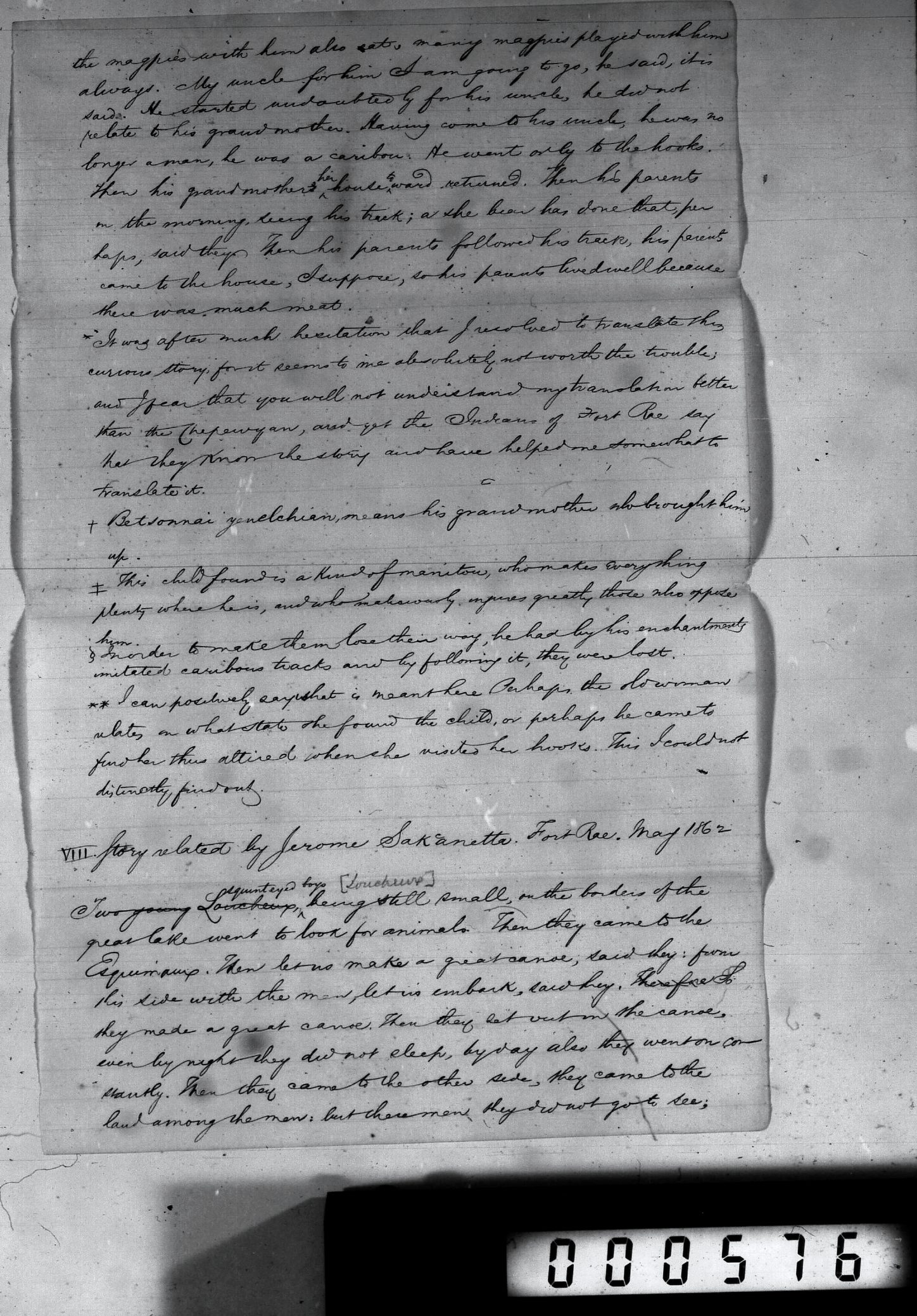
End of the Samuel Tsak'ailni tale with footnotes; opening of story VIII. "the magpies with him also eat"; the boy goes to his uncle and "he was no longer a man, he was a caribou"; footnotes: "It was after much hesitation that I resolved to translate this curious story... and yet the Indians of Fort Rae say that they Know the story and have helped me somewhat to translate it"; "Betsonnai yenelchian, means his grandmother who brought him up"; "This child found is a kind of manitou, who makes everything plenty where he is"; he "imitated caribou tracks" by enchantment so they were lost. Then heading: "VIII. Story related by Jerome Sak'anetta. Fort Rae. May 1862" - "Two squinteyed boys [Loucheux]... on the borders of the great lake went to look for animals. Then they came to the Esquimaux" and built "a great canoe"
Wisconsin Historical Society, Gibbs Family Papers, U.S. Mss Y, Micro 1117
Reel 2, frames 3925
Reel 2, frame 3925
Read beside the scan
AI first transcription from the evidence pack; not independently verified. Compare with the scan.
always. My uncle for him I am going to go, he said, it is
said. He started undoubtedly for his uncle, he did not
relate to his grandmother. Having come to his uncle, he was no
longer a man, he was a caribou. He went only to the hooks.
Then his grandmother's [inserted: her] house[inserted: to]ward returned. Then his parents
in the morning, seeing his track; a[?] the bear has done that, per
haps, said they. Then his parents followed his track, his parents
came to the house, I suppose, so his parents lived well because
there was much meat.
* It was after much hesitation that I resolved to translate this
curious story, for it seems to me absolutely not worth the trouble;
and I fear that you will not understand my translation better
than the Chepewyan, and yet the Indians of Fort Rae say
that they know the story and have helped me somewhat to
translate it.
+ Betsonnai yenelchian, means his grandmother who brought him
up.
‡ This child found is a kind of manitou, who makes everything
plenty where he is, and who maleavourly[?] injures greatly those who oppose
him.
§ In order to make them lose their way, he had by his enchantments
imitated caribous tracks and by following it, they were lost.
** I can positively say what is meant here Perhaps the old woman
relates in what state she found the child, or perhaps he came to
find her thus attired when she visited her hooks. This I could not
distinctly find out.
VIII. Story related by Jerome Sakanetta[?]. Fort Rae. May 1862
[struck: Two young Loucheux,] [inserted: squint eyed boys] [inserted: [Loucheux]] being still small, on the borders of the
great lake went to look for animals. Then they came to the
Esquimaux. Then let us make a great canoe, said they: from
this side with the men, let us embark, said hey. Therefore[?] So[?]
they made a great canoe. Then they set out in the canoe,
even by night they did not sleep, by day also they went on con-
stantly. Then they came to the other side, they came to the
land among the men: but there men they did not go to see;
[stamp: 000576]
Citation and provenance
Gibbs, G., IV. (1856). [Manuscript volume, n.p.]. Gibbs Family Papers, 1763-1918 (U.S. Mss Y, Micro 1117, Reel 2, frame 3925). Wisconsin Historical Society Archives, Madison, WI, United States.
Citation details need editorial review.
Historical sources retain their individual rights and credits. A scan’s presence here does not establish unrestricted reuse.
People identified in the source catalog
These are catalog labels. Individual identities and relationships have not all been reviewed.
Where the book uses this document
No quotation has yet been assigned directly to this catalog record. Its individual frames may have separate connections.