
Wisconsin manuscript
George Gibbs IV (manuscript volume, n.p.) · 1856 (Olympia) and later additions
Loose manuscript: end of Deluge III, and "Origin of the Dog Rib Indians". End of Deluge III (Fort Rae, 1862): he had put all the animals in the canoe "but the earth he had forgotten it (he had forgotten to take the earth aboard)"; the muskrat(?) "the rat, he plunged in last: when he came up he had the arms stiff with fatigue, in one hand he brought a little earth, in the other nothing"; the young man breathes on the little earth till it grows "like the palm of your hand", puts a little "tlandatiai" on it, then a larger bird, then the wolf, who makes the circuit of the earth in a day, then after two sleeps, then nine, and "when he had to sleep ten times, he returned no more, because the earth was great"; footnote "* Tlandatiai, a very small bird that always runs along the water's edge." Then the heading "Origin of the Dog Rib Indians / Related in Montagnais and according to the Montagnais by Beaulieu / Rivière au Sel January 1857": "As long as man shall be*. An old woman, her boy his dog had tied up. Therefore to his sister: Sister, my dog, go look for him, said he"; a handsome young man at the camp, "Let us marry, said he to her"; he becomes a dog again; she bears "two dogs and a slut"; her brother abandons her; her little ones play on the ashes leaving children's footprints. Frame counter 000569.
Wisconsin Historical Society, Gibbs Family Papers, U.S. Mss Y, Micro 1117
Reel 2, frames 3918
Reel 2, frame 3918
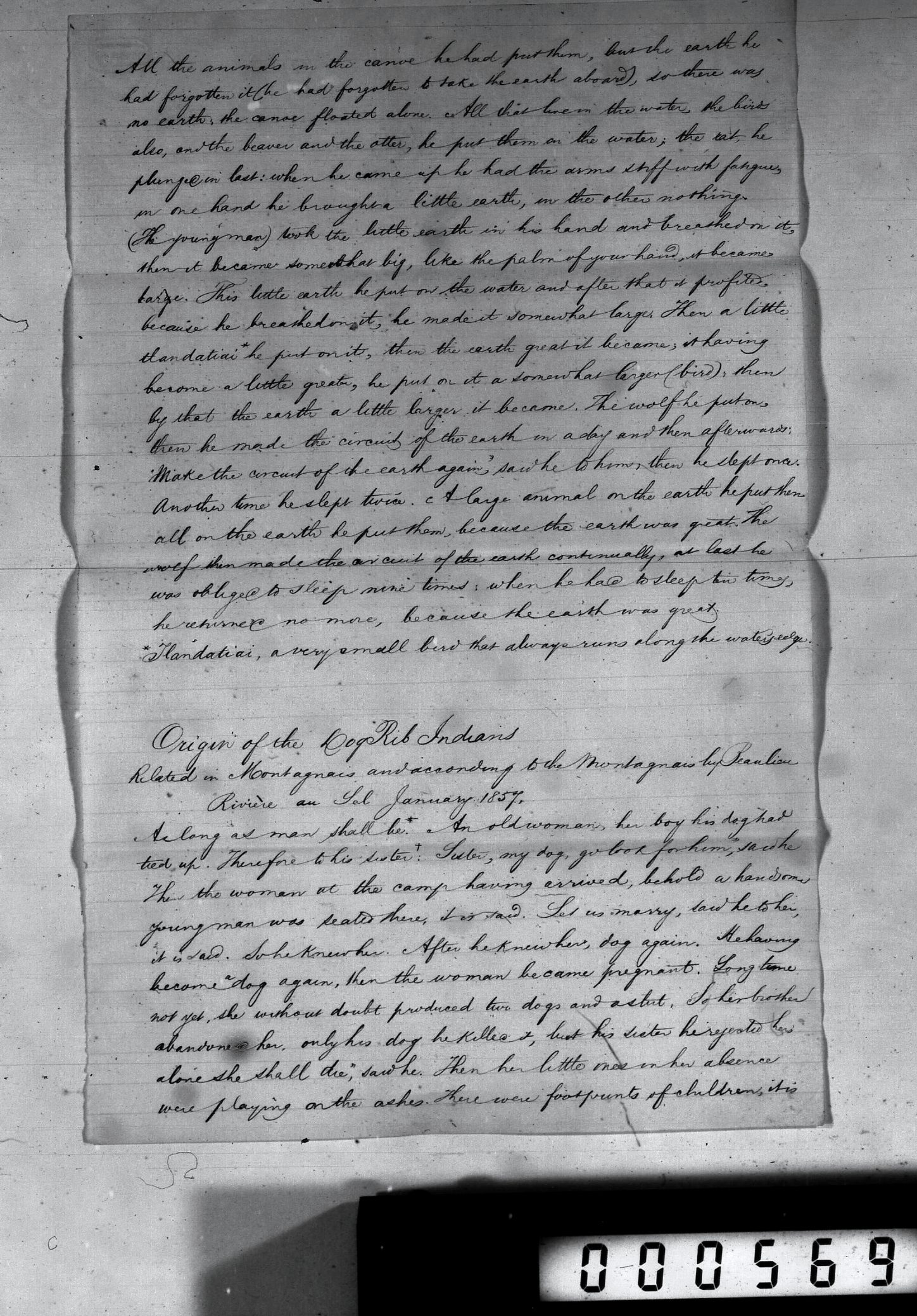
Read beside the scan
AI first transcription from the evidence pack; not independently verified. Compare with the scan.
had forgotten it (he had forgotten to take the earth aboard), so there was
no earth: the canoe floated alone. c All that live in the water, the birds
also, and the beaver and the otter, he put them on the water; the rat, he
plunged in last: when he came up he had the arms stiff with fatigue,
in one hand he brought a little earth, in the other nothing.
(The young man) took the little earth in his hand and breathed on it,
then it became somewhat big, like the palm of your hand, it became
large. This little earth he put on the water and after that it profited.
because he breathed on it, he made it somewhat large. Then a little
tlandatiai* he put on it, then the earth great it became; it having
become a little greater[?], he put on it a somewhat larger (bird); then
by that the earth a little larger it became. The wolf he put on,
then he made the circuit of the earth in a day and then afterwards:
'Make the circuit of the earth again,' said he to him; then he slept once.
Another time he slept twice. c A large animal on the earth he put them
all on the earth he put them, because the earth was great. The
wolf then made the circuit of the earth continually, at last he
was obliged to sleep nine times: when he had to sleep ten times,
he returned no more, because the earth was great.
*Tlandatiai, a very small bird that always runs along the water's edge.
Origin of the Dog Rib Indians
Related in Montagnais and according to the Montagnais by Beaulieu
Rivière au Sel January 1857.
As long as man shall be.* An old woman, her boy his dog had
tied up. Therefore to his sister†: Sister, my dog, go look for him," said he
Then the woman at the camp having arrived, behold a handsome
young man was seated there, it is said. Let us marry, said he to her,
it is said. So he knew her. After he knew her, dog again. He having
become "dog again, then the woman became pregnant. Long time
not yet, she without doubt produced two dogs and a slut. So her brother
abandoned her, only his dog he killed it, but his sister he rejected her
alone she shall die," said he. Then her little ones in her absence
were playing on the ashes. There were footprints of children, it is
Citation and provenance
Gibbs, G., IV. (1856). [Manuscript volume, n.p.]. Gibbs Family Papers, 1763-1918 (U.S. Mss Y, Micro 1117, Reel 2, frame 3918). Wisconsin Historical Society Archives, Madison, WI, United States.
Citation details need editorial review.
Historical sources retain their individual rights and credits. A scan’s presence here does not establish unrestricted reuse.
People identified in the source catalog
These are catalog labels. Individual identities and relationships have not all been reviewed.
Where the book uses this document
No quotation has yet been assigned directly to this catalog record. Its individual frames may have separate connections.