
Wisconsin manuscript
George Gibbs IV (manuscript volume, n.p.) · 1856 (Olympia) and later additions
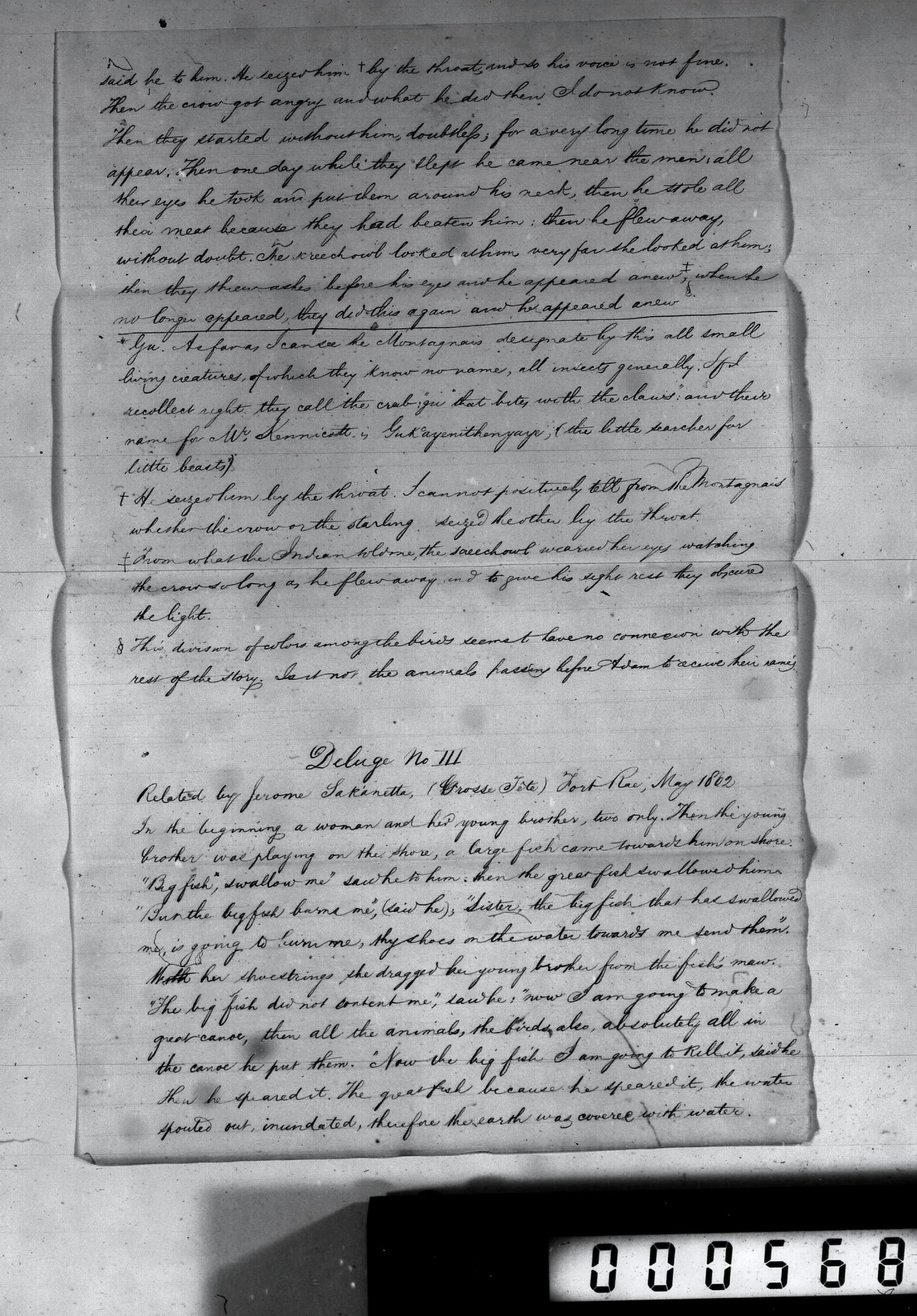
Loose manuscript: Montagnais Legends - end of Deluge II with footnotes, and "Deluge No III". End of Deluge II (crow seized by the throat, "and so his voice is not fine"; steals the men's eyes and meat; the screech owl watches him, "then they threw ashes before his eyes and he appeared anew"). Four footnotes, including a linguistic note: "* Gu. As far as I can see the Montagnais designate by this all small living creatures, of which they know no name, all insects generally. If I recollect right, they call the crab: gu that bites with the claws: and their name for Mr. Kennicott is Gutk'ayenithenyaye (the little searcher for little beasts)"; "† He seized him by the throat. I cannot positively tell from the Montagnais whether the crow or the starling seized the other by the throat"; "§ This division of colors among the birds seems to have no connexion with the rest of the story. Is it not the animals passing before Adam to receive their names?" Then the heading "Deluge No III / Related by Jerome Sakanette, (Grosse Tête) Fort Rae, May 1862": a woman and her young brother; "Big fish, swallow me"; she drags him from the fish's maw with her shoestrings; he builds "a great canoe" and puts all the animals and birds in it, spears the great fish and the water spouts out and inundates the earth. Frame counter 000568.
Wisconsin Historical Society, Gibbs Family Papers, U.S. Mss Y, Micro 1117
Reel 2, frames 3917
Reel 2, frame 3917
Read beside the scan
AI first transcription from the evidence pack; not independently verified. Compare with the scan.
Then the crow got angry and what he did then I do not know.
Then they started without him, doubtless; for a very long time he did not
appear. Then one day while they slept he came near the men; all
their eyes he took and put them around his neck, then he stole all
their meat because they had beaten him: then he flew away,
without doubt. The screechowl looked at him very far she looked at him;
then they threw ashes before his eyes and he appeared anew‡; when he
no longer appeared, they did this again and he appeared anew §.
________________________________________
*Gu. As far as I can see the Montagnais designate by this all small
living creatures, of which they know no name, all insects generally. If I
recollect right they call the crab, "gu that bites with the claws": and their
name for Mr Kennicott is Gukayenithenyaye[?], (the little searcher for
little beasts)
† He seized him by the throat. I cannot positively tell from the Montagnais
whether the crow or the starling seized the other by the throat.
‡ From what the Indian told me, the screechowl wearied her eyes watching
the crow so long as he flew away and to give his sight rest they obscured
the light.
§ This division of colors among the birds seems to[?] have no connexion with the
rest of the story. Is it not the animals passing before Adam to receive their names[?]
Deluge No III
Related by Jerome Sakanetta[?], (Grosse Tête) Fort Rae, May 1862
In the beginning a woman and her young brother, two only. Then the young
brother was playing on the shore, a large fish came towards him on shore.
"Big fish, swallow me" said he to him: then the great fish swallowed him.
"But the big fish burns me", (said he); "Sister, the big fish that has swallowed
me, is going to burn me, thy shoes on the water towards me send them".
With her shoestrings, she dragged her young brother from the fish's maw.
"The big fish did not content me", said he; "now I am going to make a
great canoe, then all the animals, the birds also, absolutely all in
the canoe he put them. "Now the big fish I am going to kill it," said he
Then he speared it. The great fish because he speared it, the water
spouted out, inundated, therefore the earth was covered with water.
[stamp: 000568]
Citation and provenance
Gibbs, G., IV. (1856). [Manuscript volume, n.p.]. Gibbs Family Papers, 1763-1918 (U.S. Mss Y, Micro 1117, Reel 2, frame 3917). Wisconsin Historical Society Archives, Madison, WI, United States.
Citation details need editorial review.
Historical sources retain their individual rights and credits. A scan’s presence here does not establish unrestricted reuse.
People identified in the source catalog
These are catalog labels. Individual identities and relationships have not all been reviewed.
Where the book uses this document
No quotation has yet been assigned directly to this catalog record. Its individual frames may have separate connections.