
Wisconsin manuscript
George Gibbs IV (manuscript volume, ms p. 246) · 1856 (Olympia) and later additions
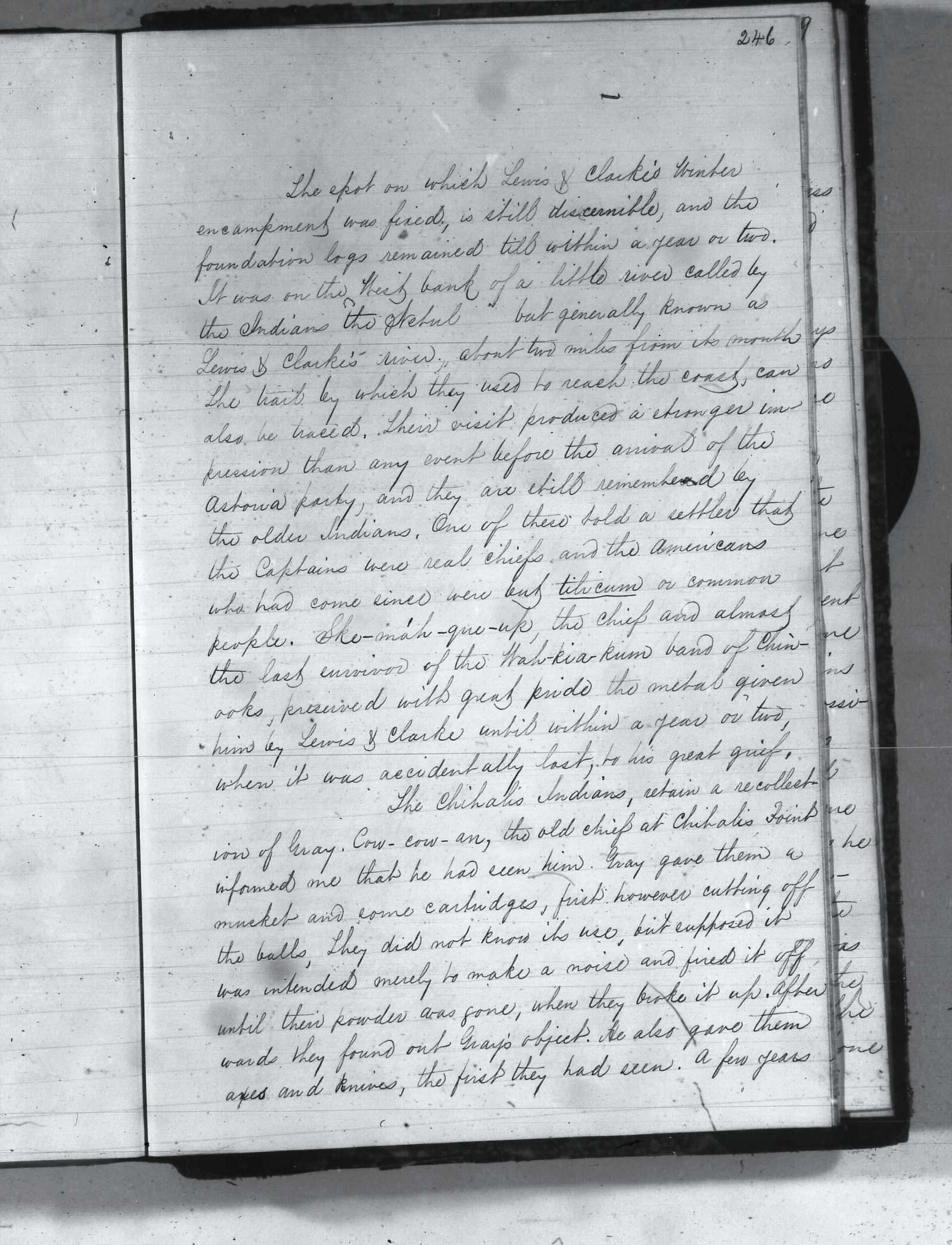
Early Visits of White Men.. Lewis & Clarke's winter encampment site still discernible, foundation logs remaining till a year or two since, "on the West bank of a little river called by the Indians the Netul [word left blank/uncertain] but generally known as Lewis & Clarke's river, about two miles from its mouth"; an old Indian told a settler "the Captains were real chiefs and the Americans who had come since were but tilicum or common people"; "Ske-mah-que-up, the chief and almost the last survivor of the Wah-kia-kum band of Chinooks," kept the medal given him by Lewis & Clarke until it was lately lost "to his great grief"; "Cow-cow-an, the old chief at Chihalis Point," told Gibbs he had seen Gray, who gave them a musket with the balls cut off, plus axes and knives, "the first they had seen." No sketch or table.
Wisconsin Historical Society, Gibbs Family Papers, U.S. Mss Y, Micro 1117
Reel 2, frames 3898
Reel 2, frame 3898
Read beside the scan
AI first transcription from the evidence pack; not independently verified. Compare with the scan.
—
The spot on which Lewis & Clarke's Winter
encampment was fixed, is still discernible, and the
foundation logs remained till within a year or two.
It was on the [inserted: West] bank of a little river called by
the Indians the Netul but generally known as
Lewis & Clarke's river, about two miles from its mouth
The trail by which they used to reach the coast, can
also be traced. Their visit produced a stronger im-
pression than any event before the arrival of the
Astoria party, and they are still remembered by
the older Indians. One of these told a settler that
the Captains were real chiefs and the Americans
who had come since were but tilicum or common
people. Ske-máh-que-up, the chief and almost
the last survivor of the Wah-kia-kum band of Chin-
ooks, preserved with great pride the metal given
him by Lewis & Clarke until within a year or two,
when it was accidentally lost, to his great grief.
The Chihalis Indians, retain a recollect-
ion of Gray. Cow-cow-an, the old chief at Chihalis Point
informed me that he had seen him. Gray gave them a
musket and some cartridges, first however cutting off
the balls, They did not know its use, but supposed it
was intended merely to make a noise and fired it off
until their powder was gone, when they broke it up. After
wards they found out Gray's object. He also gave them
axes and knives, the first they had seen. A few years
Citation and provenance
Gibbs, G., IV. (1856). [Manuscript volume, ms p. 246]. Gibbs Family Papers, 1763-1918 (U.S. Mss Y, Micro 1117, Reel 2, frame 3898). Wisconsin Historical Society Archives, Madison, WI, United States.
Citation details need editorial review.
Historical sources retain their individual rights and credits. A scan’s presence here does not establish unrestricted reuse.
People identified in the source catalog
These are catalog labels. Individual identities and relationships have not all been reviewed.
Where the book uses this document
No quotation has yet been assigned directly to this catalog record. Its individual frames may have separate connections.