
Wisconsin manuscript
George Gibbs IV (manuscript volume, ms p. 236) · 1856 (Olympia) and later additions
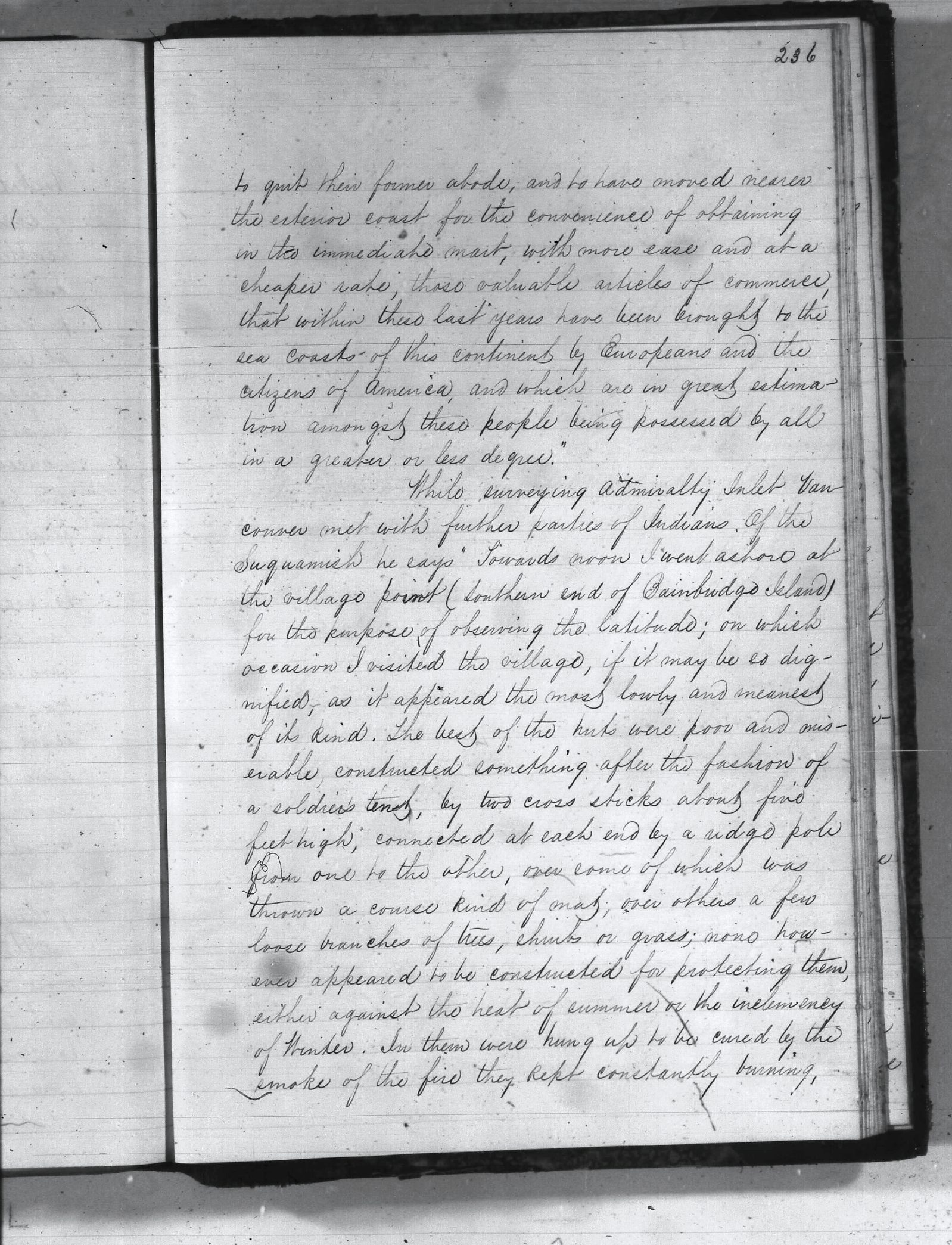
Early explorers' notices of the Puget Sound tribes (Vancouver quoted). End of the depopulation passage (removal to the coast for European articles of commerce); new section on Admiralty Inlet: "Of the Suquamish he says" Vancouver went ashore at "the village point (Southern end of Bainbridge Island)" for the latitude and found "the most lowly and meanest of its kind," huts built "after the fashion of a soldiers tent, by two cross sticks about five feet high, connected at each end by a ridge pole," covered with coarse mats or loose branches, fish hung inside to be cured by the constant smoke. No sketch or table.
Wisconsin Historical Society, Gibbs Family Papers, U.S. Mss Y, Micro 1117
Reel 2, frames 3888
Reel 2, frame 3888
Read beside the scan
AI first transcription from the evidence pack; not independently verified. Compare with the scan.
to quit their former abode, and to have moved nearer
the exterior coast for the convenience of obtaining
in the immediate mart, with more ease and at a
cheaper rate, those valuable articles of commerce,
that within these last years have been brought to the
sea coasts of this continent by Europeans and the
citizens of America, and which are in great estima-
tion amongst these people being possessed by all
in a greater or less degree."
While surveying Admiralty Inlet Van
couver met with further parties of Indians. Of the
Suquamish he says" Towards noon I went ashore at
the village point (Southern end of Bainbridge Island)
for the purpose of observing the latitude; on which
occasion I visited the village, if it may be so dig-
nified, as it appeared the most lowly and meanest
of its kind. The best of the huts were poor and mis-
erable, constructed something after the fashion of
a soldiers tent, by two cross sticks about five
feet high, connected at each end by a ridge pole
from one to the other, over some of which was
thrown a coarse kind of mat; over others a few
loose branches of trees, shrubs or grass; none how-
ever appeared to be constructed for protecting them,
either against the heat of summer or the inclemency
of Winter. In them were hung up to be cured by the
smoke of the fire they kept constantly burning,
Citation and provenance
Gibbs, G., IV. (1856). [Manuscript volume, ms p. 236]. Gibbs Family Papers, 1763-1918 (U.S. Mss Y, Micro 1117, Reel 2, frame 3888). Wisconsin Historical Society Archives, Madison, WI, United States.
Citation details need editorial review.
Historical sources retain their individual rights and credits. A scan’s presence here does not establish unrestricted reuse.
People identified in the source catalog
These are catalog labels. Individual identities and relationships have not all been reviewed.
Where the book uses this document
No quotation has yet been assigned directly to this catalog record. Its individual frames may have separate connections.