
Wisconsin manuscript
George Gibbs IV (manuscript volume, ms p. 233) · 1856 (Olympia) and later additions
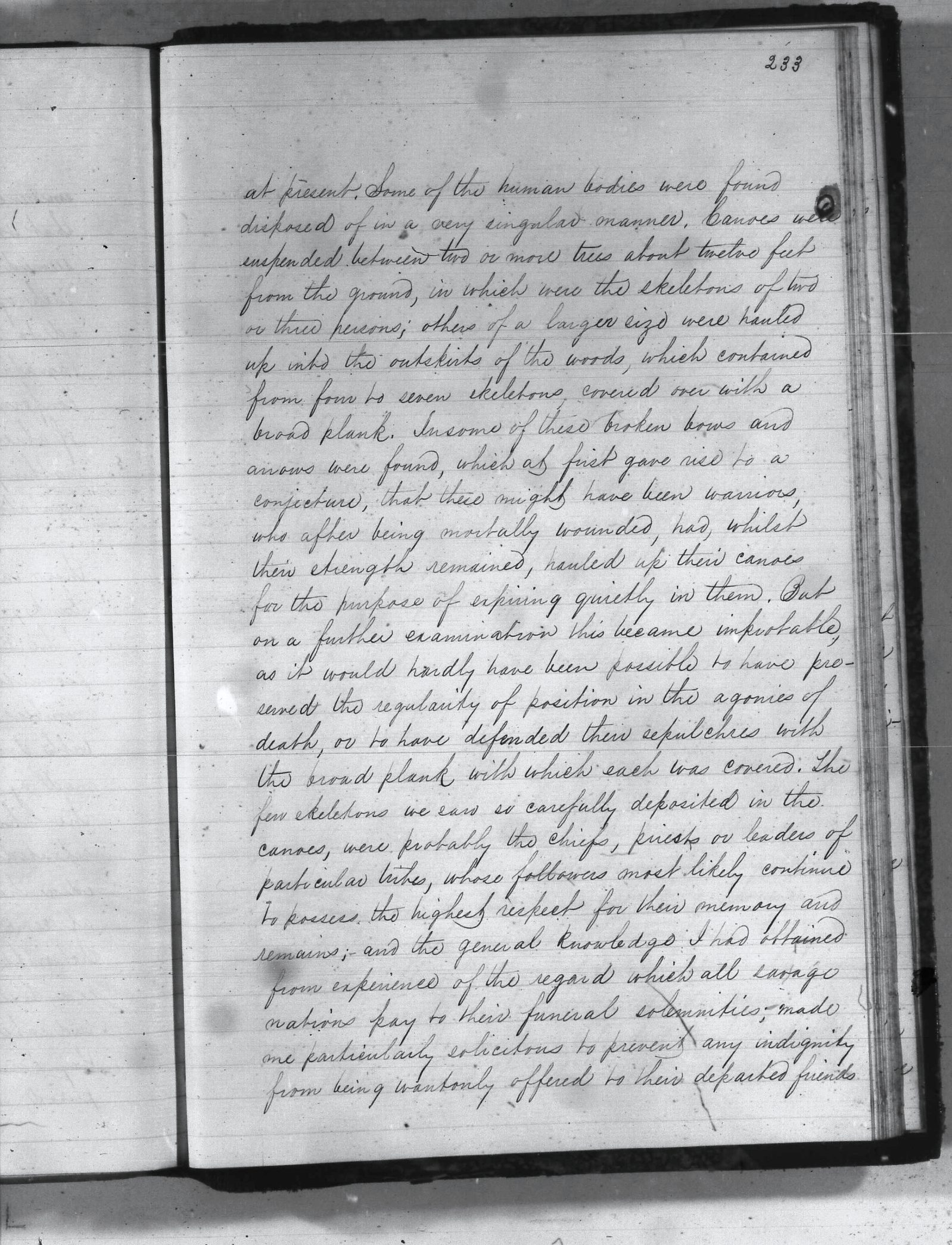
Early explorers' notices of the Puget Sound tribes (Vancouver quoted). Quoted Vancouver on canoe burial: "Canoes were suspended between two or more trees about twelve feet from the ground, in which were the skeletons of two or three persons"; larger canoes hauled into the woods holding "from four to seven skeletons, covered over with a broad plank"; broken bows and arrows found inside prompted, then defeated, a conjecture about mortally wounded warriors; the carefully deposited skeletons "were probably the chiefs, priests or leaders of particular tribes"; Vancouver solicitous to prevent indignity to "their departed friends." No sketch or table.
Wisconsin Historical Society, Gibbs Family Papers, U.S. Mss Y, Micro 1117
Reel 2, frames 3885
Reel 2, frame 3885
Read beside the scan
AI first transcription from the evidence pack; not independently verified. Compare with the scan.
at present. Some of the human bodies were found
disposed of in a very singular manner. Canoes were
suspended between two or more trees about twelve feet
from the ground, in which were the skeletons of two
or three persons; others of a larger size were hauled
up into the outskirts of the woods, which contained
from four to seven skeletons, covered over with a
broad plank. In some of these broken bows and
arrows were found, which at first gave rise to a
conjecture, that these might have been warriors,
who after being mortally wounded, had, whilst
their strength remained, hauled up their canoes
for the purpose of expiring quietly in them. But
on a further examination this became improbable,
as it would hardly have been possible to have pre-
served the regularity of position in the agonies of
death, or to have defended their sepulchres with
the broad plank with which each was covered. The
few skeletons we saw so carefully deposited in the
canoes, were probably the chiefs, priests or leaders of
particular tribes, whose followers most likely continue
to possess the highest respect for their memory and
remains;- and the general knowledge I had obtained
from experience of the regard which all savage
nations pay to their funeral solemnities; made
me particularly solicitous to prevent any indignity
from being wantonly offered to their departed friends
Citation and provenance
Gibbs, G., IV. (1856). [Manuscript volume, ms p. 233]. Gibbs Family Papers, 1763-1918 (U.S. Mss Y, Micro 1117, Reel 2, frame 3885). Wisconsin Historical Society Archives, Madison, WI, United States.
Citation details need editorial review.
Historical sources retain their individual rights and credits. A scan’s presence here does not establish unrestricted reuse.
People identified in the source catalog
These are catalog labels. Individual identities and relationships have not all been reviewed.
Where the book uses this document
No quotation has yet been assigned directly to this catalog record. Its individual frames may have separate connections.