
Wisconsin manuscript
George Gibbs IV (manuscript volume, ms p. 229) · 1856 (Olympia) and later additions
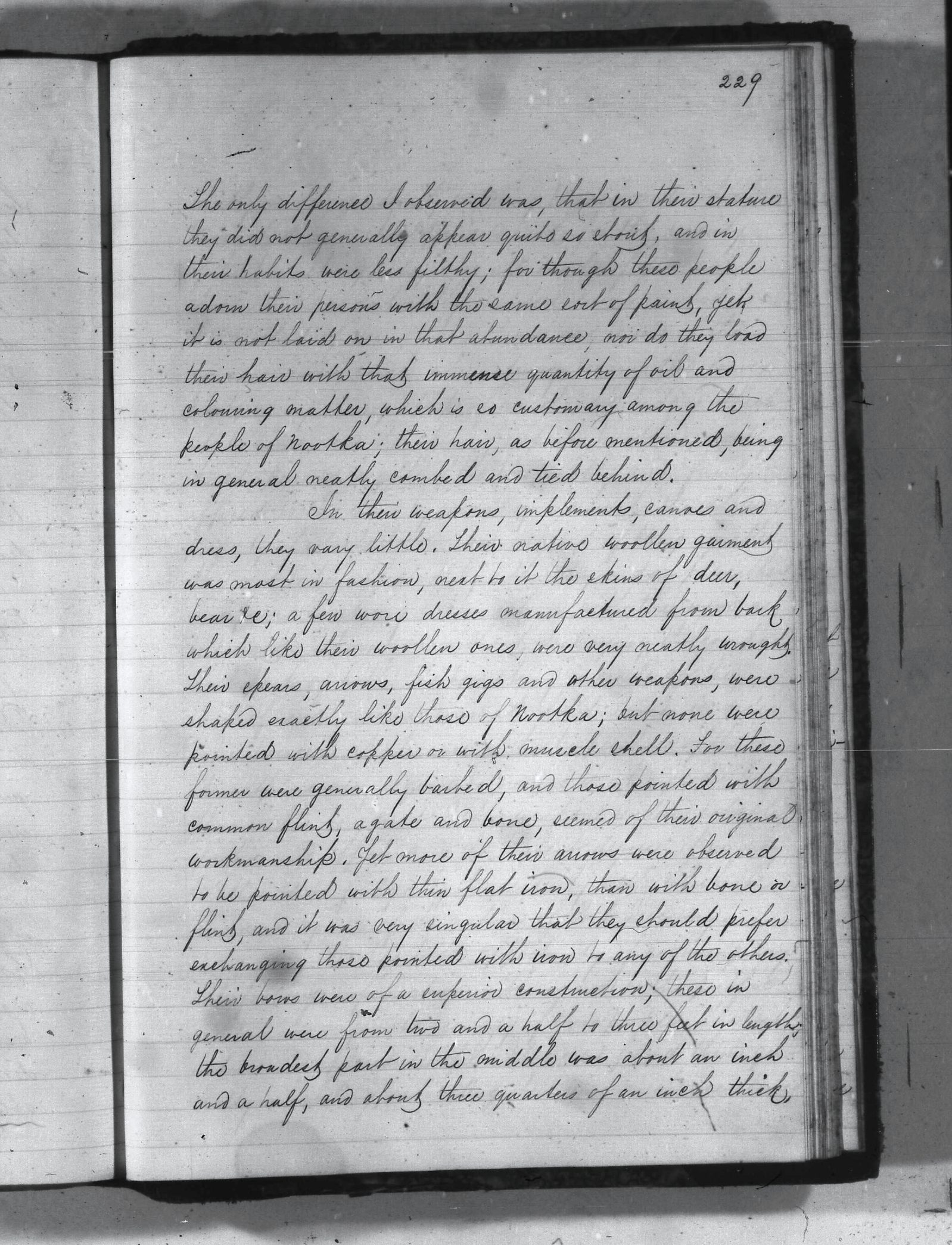
Early explorers' notices of the Puget Sound tribes (Vancouver quoted). Quoted Vancouver on Sound people vs. Nootka: less paint, hair not loaded with oil and colouring matter but "neatly combed and tied behind"; native woollen garment "most in fashion," next skins of deer and bear, "a few wore dresses manufactured from bark"; spears, arrows and fish gigs shaped like those of Nootka but none pointed with copper or muscle shell, points of "common flint, agate and bone," though more arrows were pointed with "thin flat iron"; bows two and a half to three feet long, an inch and a half broad in the middle. Hand changes to a rounder copyist script here. No sketch or table.
Wisconsin Historical Society, Gibbs Family Papers, U.S. Mss Y, Micro 1117
Reel 2, frames 3880
Reel 2, frame 3880
Read beside the scan
AI first transcription from the evidence pack; not independently verified. Compare with the scan.
The only difference I observed was, that in their stature
they did not generally appear quite so stout, and in
their habits were less filthy; for though these people
adorn their persons with the same sort of paint, yet
it is not laid on in that abundance, nor do they load
their hair with that immense quantity of oil and
colouring matter, which is so customary among the
people of Nootka; their hair, as before mentioned, being
in general neatly combed and tied behind.
In their weapons, implements, canoes and
dress, they vary little. Their native woollen garment
was most in fashion, next to it the skins of deer,
bear &c; a few wore dresses manufactured from bark
which like their woollen ones, were very neatly wrought.
Their spears, arrows, fish gigs and other weapons, were
shaped exactly like those of Nootka; but none were
pointed with copper or with muscle shell. For[?] these[?]
former were generally barbed, and those pointed with
common flint, agate and bone, seemed of their original
workmanship. Yet more of their arrows were observed
to be pointed with thin flat iron, than with bone or
flint, and it was very singular that they should prefer
exchanging those pointed with iron to any of the others.
Their bows were of a superior construction; these in
general were from two and a half to three feet in length,
the broadest part in the middle was about an inch
and a half, and about three quarters of an inch thick,
Citation and provenance
Gibbs, G., IV. (1856). [Manuscript volume, ms p. 229]. Gibbs Family Papers, 1763-1918 (U.S. Mss Y, Micro 1117, Reel 2, frame 3880). Wisconsin Historical Society Archives, Madison, WI, United States.
Citation details need editorial review.
Historical sources retain their individual rights and credits. A scan’s presence here does not establish unrestricted reuse.
People identified in the source catalog
These are catalog labels. Individual identities and relationships have not all been reviewed.
Where the book uses this document
No quotation has yet been assigned directly to this catalog record. Its individual frames may have separate connections.