
Wisconsin manuscript
George Gibbs IV (manuscript volume, ms p. 227) · 1856 (Olympia) and later additions
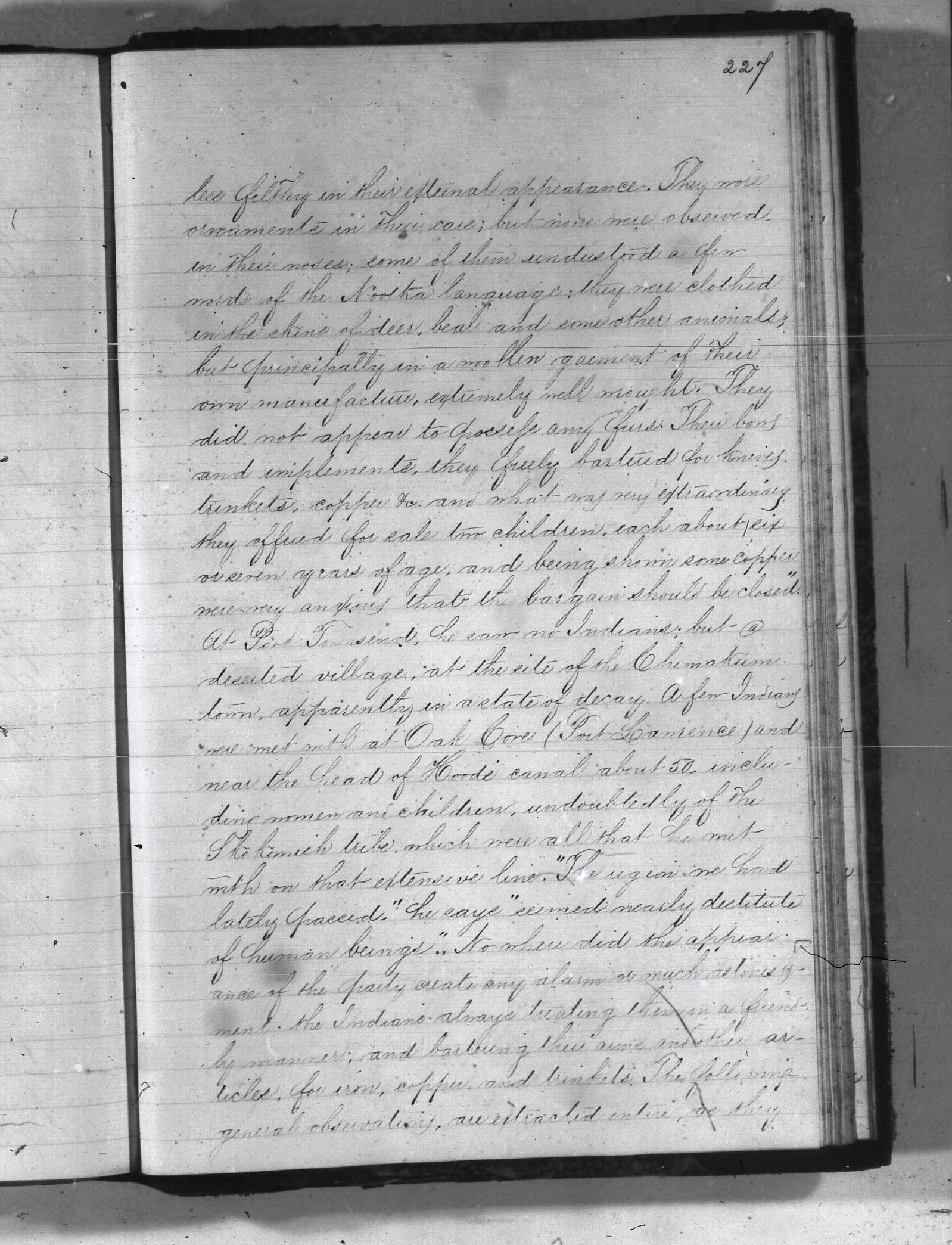
Early explorers' notices of the Puget Sound tribes (Vancouver quoted). Port Discovery people wore ear ornaments but none in the nose, understood "a few words of the Nootka language," dressed in deer and bear skins "but principally in a woollen garment of their own manufacture, extremely well wrought"; bartered bows and implements for knives, trinkets and copper, and "offered for sale two children, each about six or seven years of age"; at Port Townsend a deserted village at the site of the "Chemakum" town; about 50 Indians near the head of Hood's canal "undoubtedly of the Skokomish tribe"; the region "seemed nearly destitute of human beings." No sketch or table.
Wisconsin Historical Society, Gibbs Family Papers, U.S. Mss Y, Micro 1117
Reel 2, frames 3878
Reel 2, frame 3878
Read beside the scan
AI first transcription from the evidence pack; not independently verified. Compare with the scan.
less filthy in their external appearance. They wore
ornaments in their ears; but none were observed
in their noses; some of them understood a few
words of the Nootka language; they were clothed
in the skins of deer, bear and some other animals;
but principally in a woollen garment of their
own manufacture, extremely well wrought. They
did not appear to possess any furs. Their bows
and implements, they freely bartered for knives.
trinkets, copper &c. and what was very extraordinary
they offered for sale two children, each about six
or seven years of age, and being shown some copper
were very anxious that the bargain should be closed.
At Port Townsend, he saw no Indians; but a
deserted village; at the site of the Chimakum
town, apparently in a state of decay. A few Indians
were met with at Oak Cove (Port Lawrence) and
near the head of Hood's canal about 50. inclu-
ding women and children, undoubtedly of the
Skokomish tribe, which were all that he met
with on that extensive line. "The region we had
lately passed" he says "seemed nearly destitute
of human beings". No where did the appear-
ance of the party create any alarm or much astonish-
ment. the Indians always treating them in a friend-
ly manner, and bartering their arms and other ar-
ticles, for iron, copper, and trinkets. The following
general observations, are extracted entire, as they
Citation and provenance
Gibbs, G., IV. (1856). [Manuscript volume, ms p. 227]. Gibbs Family Papers, 1763-1918 (U.S. Mss Y, Micro 1117, Reel 2, frame 3878). Wisconsin Historical Society Archives, Madison, WI, United States.
Citation details need editorial review.
Historical sources retain their individual rights and credits. A scan’s presence here does not establish unrestricted reuse.
People identified in the source catalog
These are catalog labels. Individual identities and relationships have not all been reviewed.
Where the book uses this document
No quotation has yet been assigned directly to this catalog record. Its individual frames may have separate connections.