
Wisconsin manuscript
George Gibbs IV (manuscript volume, ms p. 218) · 1856 (Olympia) and later additions
End of "The Mo-kwo-tah-oon"; new titled Staktamish story. The grandmother throws the bones out of doors and the child dies; "if the grandmother had not thrown it away, on the fifth day it would have become like other people, except that it would never have died, nor would Indians die; but live forever. This was in the beginning, when the world was new made and it was the cause of death coming"; "These people were not dead Indians; but the Mo-kwa tah-oom, another race of beings, those of the former world"; all killed "except Klukutlikik (the beaver) who jumped into the water, dove, and became really a beaver, and Skunneh (the musk-rat) who also dove. and took her two young ones with her. These two became people, and were the parents of the present Indians"; "The Slaht-la-kwo is the screech owl. When any one is about to die, she comes to the house and calls them by name." Then the underlined heading "Tis-ai-luck-han(?), a Staktamish story": "There was a very old man among the Clip Tilikum. called Sis-ai-luck-han, who had a son of the same name"
Wisconsin Historical Society, Gibbs Family Papers, U.S. Mss Y, Micro 1117
Reel 2, frames 3869
Reel 2, frame 3869
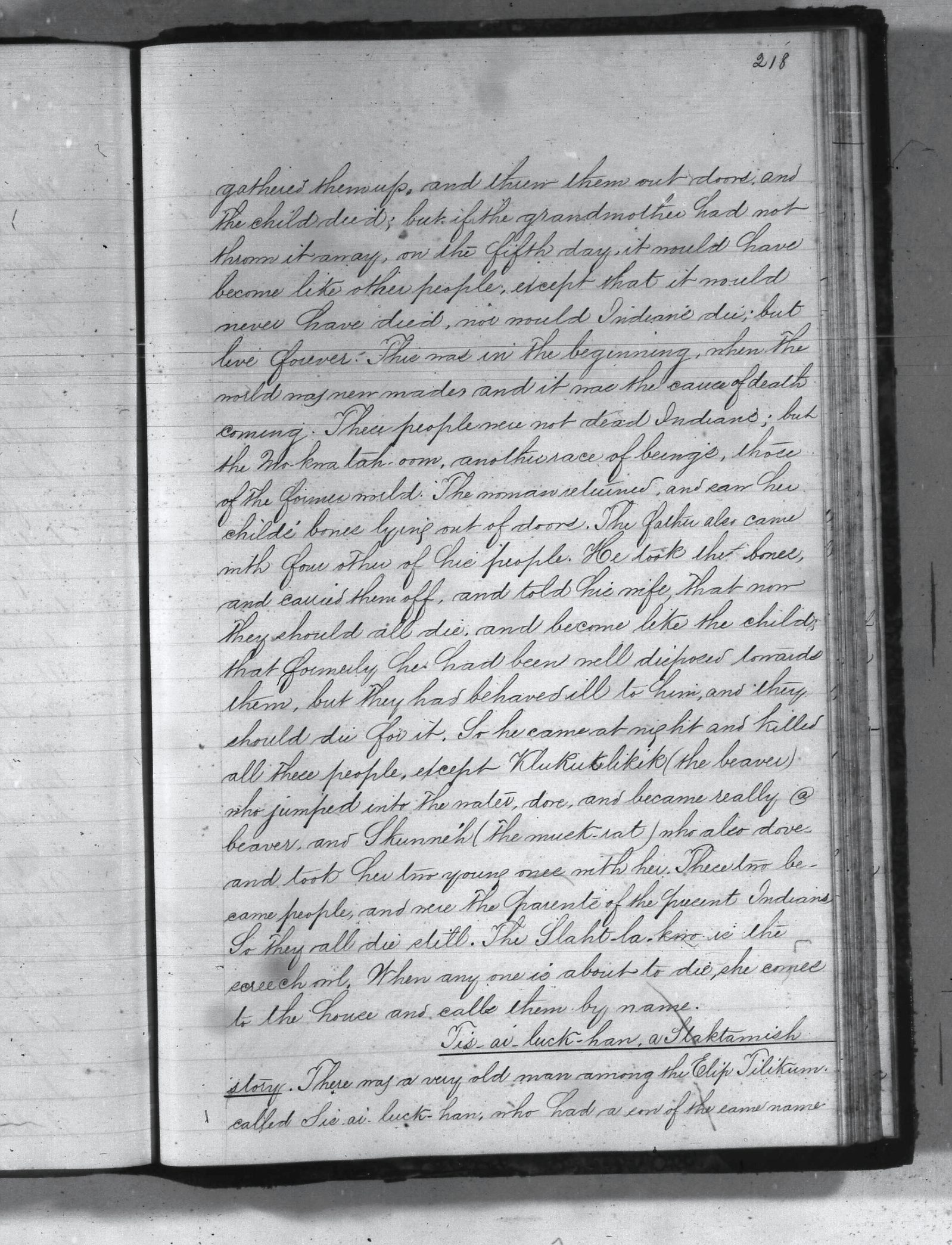
Read beside the scan
AI first transcription from the evidence pack; not independently verified. Compare with the scan.
gathered them up, and threw them out doors, and
the child died; but if the grandmother had not
thrown it away, on the fifth day, it would have
become like other people, except that it would
never have died, nor would Indians die; but
live forever. This was in the beginning, when the
world was new made; and it was the cause of death
coming. These people were not dead Indians; but
the Mo-kwa-tah-oom[?], another race of beings, those
of the former world. The woman returned, and saw her
child's bones lying out of doors. The father also came
with four other of his people. He took the bones,
and carried them off, and told his wife, that now
they should all die, and become like the child;
that formerly he had been well disposed towards
them, but they had behaved ill to him, and they
should die for it. So he came at night and killed
all these people, except Klukutlikik[?] (the beaver)
who jumped into the water, dove, and became really a
beaver, and Skunnĕh[?] (the musk-rat) who also dove
and took her two young ones with her. These two be-
came people, and were the parents of the present Indians
So they all die still. The Slaht-la-kwo[?] is the
screech owl. When any one is about to die, she comes
to the house and calls them by name.
Tis-ai-luck-han, a Staktamish[?]
story. There was a very old man among the Elip Tilikum.
called Tis-ai-luck-han, who had a son of the same name
Citation and provenance
Gibbs, G., IV. (1856). [Manuscript volume, ms p. 218]. Gibbs Family Papers, 1763-1918 (U.S. Mss Y, Micro 1117, Reel 2, frame 3869). Wisconsin Historical Society Archives, Madison, WI, United States.
Citation details need editorial review.
Historical sources retain their individual rights and credits. A scan’s presence here does not establish unrestricted reuse.
People identified in the source catalog
These are catalog labels. Individual identities and relationships have not all been reviewed.
Where the book uses this document
No quotation has yet been assigned directly to this catalog record. Its individual frames may have separate connections.