
Wisconsin manuscript
George Gibbs IV (manuscript volume, ms p. 208) · 1856 (Olympia) and later additions
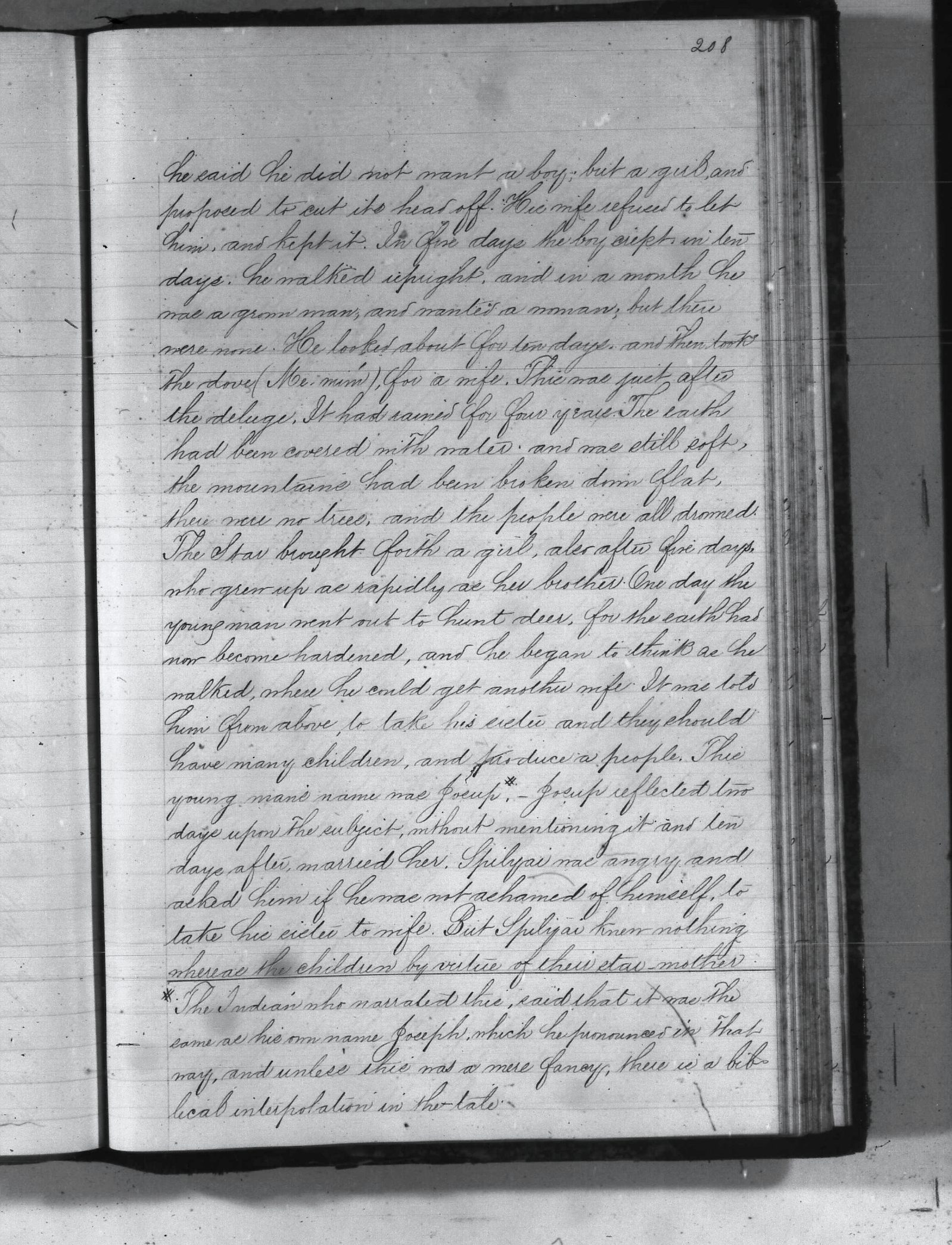
"The Story of Josup" (Klikatat), continued, with author's footnote. Spilyai "said he did not want a boy; but a girl, and proposed to cut its head off"; the boy walks upright in ten days, "in a month he was a grown man"; "then took the dove (Me-mim'), for a wife"; "This was just after the deluge. It had rained for four years. The earth had been covered with water. and was still soft, the mountains had been broken down flat, there were no trees, and the people were all drowned."; the Star bears a girl; a voice from above bids him take his sister "and they should have many children, and produce a people"; "This young man's name was Josup*". Footnote at foot of page: "* The Indian who narrated this, said that it was the same as his own name Joseph. which he pronounced in that way, and unless this was a mere fancy, there is a biblical interpolation in the tale."
Wisconsin Historical Society, Gibbs Family Papers, U.S. Mss Y, Micro 1117
Reel 2, frames 3859
Reel 2, frame 3859
Read beside the scan
AI first transcription from the evidence pack; not independently verified. Compare with the scan.
he said he did not want a boy; but a girl, and
proposed to cut its head off. His wife refused to let
him, and kept it. In five days the boy crept, in ten
days. he walked upright, and in a month he
was a grown man, and wanted a woman, but there
were none. He looked about for ten days. and then took
the dove (Me-mim'[?]), for a wife. This was just after
the deluge. It had rained for four years. The earth
had been covered with water. and was still soft,
the mountains had been broken down flat,
there were no trees, and the people were all drowned.
The Star brought forth a girl, also after five days,
who grew up as rapidly as her brother. One day the
young man went out to hunt deer, for the earth had
now become hardened, and he began to think as he
walked, where he could get another wife. It was told
him from above, to take his sister and they should
have many children, and produce a people. This
young mans name was Josup[?]*. - Josup[?] reflected two
days upon the subject, without mentioning it and ten
days after, married her. Spilyai was angry and
asked him if he was not ashamed of himself, to
take his sister to wife. But Spilyai knew nothing
whereas the children by virtue of their star-mother
______________________________
*. The Indian who narrated this, said that it was the
same as his own name Joseph, which he pronounced in that
way, and unless this was a mere fancy, there is a bib-
lical interpolation in the tale.
Citation and provenance
Gibbs, G., IV. (1856). [Manuscript volume, ms p. 208]. Gibbs Family Papers, 1763-1918 (U.S. Mss Y, Micro 1117, Reel 2, frame 3859). Wisconsin Historical Society Archives, Madison, WI, United States.
Citation details need editorial review.
Historical sources retain their individual rights and credits. A scan’s presence here does not establish unrestricted reuse.
People identified in the source catalog
These are catalog labels. Individual identities and relationships have not all been reviewed.
Where the book uses this document
No quotation has yet been assigned directly to this catalog record. Its individual frames may have separate connections.