
Wisconsin manuscript
George Gibbs IV (manuscript volume, ms p. 200) · 1856 (Olympia) and later additions
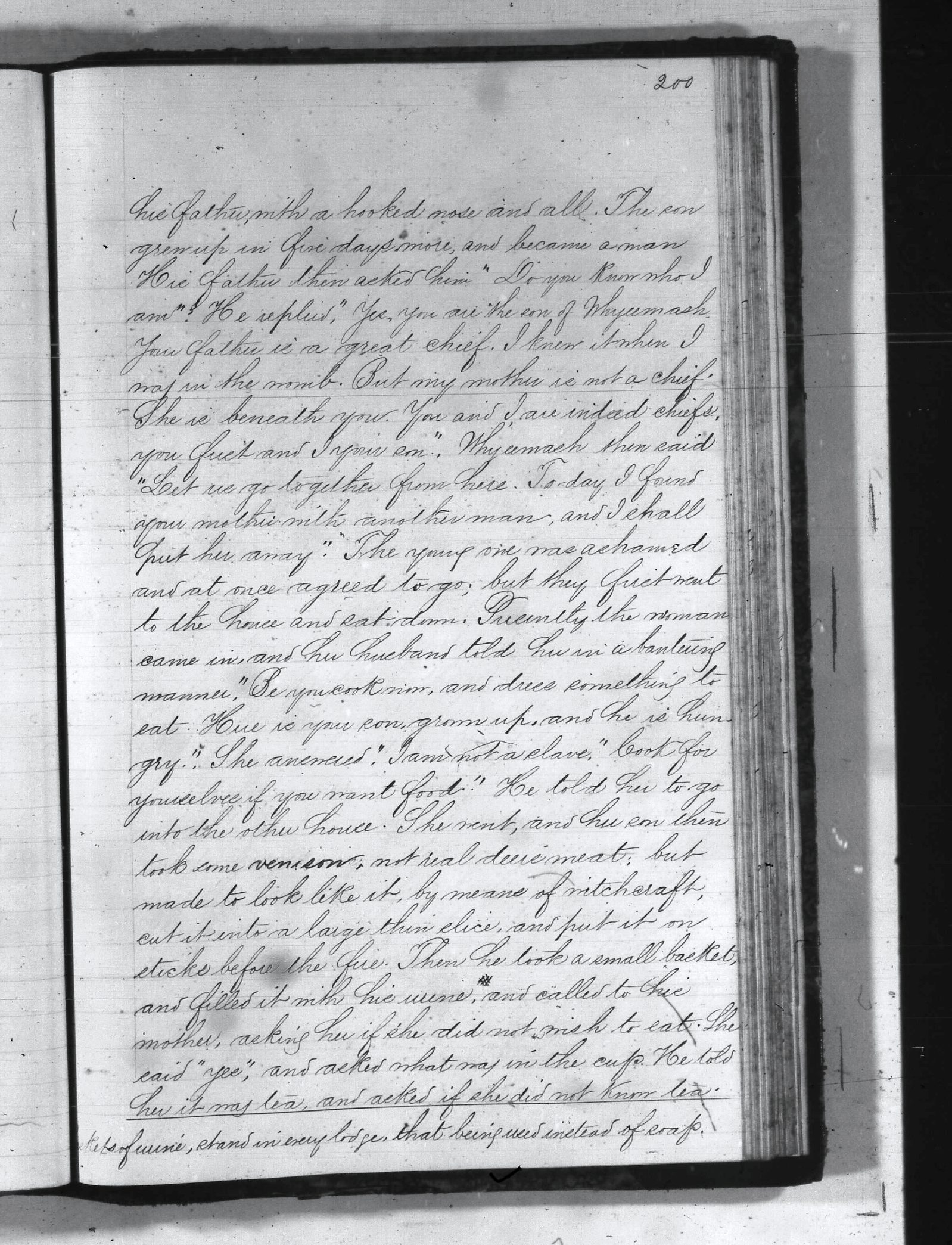
TALE: "The Story of Why-ei-ma" (cont.) — the precocious son; the witchcraft venison and "tea"; footnote on urine baskets. The son is like "his father, with a hooked nose and all. The son grew up in five days more, and became a man"; asked "Do you know who I am"? he replies "Yes, you are the son of Whyeemash. Your father is a great chief. I knew it when I was in the womb. But my mother is not a chief. She is beneath you. You and I are indeed chiefs, you first and I your son"; Whyeemash: "Let us go together from here. To-day I found your mother with another man, and I shall put her away"; told to cook, she answers "I am not a slave, Cook for yourselves if you want food"; the son "took some venison; not real deer's meat; but made to look like it, by means of witchcraft, cut it into a large thin slice, and put it on sticks before the fire. Then he took a small basket, and filled it with his urine, and called to his mother, asking her if she did not wish to eat"; he told her "it was tea, and asked if she did not know tea." Author's footnote runs across the foot of the page, its opening words lost in the gutter: "[bas]kets of urine, stand in every lodge, that being used instead of soap."
Wisconsin Historical Society, Gibbs Family Papers, U.S. Mss Y, Micro 1117
Reel 2, frames 3849
Reel 2, frame 3849
Read beside the scan
AI first transcription from the evidence pack; not independently verified. Compare with the scan.
his father, with a hooked nose and all. The son
grew up in five days more, and became a man
His father then asked him "Do you know who I
am"? He replied, "Yes, you are the son of Whyeemash[?]
Your father is a great chief. I knew it when I
was in the womb. But my mother is not a chief.
She is beneath you. You and I are indeed chiefs,
you first and I your son". Whyeemash[?] then said
"Let us go together from here. To-day I found
your mother with another man, and I shall
put her away". The young one was ashamed
and at once agreed to go; but they first went
to the house and sat down. Presently the woman
came in, and her husband told her in a bantering
manner, "Be you cook now, and dress something to
eat. Here is your son, grown up, and he is hun-
gry". She answered, "I am not a slave." "Cook for
yourselves if you want food." He told her to go
into the other house. She went, and her son then
took some venison, not real deer meat, but
made to look like it, by means of witchcraft,
cut it into a large thin slice, and put it on
sticks before the fire. Then he took a small basket,
and filled it with his urine,* and called to his
mother, asking her if she did not wish to eat. She
said "yes", and asked what was in the cup. He told
her it was tea, and asked if she did not know tea.
______________________________
[illegible]kets of urine, stand in every lodge, that being used instead of soap.
Citation and provenance
Gibbs, G., IV. (1856). [Manuscript volume, ms p. 200]. Gibbs Family Papers, 1763-1918 (U.S. Mss Y, Micro 1117, Reel 2, frame 3849). Wisconsin Historical Society Archives, Madison, WI, United States.
Citation details need editorial review.
Historical sources retain their individual rights and credits. A scan’s presence here does not establish unrestricted reuse.
People identified in the source catalog
These are catalog labels. Individual identities and relationships have not all been reviewed.
Where the book uses this document
No quotation has yet been assigned directly to this catalog record. Its individual frames may have separate connections.