
Wisconsin manuscript
George Gibbs IV (manuscript volume, ms p. 190) · 1856 (Olympia) and later additions
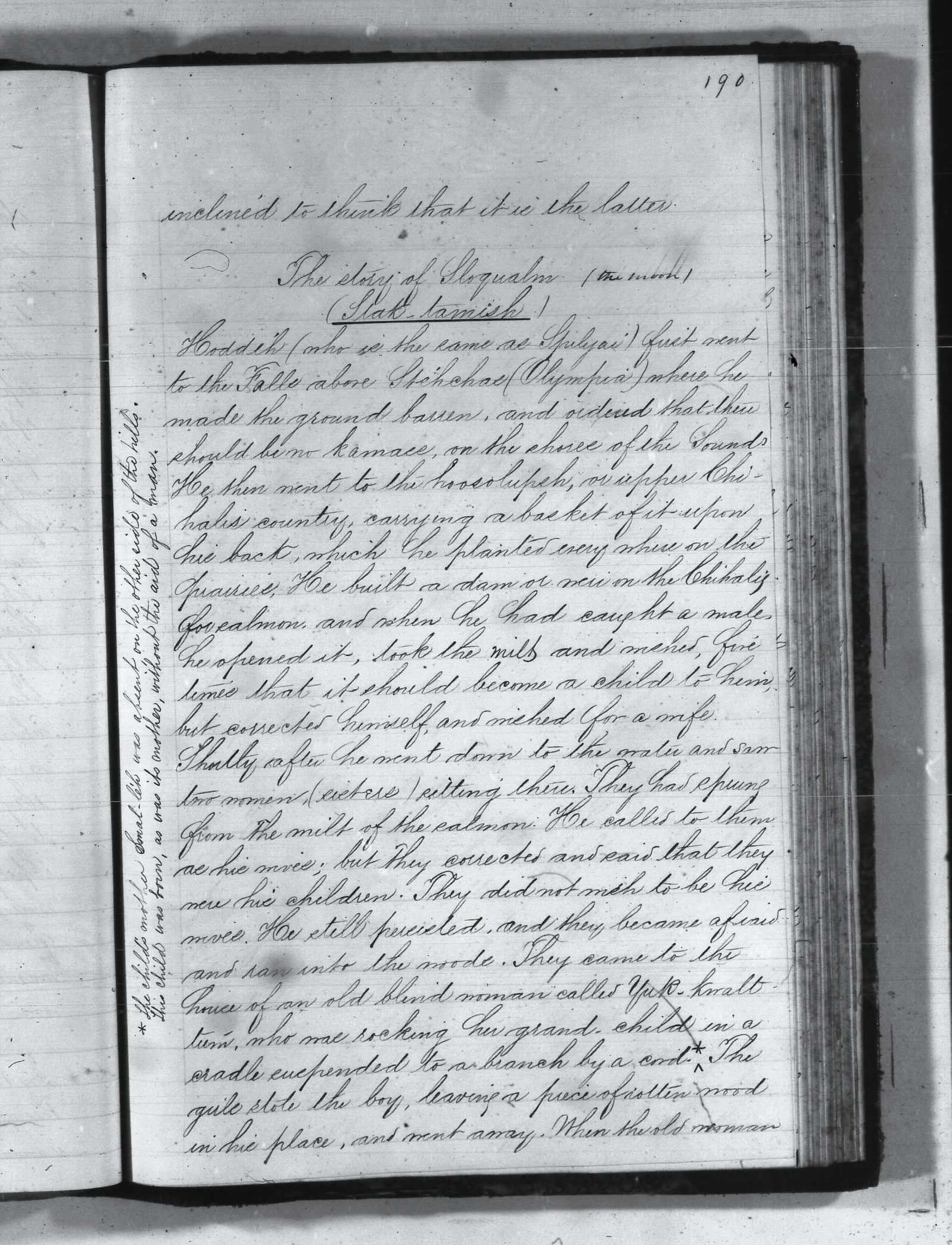
footnote concluded; then TALE, headed "The story of Sloqualm ( the moon )" / "(Stak-tamish.)". Footnote ends: "inclined to think that it is the latter." New titled tale: "Hoddeh (who is the same as Spilyai) first went to the Falls above Stehchas (Olympia) where he made the ground barren, and ordered that there should be no kamass on the shores of the Sound"; he then went to "the hooeolupsh(?), or upper Chihalis country, carrying a basket of it upon his back, which he planted every where on the prairies"; "He built a dam or weir on the Chihalis for salmon," opened a male fish, "took the milt and wished, five times that it should become a child to him, but corrected himself, and wished for a wife"; two women "had sprung from the milt of the salmon," but refused to be his wives, "said that they were his children," and ran into the woods; they reach "the house of an old blind woman called Yuk-kwalt-tum(?)" rocking her grandchild in "a cradle suspended to a branch by a cord," and steal the boy, "leaving a piece of rotten wood in his place." Marginal footnote written vertically down the left edge: "* the childs mother was absent on the other side of the hill. this child was Twin(?), as was the mother, without the aid of a man." No sketch or diagram.
Wisconsin Historical Society, Gibbs Family Papers, U.S. Mss Y, Micro 1117
Reel 2, frames 3838
Reel 2, frame 3838
Read beside the scan
AI first transcription from the evidence pack; not independently verified. Compare with the scan.
inclined to think that it is the latter
The story of Sloqualm[?] (the moon)
(Stak-tamish)
Hoddeh[?] (who is the same as Spilyai) first went
to the Falls above Stéhchass[?] (Olympia) where he
made the ground barren, and ordered that there
should be no kamass, on the shores of the Sound.
He then went to the hoosolupsh[?], or upper Chi-
halis country, carrying a basket of it upon
his back, which he planted every where on the
prairies. He built a dam or weir on the Chihalis
for salmon. and when he had caught a male
he opened it, took the milt and wished, five
times that it should become a child to him,
but corrected himself, and wished for a wife.
Shortly after he went down to the water and saw
two women, (sisters) sitting there. They had sprung
from the milt of the salmon. He called to them
as his wives; but they corrected and said that they
were his children. They did not wish to be his
wives. He still persisted, and they became afraid
and ran into the woods. They came to the
house of an old blind woman called Yuk-kwalt-
tum[?], who was rocking her grand-child in a
cradle suspended to a branch by a cord.^* The
girls stole the boy, leaving a piece of rotten wood
in his place, and went away. When the old woman
[left margin, written vertically:]
* The childs mother Sinat-lik[?] was absent on the other side of the hills.
This child was born, as was its mother, without the aid of a man.
Citation and provenance
Gibbs, G., IV. (1856). [Manuscript volume, ms p. 190]. Gibbs Family Papers, 1763-1918 (U.S. Mss Y, Micro 1117, Reel 2, frame 3838). Wisconsin Historical Society Archives, Madison, WI, United States.
Citation details need editorial review.
Historical sources retain their individual rights and credits. A scan’s presence here does not establish unrestricted reuse.
People identified in the source catalog
These are catalog labels. Individual identities and relationships have not all been reviewed.
Where the book uses this document
No quotation has yet been assigned directly to this catalog record. Its individual frames may have separate connections.