
Wisconsin manuscript
George Gibbs IV (manuscript volume, ms p. 179) · 1856 (Olympia) and later additions
Skookum Sticks; the S'Keena secret society. The sticks may be held by others, whose fingers "become clenched so that they cannot be disengaged unless the exhibitor blows on them", after which they "remain stiff till soaked in warm water"; no number of men can stop the motion, only the operator, "by throwing out his hands, and blowing at the same time". A further kind of tamahnous said to have originated among the Clallams, known chiefly to Indians on Hood's Canal and the western Sound, "or rather to the fraternity in whose breasts its mysteries are deposited"; Gibbs, "Not being initiated", reports it as "variously called S'Keena, S'Kin-hin and S'kehn, heh-nim"; men, women and children are received, chastity not required; the ceremony lasts five days during which "the novitiates are actually dead", and on the fifth day are brought out with a rope around the waist, "raised up by five persons, holding them on their fingers ends".
Wisconsin Historical Society, Gibbs Family Papers, U.S. Mss Y, Micro 1117
Reel 2, frames 3828
Reel 2, frame 3828
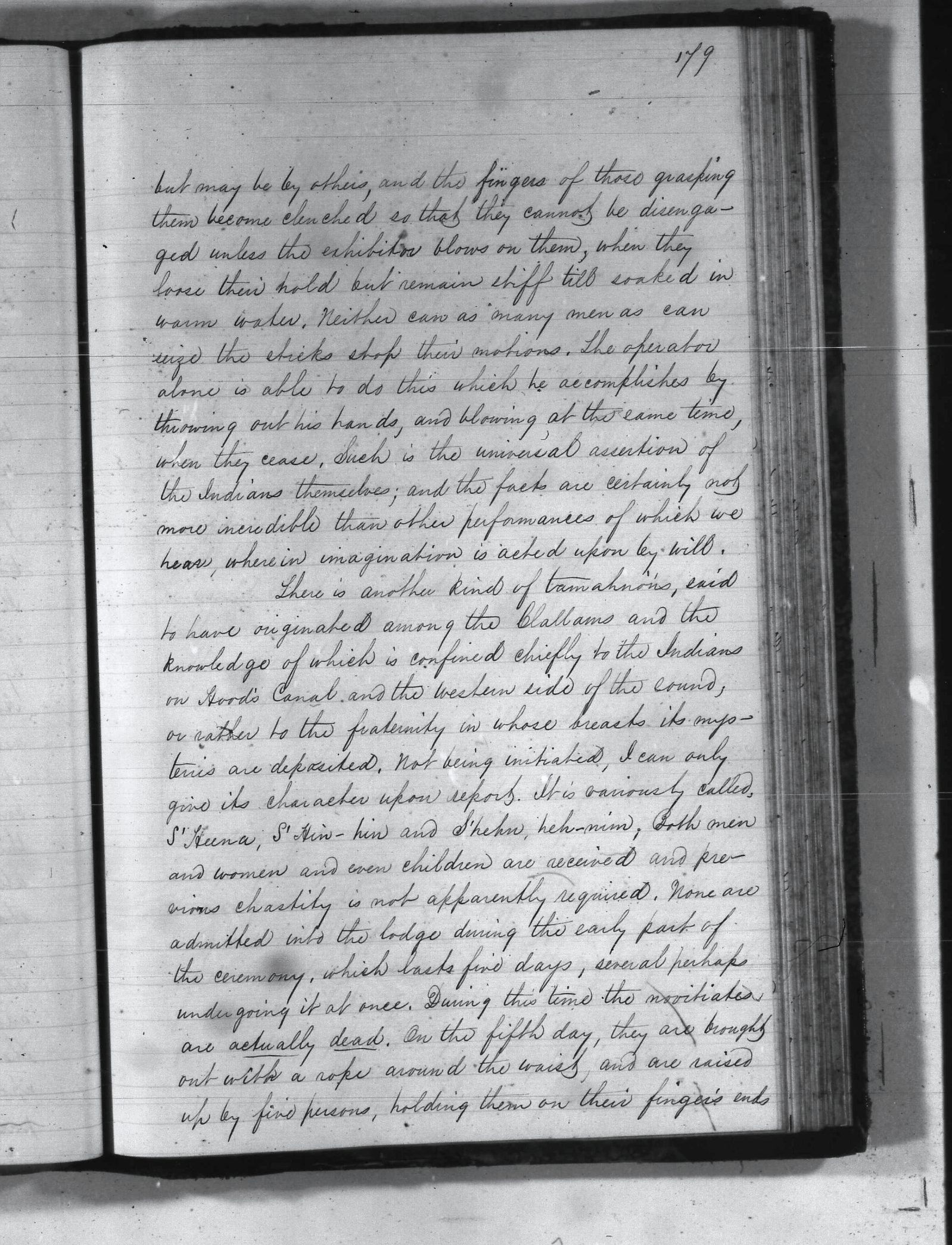
Read beside the scan
AI first transcription from the evidence pack; not independently verified. Compare with the scan.
but may be by others, and the fingers of those grasping
them become clenched so that they cannot be disenga-
ged unless the exhibitor blows on them, when they
loose their hold but remain stiff till soaked in
warm water. Neither can as many men as can
seize the sticks stop their motions. The operator
alone is able to do this which he accomplishes by
throwing out his hands, and blowing at the same time,
when they cease. Such is the universal assertion of
the Indians themselves; and the facts are certainly not
more incredible than other performances of which we
hear, wherein imagination is acted upon by will.
There is another kind of tamahnóus, said
to have originated among the Clallams and the
knowledge of which is confined chiefly to the Indians
on Hood's Canal and the western side of the sound,
or rather to the fraternity in whose breasts its mys-
teries are deposited. Not being initiated, I can only
give its character upon report. It is variously called,
S'Heena[?], S'Hin-hin[?] and S'hehn, heh-nim[?], Both men
and women and even children are received and pre-
vious chastity is not apparently required. None are
admitted into the lodge during the early part of
the ceremony, which lasts five days, several perhaps
undergoing it at once. During this time the novitiates
are _actually_ _dead_. On the fifth day, they are brought
out with a rope around the waist, and are raised
up by five persons, holding them on their fingers ends
Citation and provenance
Gibbs, G., IV. (1856). [Manuscript volume, ms p. 179]. Gibbs Family Papers, 1763-1918 (U.S. Mss Y, Micro 1117, Reel 2, frame 3828). Wisconsin Historical Society Archives, Madison, WI, United States.
Citation details need editorial review.
Historical sources retain their individual rights and credits. A scan’s presence here does not establish unrestricted reuse.
People identified in the source catalog
These are catalog labels. Individual identities and relationships have not all been reviewed.
Where the book uses this document
No quotation has yet been assigned directly to this catalog record. Its individual frames may have separate connections.