
Wisconsin manuscript
George Gibbs IV (manuscript volume, ms p. 169) · 1856 (Olympia) and later additions
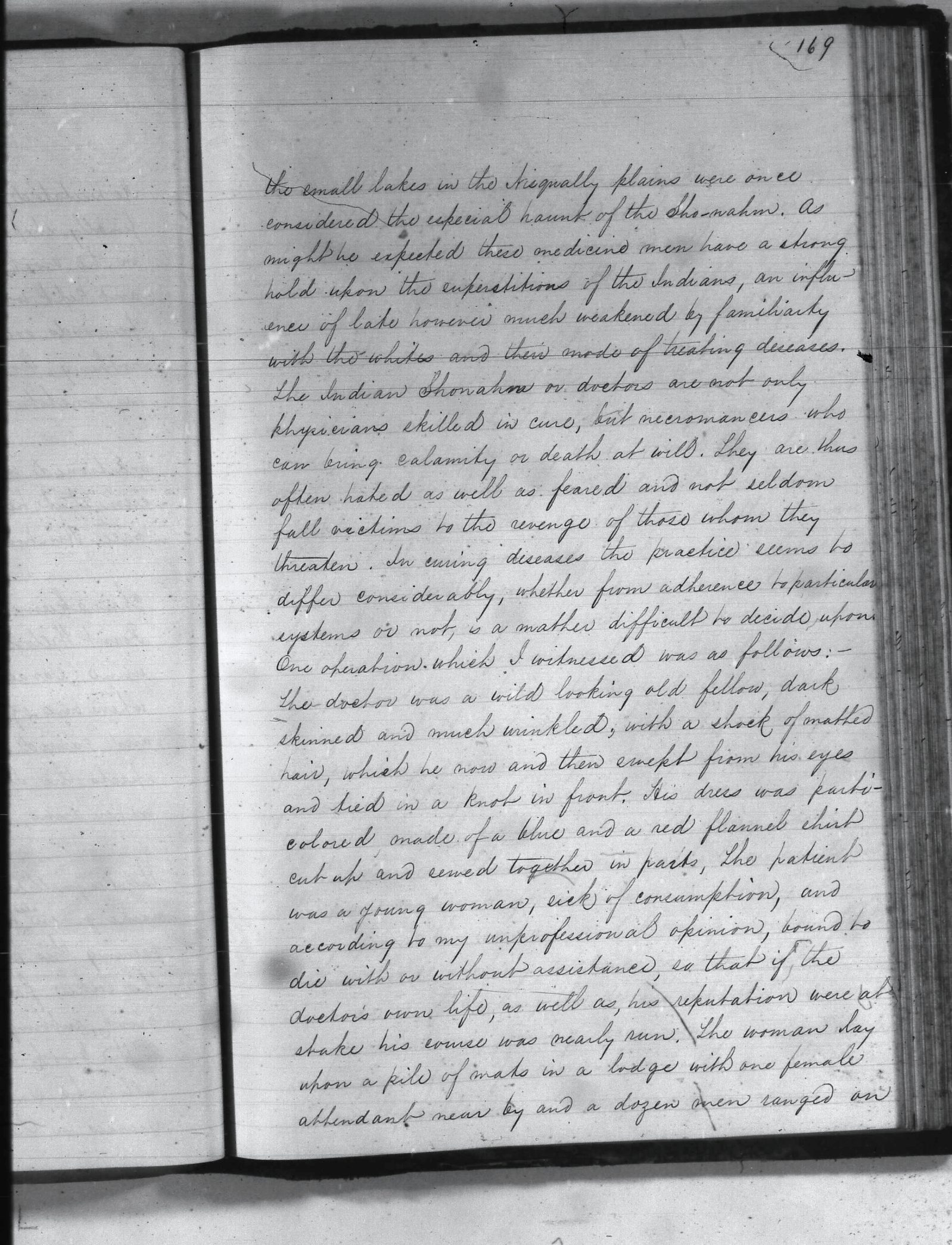
Medicine men and a curing ceremony. "the small lakes in the Nisqually plains" the especial haunt of the Sho-nahm; medicine men's hold weakened by familiarity with the whites; the "Shonahm or doctors are not only physicians skilled in cure, but necromancers who can bring calamity or death at will", hated and feared and sometimes killed. Gibbs's eyewitness account of one operation begins: the doctor "a wild looking old fellow, dark skinned and much wrinkled", hair tied "in a knot in front", dress "parti-colored, made of a blue and a red flannel shirt cut up and sewed together in parts"; the patient a young woman "sick of consumption" lying on a pile of mats with a dozen men ranged about.
Wisconsin Historical Society, Gibbs Family Papers, U.S. Mss Y, Micro 1117
Reel 2, frames 3818
Reel 2, frame 3818
Read beside the scan
AI first transcription from the evidence pack; not independently verified. Compare with the scan.
the small lakes in the Nisqually plains were once
considered the especial haunt of the Sho-wahm[?]. As
might be expected these medicine men have a strong
hold upon the superstitions of the Indians, an influ-
ence of late however much weakened by familiarity
with the whites and their mode of treating diseases.
The Indian Shonahm[?] or doctors are not only
physicians skilled in cure, but necromancers who
can bring calamity or death at will. They are thus
often hated as well as feared and not seldom
fall victims to the revenge of those whom they
threaten. In curing diseases the practice seems to
differ considerably, whether from adherence to particular
systems or not, is a matter difficult to decide, upon.
One operation which I witnessed was as follows:–
The doctor was a wild looking old fellow, dark
skinned and much wrinkled, with a shock of matted
hair, which he now and then swept from his eyes
and tied in a knot in front. His dress was parti-
colored, made of a blue and a red flannel shirt
cut up and sewed together in parts, The patient
was a young woman, sick of consumption, and
according to my unprofessional opinion, bound to
die with or without assistance, so that if, the
doctor's own life, as well as, his reputation were at
stake his course was nearly run. The woman lay
upon a pile of mats in a lodge with one female
attendant near by and a dozen men ranged on
Citation and provenance
Gibbs, G., IV. (1856). [Manuscript volume, ms p. 169]. Gibbs Family Papers, 1763-1918 (U.S. Mss Y, Micro 1117, Reel 2, frame 3818). Wisconsin Historical Society Archives, Madison, WI, United States.
Citation details need editorial review.
Historical sources retain their individual rights and credits. A scan’s presence here does not establish unrestricted reuse.
People identified in the source catalog
These are catalog labels. Individual identities and relationships have not all been reviewed.
Where the book uses this document
No quotation has yet been assigned directly to this catalog record. Its individual frames may have separate connections.