
Wisconsin manuscript
George Gibbs IV (manuscript volume, ms p. 165) · 1856 (Olympia) and later additions
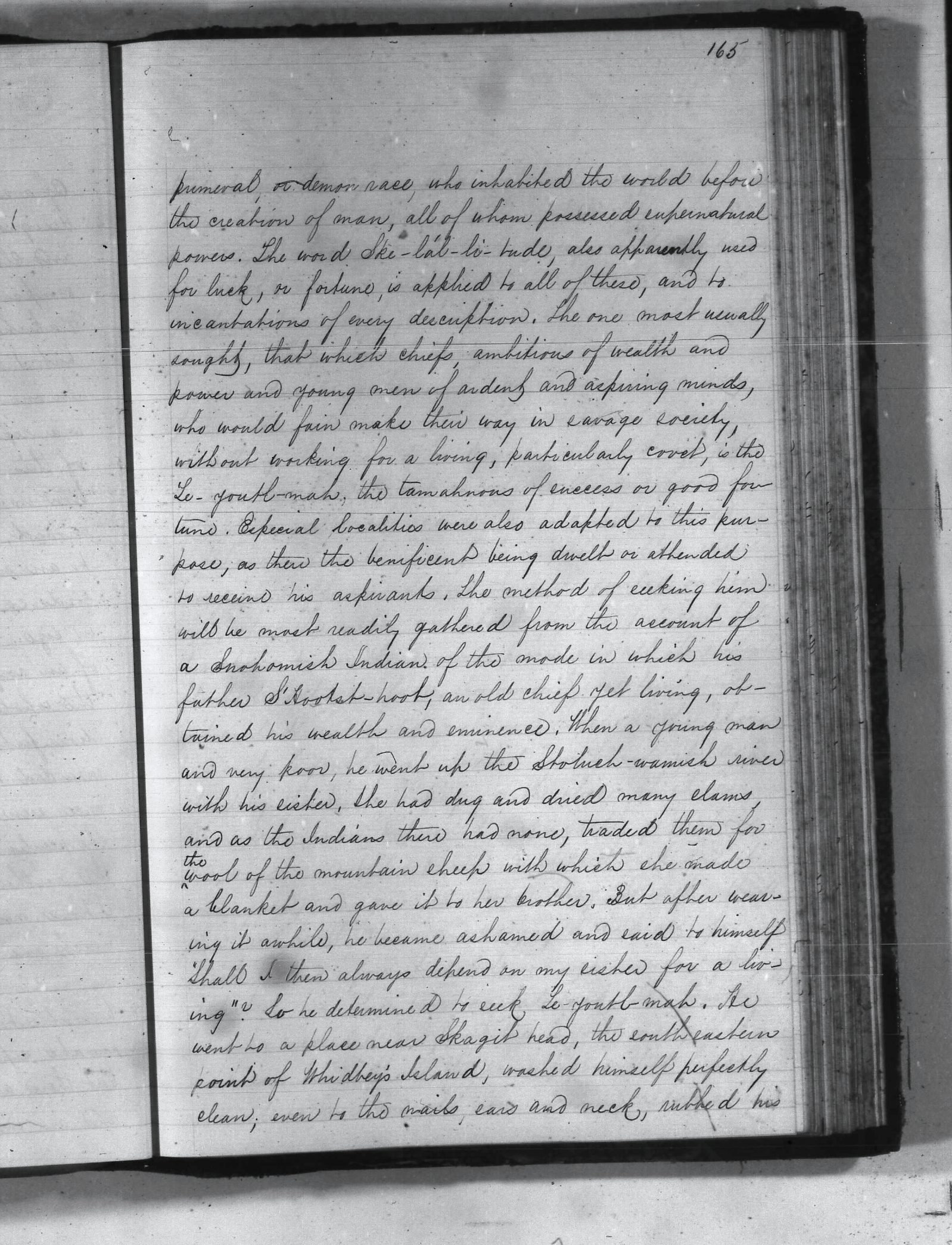
The Samahnous — Skelalitude and Le-youtl-mah. The "primeval, or demon race" preceding man; the word "Ske-lat-li-tude", also used for luck or fortune, applied to all of these and to incantations. The most coveted is "Le-youtl-mah, the tamahnous of success or good fortune". Long narrative from a Snohomish Indian about his father "S'Hootst-hoot, an old chief yet living": as a poor young man he went up "the Stoluch-wamish river" with his sister, who traded dried clams for mountain sheep wool and wove him a blanket; ashamed of dependence he sought Le-youtl-mah at a place near "Skagit head, the south eastern point of Whidbey's Island", washing himself perfectly clean. Named informant and vocabulary terms.
Wisconsin Historical Society, Gibbs Family Papers, U.S. Mss Y, Micro 1117
Reel 2, frames 3814
Reel 2, frame 3814
Read beside the scan
AI first transcription from the evidence pack; not independently verified. Compare with the scan.
primeval, or demon race, who inhabited the world before
the creation of man, all of whom possessed supernatural
powers. The word Ské-láb-lo-tude[?], also apparently used
for luck, or fortune, is applied to all of these, and to
incantations of every description. The one most usually
sought, that which chiefs, ambitious of wealth and
power and young men of ardent and aspiring minds,
who would fain make their way in savage society,
without working for a living, particularly covet, is the
Le-youtl-mah, the tamahnous of success or good for-
tune. Especial localities were also adapted to this pur-
pose, as there the benificent being dwelt or attended
to receive his aspirants. The method of seeking him
will be most readily gathered from the account of
a Snohomish Indian of the mode in which his
father S'hootst-hoot[?], an old chief yet living, ob-
tained his wealth and eminence. When a young man
and very poor, he went up the Stoluch-wamish river
with his sister. She had dug and dried many clams,
and as the Indians there had none, traded them for
[inserted: the] wool of the mountain sheep with which she made
a blanket and gave it to her brother. But after wear-
ing it awhile, he became ashamed and said to himself
"Shall I then always depend on my sister for a liv-
ing"? So he determined to seek Le-youtl-mah. He
went to a place near Skagit head, the south eastern
point of Whidbey's Island, washed himself perfectly
clean, even to the nails, ears and neck, rubbed his
Citation and provenance
Gibbs, G., IV. (1856). [Manuscript volume, ms p. 165]. Gibbs Family Papers, 1763-1918 (U.S. Mss Y, Micro 1117, Reel 2, frame 3814). Wisconsin Historical Society Archives, Madison, WI, United States.
Citation details need editorial review.
Historical sources retain their individual rights and credits. A scan’s presence here does not establish unrestricted reuse.
People identified in the source catalog
These are catalog labels. Individual identities and relationships have not all been reviewed.
Where the book uses this document
No quotation has yet been assigned directly to this catalog record. Its individual frames may have separate connections.