
Wisconsin manuscript
George Gibbs IV (manuscript volume, ms p. 164) · 1856 (Olympia) and later additions
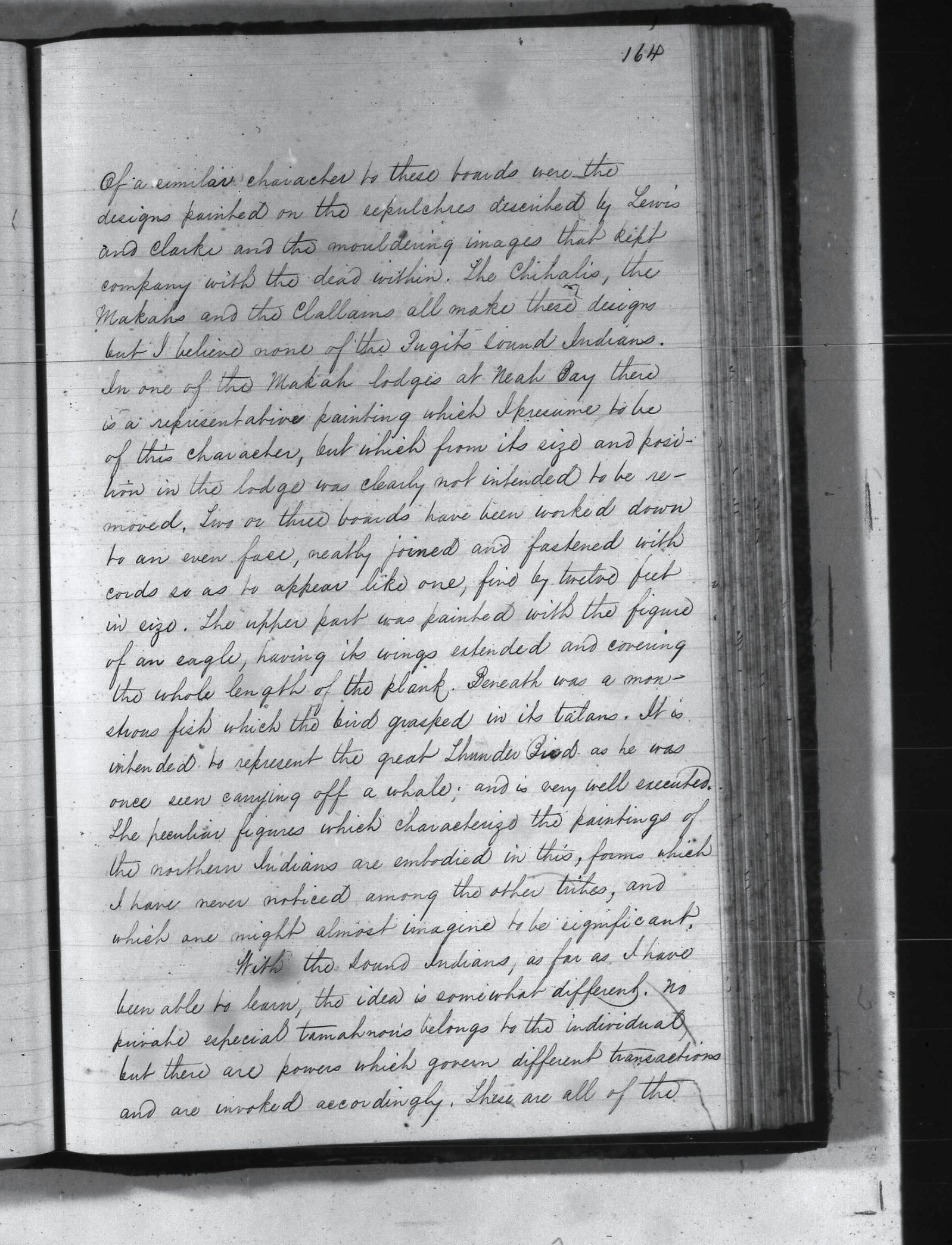
The Samahnous — painted boards, Thunder Bird. Grave designs compared with "the sepulchres described by Lewis and Clarke"; made by "The Chihalis, the Makahs and the Clallams" but not, Gibbs believes, the Puget Sound Indians. Detailed description of a painting in a Makah lodge at Neah Bay: two or three boards worked to an even face, joined with cords, "five by twelve feet in size", the upper part an eagle with wings extended the whole length of the plank, beneath "a monstrous fish which the bird grasped in its talans", intended to represent "the great Thunder Bird as he was once seen carrying off a whale". Northern painting style noted.
Wisconsin Historical Society, Gibbs Family Papers, U.S. Mss Y, Micro 1117
Reel 2, frames 3813
Reel 2, frame 3813
Read beside the scan
AI first transcription from the evidence pack; not independently verified. Compare with the scan.
Of a similar character to these boards were the
designs painted on the sepulchres described by Lewis
and Clarke and the mouldering images that kept
company with the dead within. The Chihalis, the
Makahs and the Clallams all make these designs
but I believe none of the Pugits[?] Sound Indians.
In one of the Makah lodges at Neah Bay there
is a representative painting which I presume to be
of this character, but which from its size and posi-
tion in the lodge was clearly not intended to be re-
moved. Two or three boards have been worked down
to an even face, neatly joined and fastened with
cords so as to appear like one, five by twelve feet
in size. The upper part was painted with the figure
of an eagle, having its wings extended and covering
the whole length of the plank. Beneath was a mon-
strous fish which the bird grasped in its talons[?]. It is
intended to represent the great Thunder Bird as he was
once seen carrying off a whale; and is very well executed.
The peculiar figures which characterize the paintings of
the northern Indians are embodied in this, forms which
I have never noticed among the other tribes, and
which one might almost imagine to be significant.
With the Sound Indians, as far as I have
been able to learn, the idea is somewhat different. No
private especial tamahnous belongs to the individual,
but there are powers which govern different transactions
and are invoked accordingly. These are all of the
Citation and provenance
Gibbs, G., IV. (1856). [Manuscript volume, ms p. 164]. Gibbs Family Papers, 1763-1918 (U.S. Mss Y, Micro 1117, Reel 2, frame 3813). Wisconsin Historical Society Archives, Madison, WI, United States.
Citation details need editorial review.
Historical sources retain their individual rights and credits. A scan’s presence here does not establish unrestricted reuse.
People identified in the source catalog
These are catalog labels. Individual identities and relationships have not all been reviewed.
Where the book uses this document
No quotation has yet been assigned directly to this catalog record. Its individual frames may have separate connections.