
Wisconsin manuscript
George Gibbs IV (manuscript volume, ms p. 156) · 1856 (Olympia) and later additions
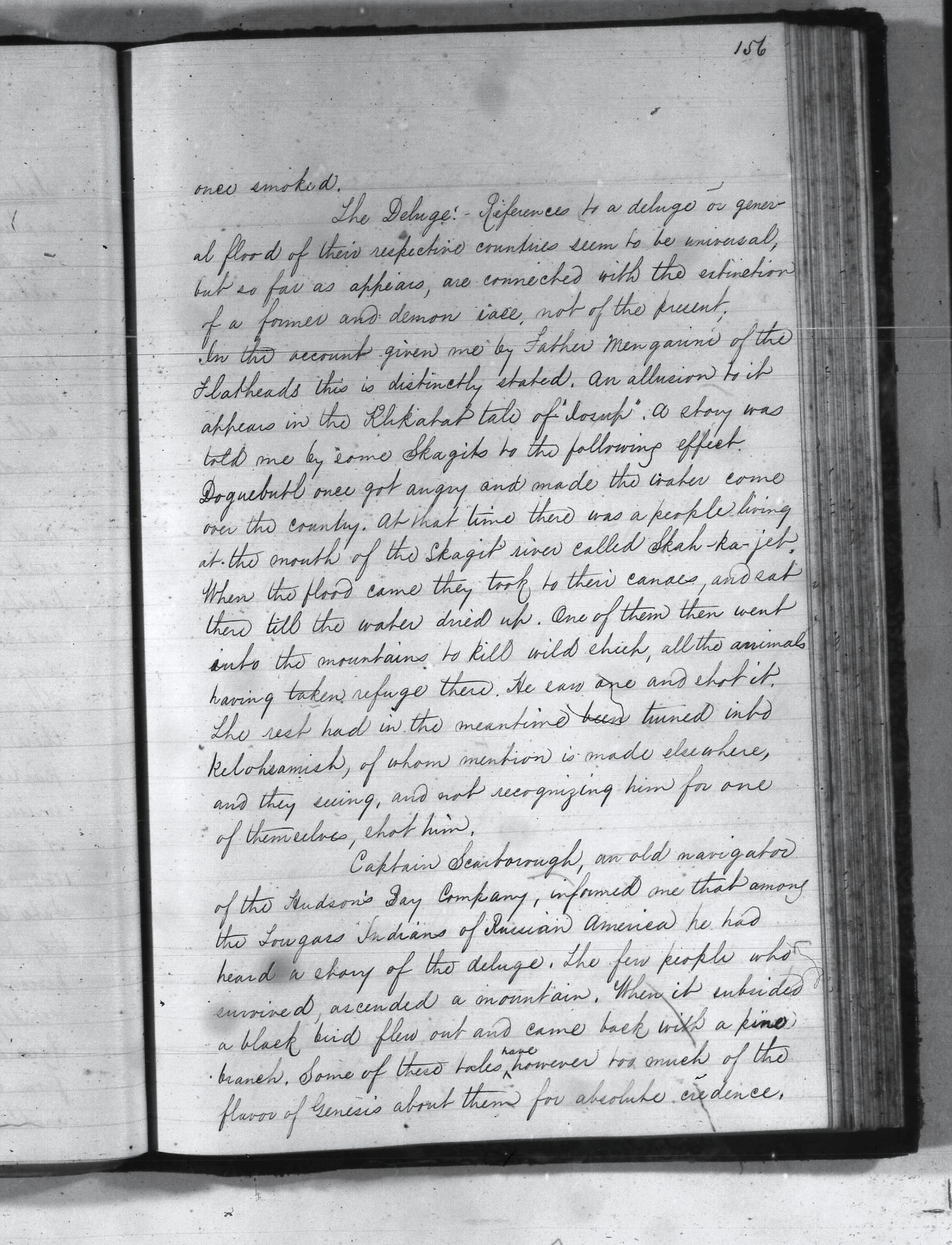
The Deluge (section heading on this page). "once smoked."; new heading "The Deluge:" - "References to a deluge or general flood of their respective countries seem to be universal, but so far as appears, are connected with the extinction of a former and demon race, not of the present"; distinctly stated in Father Mengarini's Flathead account; "An allusion to it appears in the Klikatat tale of 'Iosup(?)'"; Skagit story: "Doquebutl once got angry and made the water come over the country. At that time there was a people living at the mouth of the Skagit river called Skah-ka-jet. When the flood came they took to their canoes, and sat there till the water dried up." One went into the mountains "to kill wild [illegible], all the animals having taken refuge there," and was himself shot by the rest, who "had in the meantime been turned into Kelohsamish, of whom mention is made elsewhere," and did not recognize him; "Captain Scarborough, an old navigator of the Hudson's Bay Company," heard among "the Tongas(?) Indians of Russian America" a deluge story in which survivors ascended a mountain and, when it subsided, "a black bird flew out and came back with a pine branch"; Gibbs's caution: "Some of these tales have however too much of the flavor of Genesis about them for absolute credence." No sketch or diagram.
Wisconsin Historical Society, Gibbs Family Papers, U.S. Mss Y, Micro 1117
Reel 2, frames 3803
Reel 2, frame 3803
Read beside the scan
AI first transcription from the evidence pack; not independently verified. Compare with the scan.
once smoked.
The Deluge:- References to a deluge or gener-
al flood of their respective countries seem to be universal,
but so far as appears, are connected with the extinction
of a former and demon race, not of the present.
In the account given me by Father Mengarini[?] of the
Flatheads this is distinctly stated. An allusion to it
appears in the Klikatat tale of "Iosup"[?]. A story was
told me by some Skagits to the following effect.
Doquebutl once got angry and made the water come
over the country. At that time there was a people living
at the mouth of the Skagit river called Skah-ka-jet.
When the flood came they took to their canoes, and sat
there till the water dried up. One of them then went
into the mountains to kill wild chich[?], all the animals
having taken refuge there. He saw one and shot it.
The rest had in the meantime [struck: been] turned into
Kelohsamish[?], of whom mention is made elsewhere,
and they seeing, and not recognizing him for one
of themselves, shot him.
Captain Scarborough, an old navigator
of the Hudson's Bay Company, informed me that among
the Tougass[?] Indians of Russian America he had
heard a story of the deluge. The few people who
survived, ascended a mountain. When it subsided
a black bird flew out and came back with a pine
branch. Some of these tales [inserted: have] however too much of the
flavor of Genesis about them for absolute credence.
Citation and provenance
Gibbs, G., IV. (1856). [Manuscript volume, ms p. 156]. Gibbs Family Papers, 1763-1918 (U.S. Mss Y, Micro 1117, Reel 2, frame 3803). Wisconsin Historical Society Archives, Madison, WI, United States.
Citation details need editorial review.
Historical sources retain their individual rights and credits. A scan’s presence here does not establish unrestricted reuse.
People identified in the source catalog
These are catalog labels. Individual identities and relationships have not all been reviewed.
Where the book uses this document
No quotation has yet been assigned directly to this catalog record. Its individual frames may have separate connections.