
Wisconsin manuscript
George Gibbs IV (manuscript volume, ms p. 152) · 1856 (Olympia) and later additions
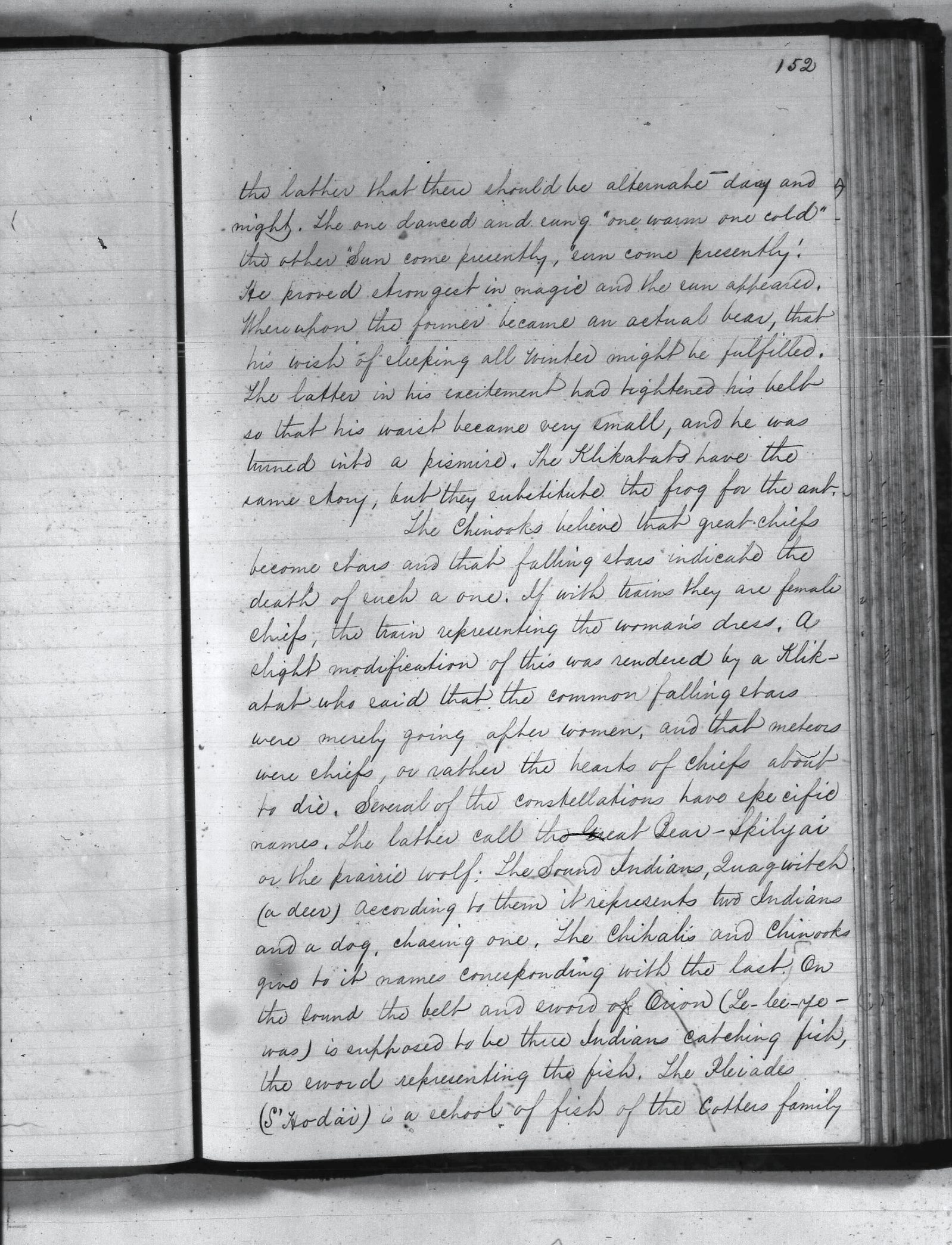
Cosmogony: the bear and the ant; star lore and constellations. The ant wished "that there should be alternate day and night. The one danced and sung 'one warm one cold' the other 'Sun come presently, sun come presently'. He proved strongest in magic and the sun appeared." The bear-wisher "became an actual bear, that his wish of sleeping all winter might be fulfilled," the other tightened his belt in excitement "so that his waist became very small, and he was turned into a pismire. The Klikatats have the same story, but they substitute the frog for the ant."; "The Chinooks believe that great chiefs become stars and that falling stars indicate the death of such a one. If with trains they are female chiefs, the train representing the woman's dress."; a Klikatat said common falling stars "were merely going after women, and that meteors were chiefs, or rather the hearts of chiefs about to die"; constellations: the latter call the Great Bear "Spilyai or the prairie wolf"; "The Sound Indians, Quagwitch (a deer)," representing "two Indians and a dog, chasing one"; Chihalis and Chinooks give corresponding names; on the Sound "the belt and sword of Orion (Le-lee-yo-was) is supposed to be three Indians catching fish, the sword representing the fish"; "The Pleiades (S'Kodai) is a school of fish of the Cottus(?) family." No sketch or diagram.
Wisconsin Historical Society, Gibbs Family Papers, U.S. Mss Y, Micro 1117
Reel 2, frames 3798
Reel 2, frame 3798
Read beside the scan
AI first transcription from the evidence pack; not independently verified. Compare with the scan.
the latter that there should be alternate day and
night. The one danced and sung "one warm one cold" –
the other "Sun come presently, sun come presently."
He proved strongest in magic and the sun appeared.
Whereupon the former became an actual bear, that
his wish of sleeping all winter might be fulfilled.
The latter in his excitement had tightened his belt
so that his waist became very small, and he was
turned into a pismire. The Klikatats have the
same story, but they substitute the frog for the ant.
The Chinooks believe that great chiefs
become stars and that falling stars indicate the
death of such a one. If with trains they are female
chiefs, the train representing the woman's dress. A
slight modification of this was rendered by a Klik-
atat who said that the common falling stars
were merely going after women, and that meteors
were chiefs, or rather the hearts of chiefs about
to die. Several of the constellations have specific
names. The latter call the Great[?] Bear – Spilyai[?]
or the prairie wolf. The Sound Indians, Quaqwitch[?]
(a deer) according to them it represents two Indians
and a dog, chasing one. The Chihalis and Chinooks
give to it names corresponding with the last. On
the Sound the belt and sword of Orion (Le-lee-fo[?]-
was) is supposed to be three Indians catching fish,
the sword representing the fish. The Pleiades
(S'Hodai[?]) is a school of fish of the Cotters[?] family
Citation and provenance
Gibbs, G., IV. (1856). [Manuscript volume, ms p. 152]. Gibbs Family Papers, 1763-1918 (U.S. Mss Y, Micro 1117, Reel 2, frame 3798). Wisconsin Historical Society Archives, Madison, WI, United States.
Citation details need editorial review.
Historical sources retain their individual rights and credits. A scan’s presence here does not establish unrestricted reuse.
People identified in the source catalog
These are catalog labels. Individual identities and relationships have not all been reviewed.
Where the book uses this document
No quotation has yet been assigned directly to this catalog record. Its individual frames may have separate connections.