
Wisconsin manuscript
George Gibbs IV (manuscript volume, ms p. 148) · 1856 (Olympia) and later additions
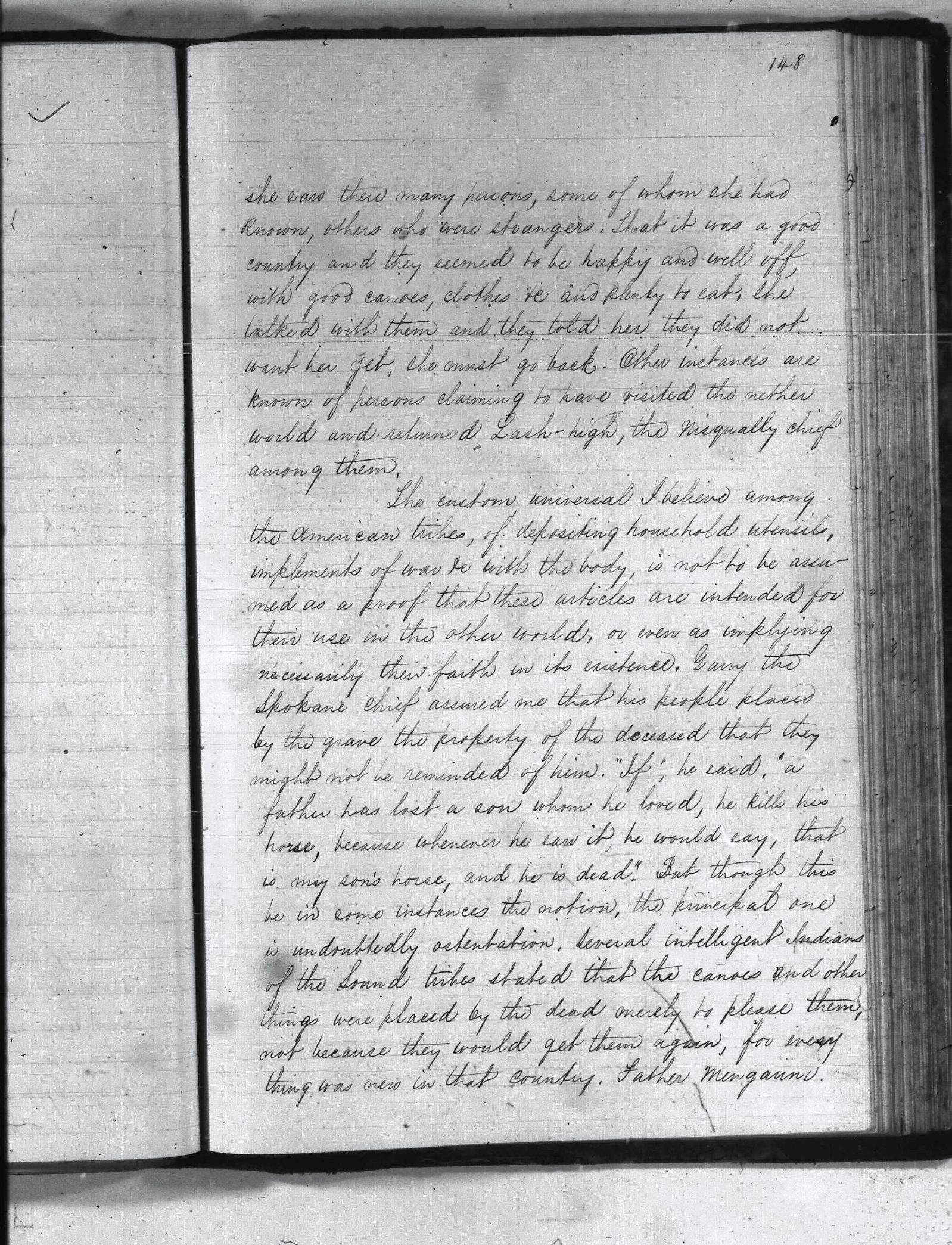
Future state; grave goods. The Astoria woman "saw there many persons, some of whom she had known, others who were strangers. That it was a good country and they seemed to be happy and well off, with good canoes, clothes &c and plenty to eat," but they told her "they did not want her yet, she must go back"; other claimed visits to the nether world, "Lash-high, the Nisqually chief among them"; the universal custom of depositing household utensils and implements of war with the body is not proof they are meant for use in the other world; "Garry the Spokane chief" quoted verbatim: "If", he said, "a father has lost a son whom he loved, he kills his horse, because whenever he saw it, he would say, that is my son's horse, and he is dead."; Gibbs holds the principal motive "is undoubtedly ostentation"; Sound tribes said canoes and other things were placed by the dead "merely to please them, not because they would get them again, for every thing was new in that country"; Father Mengarini named. No sketch or diagram.
Wisconsin Historical Society, Gibbs Family Papers, U.S. Mss Y, Micro 1117
Reel 2, frames 3793
Reel 2, frame 3793
Read beside the scan
AI first transcription from the evidence pack; not independently verified. Compare with the scan.
148
she saw there many persons, some of whom she had
known, others who were strangers. That it was a good
country and they seemed to be happy and well off,
with good canoes, clothes &c and plenty to eat. She
talked with them and they told her they did not
want her yet, she must go back. Other instances are
known of persons claiming to have visited the nether
world and returned, Lash-high[?], the Nisqually chief
among them.
The custom universal I believe among
the american tribes, of depositing household utensils,
implements of war &c with the body, is not to be assu-
med as a proof that these articles are intended for
their use in the other world, or even as implying
necessarily their faith in its existence. Garry[?] the
Spokane chief assured me that his people placed
by the grave the property of the deceased that they
might not be reminded of him. "If", he said, "a
father has lost a son whom he loved, he kills his
horse, because whenever he saw it, he would say, that
is my son's horse, and he is dead". But though this
be in some instances the notion, the principal one
is undoubtedly ostentation. Several intelligent Indians
of the Sound tribes stated that the canoes and other
things were placed by the dead merely to please them,
not because they would get them again, for every
thing was new in that country. Father Mengarini[?]
Citation and provenance
Gibbs, G., IV. (1856). [Manuscript volume, ms p. 148]. Gibbs Family Papers, 1763-1918 (U.S. Mss Y, Micro 1117, Reel 2, frame 3793). Wisconsin Historical Society Archives, Madison, WI, United States.
Citation details need editorial review.
Historical sources retain their individual rights and credits. A scan’s presence here does not establish unrestricted reuse.
People identified in the source catalog
These are catalog labels. Individual identities and relationships have not all been reviewed.
Where the book uses this document
No quotation has yet been assigned directly to this catalog record. Its individual frames may have separate connections.