
Wisconsin manuscript
George Gibbs IV (manuscript volume, ms p. 146) · 1856 (Olympia) and later additions
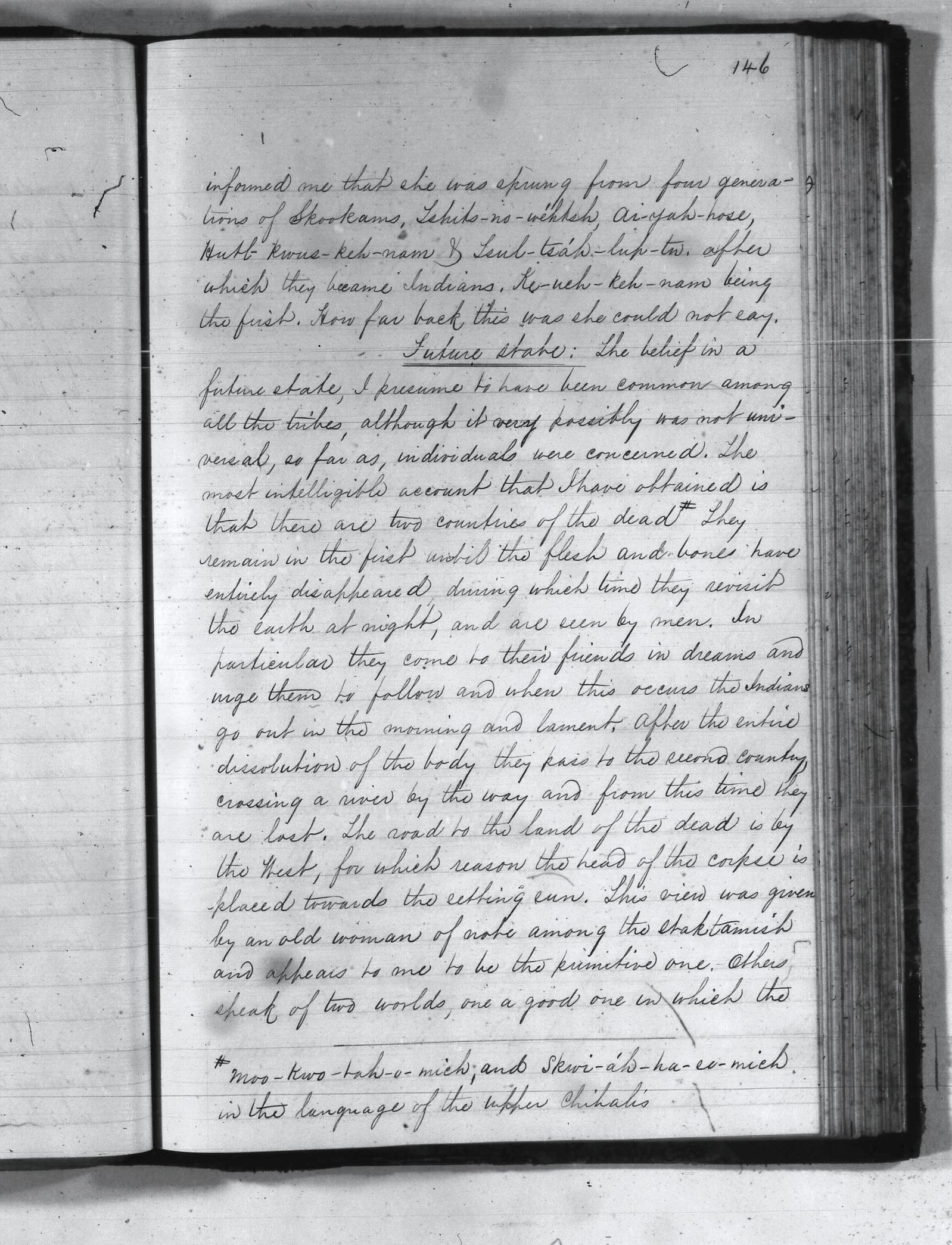
Future state (section heading on this page). The old Nisqually woman "informed me that she was sprung from four generations of Skookams, Tshits-no-wehtsh(?), Ai-yah-hose(?), Hutl-kwus-keh-nam(?) & Tsutl-tsah-lup-tu(?). after which they became Indians. Ke-uch-keh-nam(?) being the first."; new underlined heading "Future state:" - belief presumed common to all tribes; "there are two countries of the dead" (marked with a footnote dagger); the dead remain in the first until flesh and bones disappear, revisiting earth at night, coming "to their friends in dreams and urge them to follow," after which the Indians "go out in the morning and lament"; after dissolution they pass to the second country, "crossing a river by the way and from this time they are lost"; "The road to the land of the dead is by the West, for which reason the head of the corpse is placed towards the setting sun"; view given "by an old woman of note among the Staktamish"; FOOTNOTE at foot of page: "moo-kwo-tah-o-mich, and Skwi-ah-ha-eo-mich. in the language of the upper Chihalis". Footnote is the only marginal matter; no sketch or diagram.
Wisconsin Historical Society, Gibbs Family Papers, U.S. Mss Y, Micro 1117
Reel 2, frames 3791
Reel 2, frame 3791
Read beside the scan
AI first transcription from the evidence pack; not independently verified. Compare with the scan.
informed me that she was sprung from four genera-
tions of Skookams, Tshits-no-wéhtsh, Ai-yah-hose,
Hutt-kwus-keh-nam & Tsub-tsáh-lup-tw[?]. after
which they became Indians. Ke-uch[?]-keh-nam being
the first. How far back this was she could not say.
Future state: The belief in a
future state, I presume to have been common among
all the tribes, although it very possibly was not uni-
versal, so far as, individuals were concerned. The
most intelligible account that I have obtained is
that there are two countries of the dead# They
remain in the first until the flesh and bones have
entirely disappeared, during which time they revisit
the earth at night, and are seen by men. In
particular they come to their friends in dreams and
urge them to follow and when this occurs the Indians
go out in the morning and lament. After the entire
dissolution of the body they pass to the second country,
crossing a river by the way and from this time they
are lost. The road to the land of the dead is by
the West, for which reason the head of the corpse is
placed towards the setting sun. This view was given
by an old woman of note among the Staktamish
and appears to me to be the primitive one. Others
speak of two worlds, one a good one in which the
______________________
# moo-kwo-tah-o-mich, and Skwi-áh-ha-co[?]-mich
in the language of the upper Chihalis
Citation and provenance
Gibbs, G., IV. (1856). [Manuscript volume, ms p. 146]. Gibbs Family Papers, 1763-1918 (U.S. Mss Y, Micro 1117, Reel 2, frame 3791). Wisconsin Historical Society Archives, Madison, WI, United States.
Citation details need editorial review.
Historical sources retain their individual rights and credits. A scan’s presence here does not establish unrestricted reuse.
People identified in the source catalog
These are catalog labels. Individual identities and relationships have not all been reviewed.
Where the book uses this document
No quotation has yet been assigned directly to this catalog record. Its individual frames may have separate connections.