
Wisconsin manuscript
George Gibbs IV (manuscript volume, ms p. 144) · 1856 (Olympia) and later additions
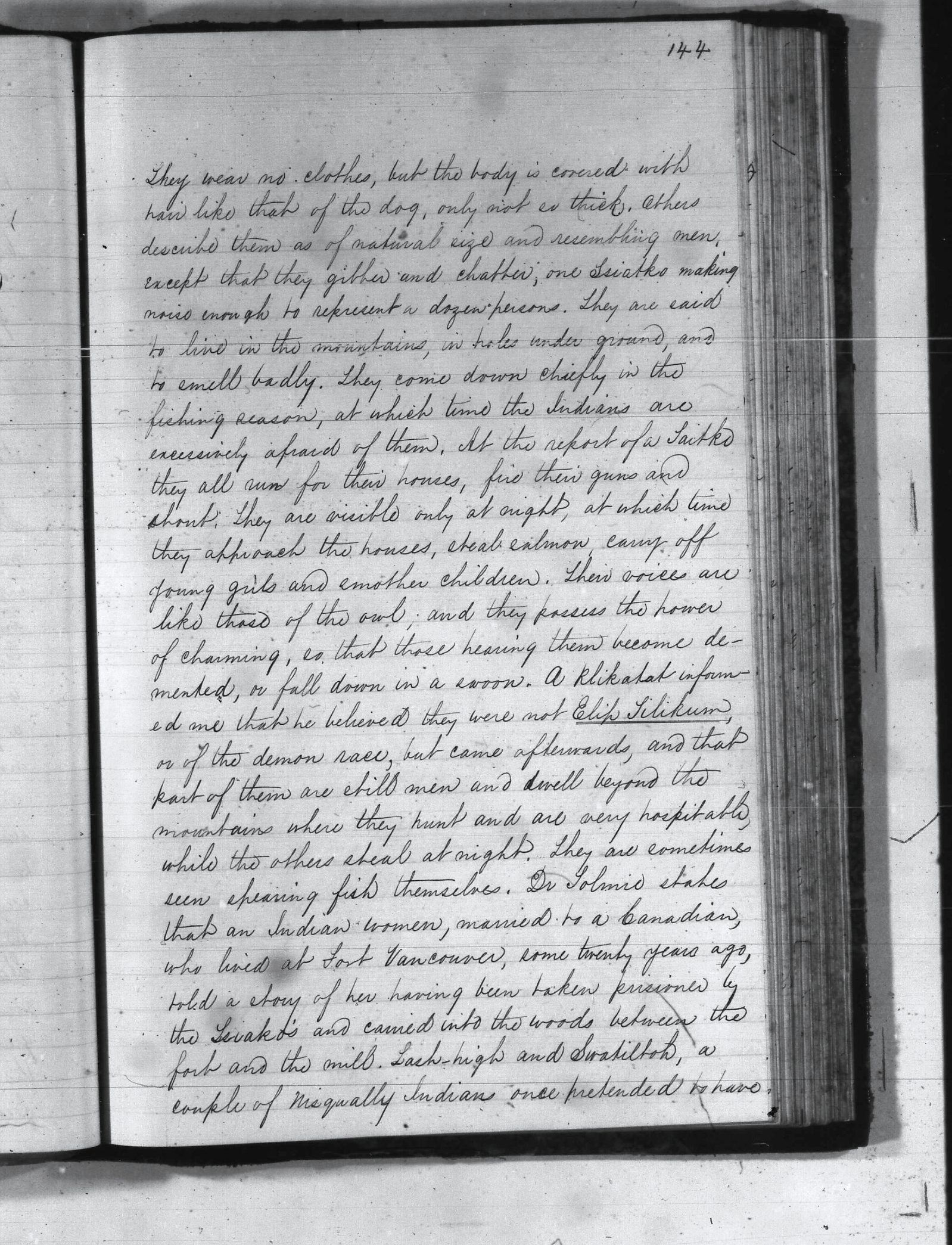
Religion and superstition: the Tsiatko. Tsiatko "wear no clothes, but the body is covered with hair like that of the dog, only not so thick"; others say natural size, resembling men "except that they gibber and chatter, one Tsiatko making noise enough to represent a dozen persons"; live in the mountains "in holes under ground, and to smell badly"; come down in the fishing season, at the report of one "they all run for their houses, fire their guns and shout"; visible only at night, "steal salmon, carry off young girls and smother children"; voices "like those of the owl," possessing "the power of charming, so that those hearing them become demented, or fall down in a swoon"; a Klikatat informant held they were not "Elip Tilikum" (underlined) but came afterwards, part still men dwelling beyond the mountains, hospitable hunters; "Dr Tolmie" states an Indian woman married to a Canadian at Fort Vancouver told of being taken prisoner by the Tsiatkos and carried into the woods between the fort and the mill; "Lash-high and Swatiltoh, a couple of Nisqually Indians" begin the next anecdote. No sketch or diagram.
Wisconsin Historical Society, Gibbs Family Papers, U.S. Mss Y, Micro 1117
Reel 2, frames 3789
Reel 2, frame 3789
Read beside the scan
AI first transcription from the evidence pack; not independently verified. Compare with the scan.
They wear no clothes, but the body is covered with
hair like that of the dog, only not so thick. Others
describe them as of natural size and resembling men,
except that they gibber and chatter; one Tsiatko making
noise enough to represent a dozen persons. They are said
to live in the mountains, in holes under ground, and
to smell badly. They come down chiefly in the
fishing season, at which time the Indians are
excessively afraid of them. At the report of a Tsiatko[?]
they all run for their houses, fire their guns and
shout. They are visible only at night, at which time
they approach the houses, steal salmon, carry off
young girls and smother children. Their voices are
like those of the owl, and they possess the power
of charming, so that those hearing them become de-
mented, or fall down in a swoon. A Klikatat inform-
ed me that he believed they were not Elip Tilikum,
or of the demon race, but came afterwards, and that
part of them are still men and dwell beyond the
mountains where they hunt and are very hospitable,
while the others steal at night. They are sometimes
seen spearing fish themselves. Dr Tolmie states
that an Indian women, married to a Canadian,
who lived at Fort Vancouver, some twenty years ago,
told a story of her having been taken prisoner by
the Tsiatko's[?] and carried into the woods between the
fort and the mill. Lash-high[?] and Swatilton[?], a
couple of Nisqually[?] Indians once pretended to have
Citation and provenance
Gibbs, G., IV. (1856). [Manuscript volume, ms p. 144]. Gibbs Family Papers, 1763-1918 (U.S. Mss Y, Micro 1117, Reel 2, frame 3789). Wisconsin Historical Society Archives, Madison, WI, United States.
Citation details need editorial review.
Historical sources retain their individual rights and credits. A scan’s presence here does not establish unrestricted reuse.
People identified in the source catalog
These are catalog labels. Individual identities and relationships have not all been reviewed.
Where the book uses this document
No quotation has yet been assigned directly to this catalog record. Its individual frames may have separate connections.