
Wisconsin manuscript
George Gibbs IV (manuscript volume, ms p. 143) · 1856 (Olympia) and later additions
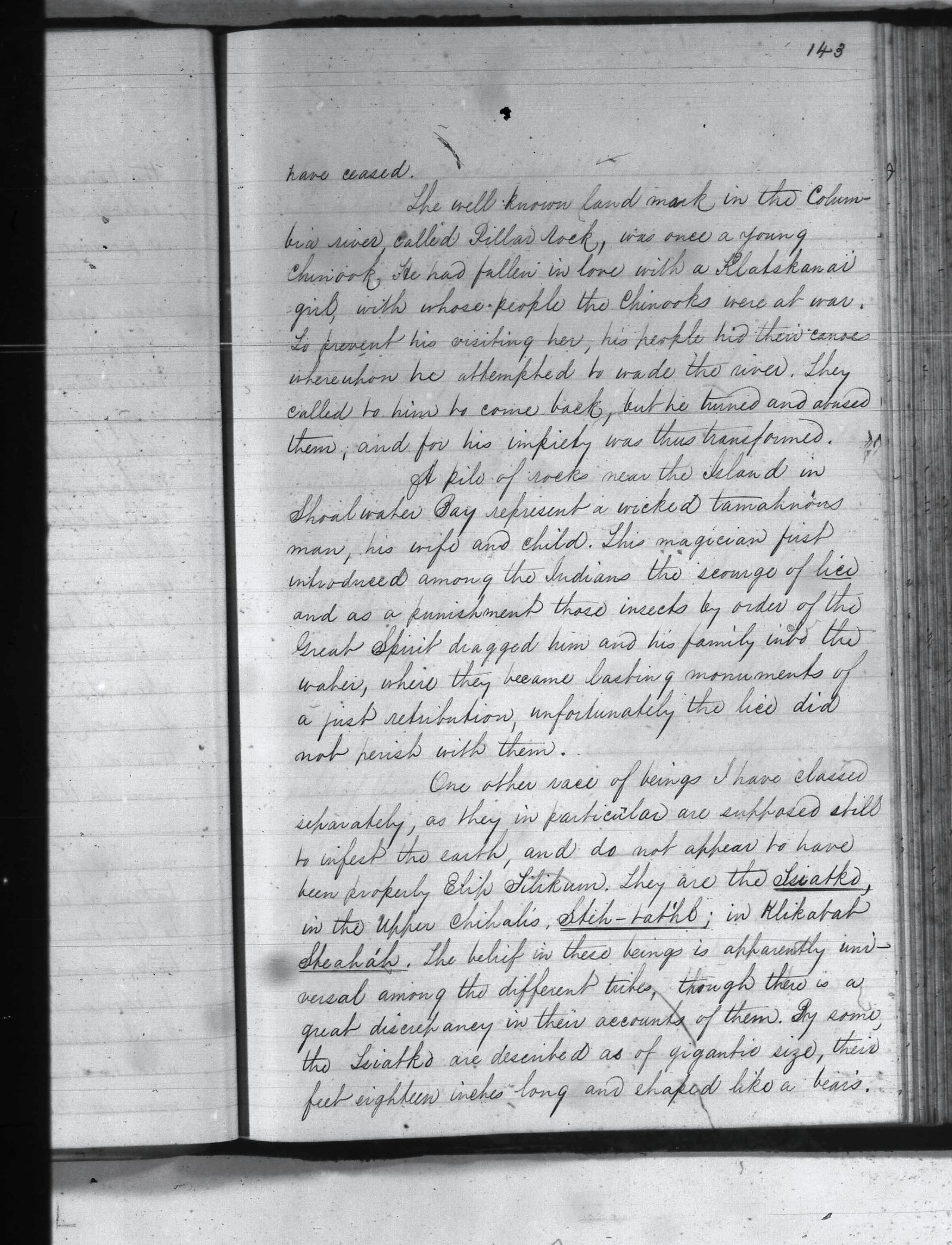
Religion and superstition: transformation rocks; the Tsiatko introduced. "The well known land mark in the Columbia river, called Pillar Rock, was once a young Chinook" who loved "a Klatskanai girl" whose people the Chinooks were at war with; his people hid the canoes, he waded the river, "turned and abused them, and for his impiety was thus transformed"; a pile of rocks near the Island in Shoalwater Bay is "a wicked tamahnous man, his wife and child" - this magician "first introduced among the Indians the scourge of lice" and as punishment the insects dragged him and his family into the water by order of the Great Spirit, "unfortunately the lice did not perish with them"; a race classed separately, not properly "Elip Tilikum": "They are the Tsiatko, in the Upper Chihalis, Steh-tathl; in Klikatat Sheahah" (all three underlined); some describe the Tsiatko "as of gigantic size, their feet eighteen inches long and shaped like a bear's." No sketch or diagram.
Wisconsin Historical Society, Gibbs Family Papers, U.S. Mss Y, Micro 1117
Reel 2, frames 3788
Reel 2, frame 3788
Read beside the scan
AI first transcription from the evidence pack; not independently verified. Compare with the scan.
have ceased.
The well known land mark in the Colum-
bia river, called Pillar rock, was once a young
Chinook. He had fallen in love with a Klatskanai
girl, with whose people the Chinooks were at war.
To prevent his visiting her, his people hid their canoes
whereupon he attempted to wade the river. They
called to him to come back, but he turned and abused
them, and for his impiety was thus transformed.
A pile of rocks near the Island in
Shoalwater Bay represent a wicked tamahnōus[?]
man, his wife and child. This magician first
introduced among the Indians the scourge of lice
and as a punishment those insects by order of the
Great Spirit dragged him and his family into the
water, where they became lasting monuments of
a just retribution, unfortunately the lice did
not perish with them.
One other race of beings I have classed
separately, as they in particular are supposed still
to infest the earth, and do not appear to have
been properly Elip Tilikum. They are the Tsiatko,
in the Upper Chihalis, Stih-tathl[?]; in Klikatat
Sheaháh. The belief in these beings is apparently uni-
versal among the different tribes, though there is a
great discrepancy in their accounts of them. By some,
the Tsiatko are described as of gigantic size, their
feet eighteen inches long and shaped like a bear's.
Citation and provenance
Gibbs, G., IV. (1856). [Manuscript volume, ms p. 143]. Gibbs Family Papers, 1763-1918 (U.S. Mss Y, Micro 1117, Reel 2, frame 3788). Wisconsin Historical Society Archives, Madison, WI, United States.
Citation details need editorial review.
Historical sources retain their individual rights and credits. A scan’s presence here does not establish unrestricted reuse.
People identified in the source catalog
These are catalog labels. Individual identities and relationships have not all been reviewed.
Where the book uses this document
No quotation has yet been assigned directly to this catalog record. Its individual frames may have separate connections.