
Wisconsin manuscript
George Gibbs IV (manuscript volume, ms p. 142) · 1856 (Olympia) and later additions
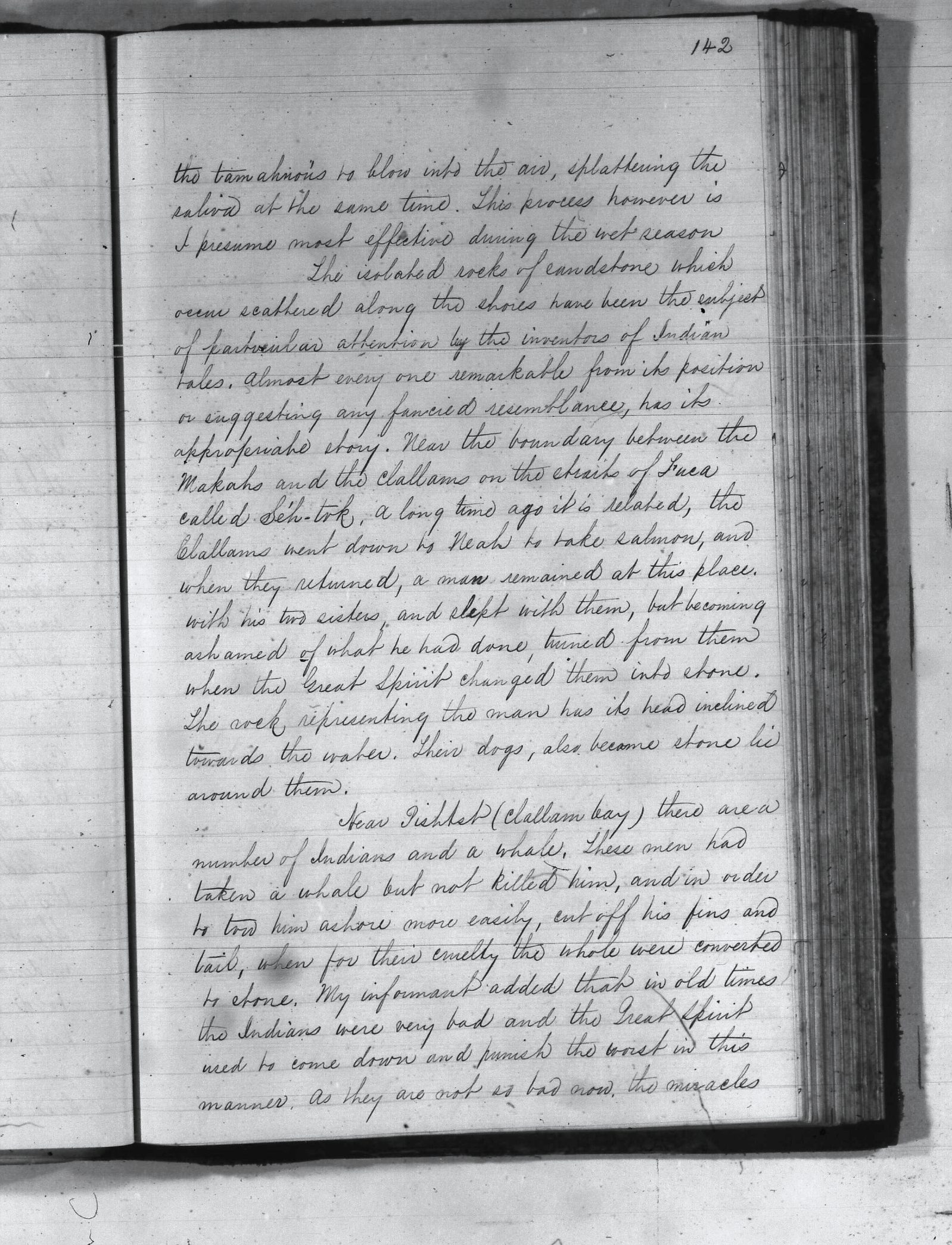
Religion and superstition: transformation rocks of the Strait of Juca. Tamahnous performed by blowing into the air and "splattering the saliva at the same time"; "The isolated rocks of sandstone which occur scattered along the shores have been the subject of particular attention by the inventors of Indian tales"; near the boundary between "the Makahs and the Clallams on the straits of Fuca called Seh-tok," Clallams went down to Neah to take salmon, a man remained with his two sisters and slept with them, "but becoming ashamed of what he had done, turned from them when the Great Spirit changed them into stone"; "The rock representing the man has its head inclined towards the water. Their dogs, also become stone lie around them."; near "Pishtst(?) (Clallam bay)" rocks are Indians and a whale - the men cut off a living whale's fins and tail to tow him ashore "when for their cruelty the whole were converted to stone"; informant added that in old times the Great Spirit came down to punish the worst in this manner. No sketch or diagram.
Wisconsin Historical Society, Gibbs Family Papers, U.S. Mss Y, Micro 1117
Reel 2, frames 3787
Reel 2, frame 3787
Read beside the scan
AI first transcription from the evidence pack; not independently verified. Compare with the scan.
the tamahnous to blow into the air, splattering the
saliva at the same time. This process however is
I presume most effective during the wet season
The isolated rocks of sandstone which
occur scattered along the shores have been the subject
of particular attention by the inventors of Indian
tales. Almost every one remarkable from its position
or suggesting any fancied resemblance, has its
appropriate story. Near the boundary between the
Makahs and the Clallams on the straits of Fuca
called Séh-tok, a long time ago it is related, the
Clallams went down to Neah to take salmon, and
when they returned, a man remained at this place.
with his two sisters, and slept with them, but becoming
ashamed of what he had done, turned from them
when the Great Spirit changed them into stone.
The rock representing the man has its head inclined
towards the water. Their dogs, also became stone lie
around them.
Near Pishtst[?] (Clallam bay) there are a
number of Indians and a whale. These men had
taken a whale but not killed him, and in order
to tow him ashore more easily, cut off his fins and
tail, when for their cruelty the whole were converted
to stone. My informant added that in old times
the Indians were very bad and the Great Spirit
used to come down and punish the worst in this
manner. as they are not so bad now. the miracles
Citation and provenance
Gibbs, G., IV. (1856). [Manuscript volume, ms p. 142]. Gibbs Family Papers, 1763-1918 (U.S. Mss Y, Micro 1117, Reel 2, frame 3787). Wisconsin Historical Society Archives, Madison, WI, United States.
Citation details need editorial review.
Historical sources retain their individual rights and credits. A scan’s presence here does not establish unrestricted reuse.
People identified in the source catalog
These are catalog labels. Individual identities and relationships have not all been reviewed.
Where the book uses this document
No quotation has yet been assigned directly to this catalog record. Its individual frames may have separate connections.