
Wisconsin manuscript
George Gibbs IV (manuscript volume, ms p. 141) · 1856 (Olympia) and later additions
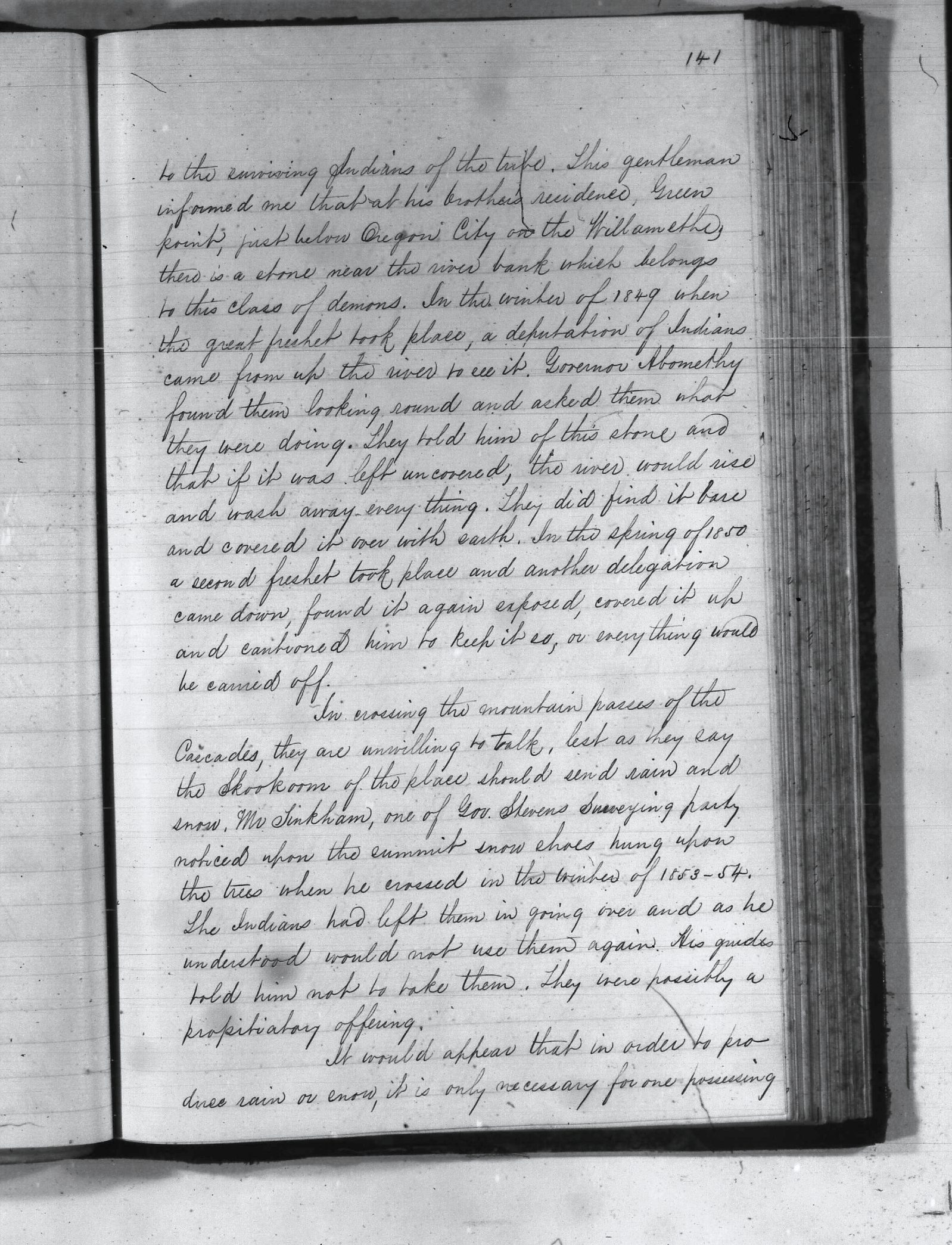
Religion and superstition: weather stones; Cascade passes. Named informant is the brother of Gov. Abernethy: at "Green point, just below Oregon City on the Willamette" a stone by the river bank belongs to the class of demons; "In the winter of 1849 when the great freshet took place, a deputation of Indians came from up the river to see it," told Governor Abernethy that if left uncovered "the river would rise and wash away every thing," found it bare and covered it with earth; a second freshet in the spring of 1850 brought another delegation which re-covered it and cautioned him to keep it so; crossing the Cascade passes Indians "are unwilling to talk, lest as they say the Skookoom of the place should send rain and snow"; "Mr Tinkham, one of Gov. Stevens Surveying party" saw snow shoes hung on trees on the summit in the winter of 1853-54, left by Indians and not to be taken - "They were possibly a propitiatory offering." No sketch or diagram.
Wisconsin Historical Society, Gibbs Family Papers, U.S. Mss Y, Micro 1117
Reel 2, frames 3785
Reel 2, frame 3785
Read beside the scan
AI first transcription from the evidence pack; not independently verified. Compare with the scan.
to the surviving Indians of the tribe. This gentleman
informed me that at his brothers residence, Green
point, just below Oregon City on the Willamette,
there is a stone near the river bank which belongs
to this class of demons. In the winter of 1849 when
the great freshet took place, a deputation of Indians
came from up the river to see it. Governor Abernethy[?]
found them looking round and asked them what
they were doing. They told him of this stone and
that if it was left uncovered, the river would rise
and wash away every thing. They did find it bare
and covered it over with earth. In the spring of 1850
a second freshet took place and another delegation
came down, found it again exposed, covered it up
and cautioned him to keep it so, or everything would
be carried off.
In crossing the mountain passes of the
Cascades, they are unwilling to talk, lest as they say
the Skookoom of the place should send rain and
snow. Mr Tinkham, one of Gov. Stevens Surveying party
noticed upon the summit snow shoes hung upon
the trees when he crossed in the winter of 1853-54.
The Indians had left them in going over and as he
understood would not use them again. His guides
told him not to take them. They were possibly a
propitiatory offering.
It would appear that in order to pro
duce rain or snow, it is only necessary for one possessing
Citation and provenance
Gibbs, G., IV. (1856). [Manuscript volume, ms p. 141]. Gibbs Family Papers, 1763-1918 (U.S. Mss Y, Micro 1117, Reel 2, frame 3785). Wisconsin Historical Society Archives, Madison, WI, United States.
Citation details need editorial review.
Historical sources retain their individual rights and credits. A scan’s presence here does not establish unrestricted reuse.
People identified in the source catalog
These are catalog labels. Individual identities and relationships have not all been reviewed.
Where the book uses this document
No quotation has yet been assigned directly to this catalog record. Its individual frames may have separate connections.