
Wisconsin manuscript
George Gibbs IV (manuscript volume, ms p. 140) · 1856 (Olympia) and later additions
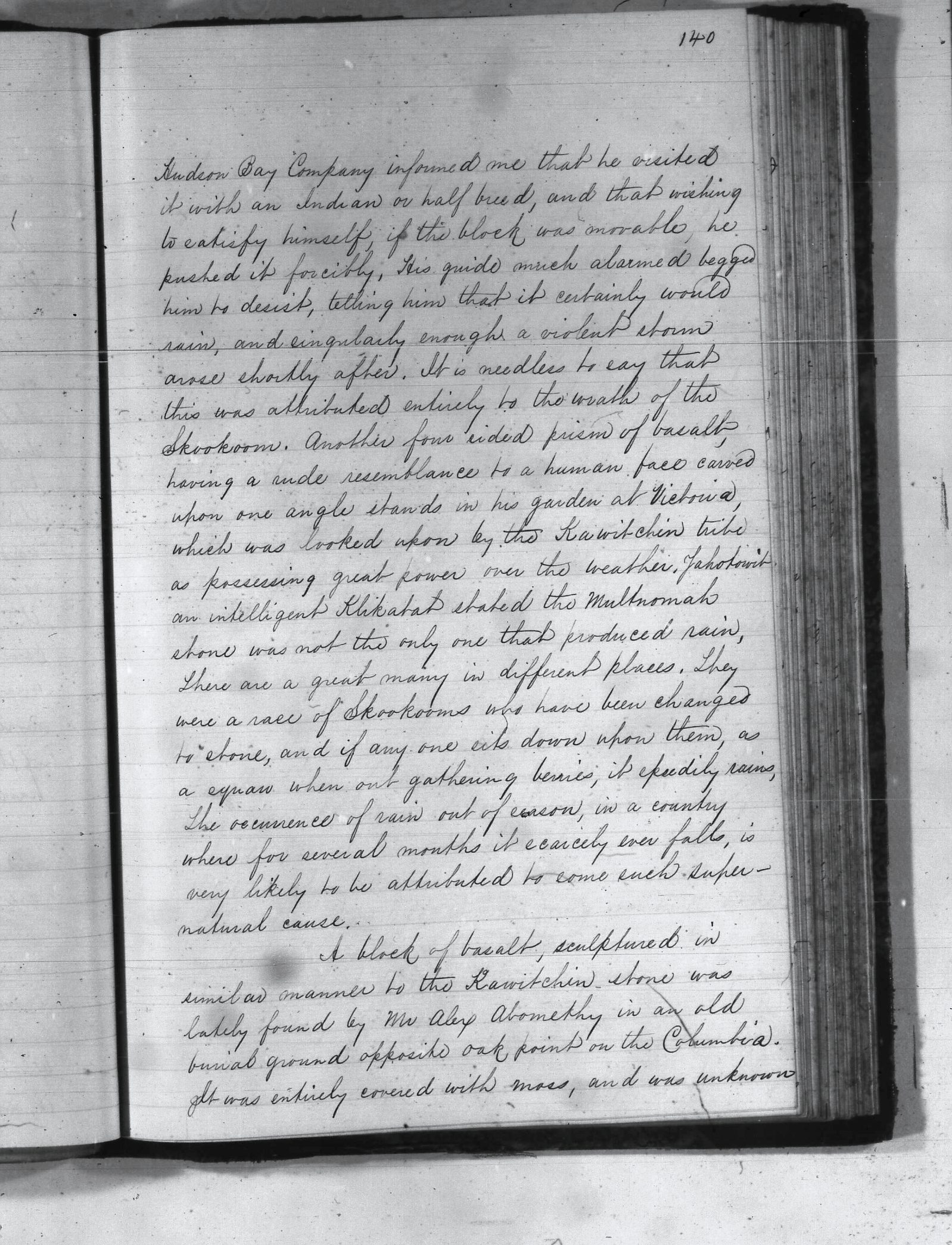
Religion and superstition: weather stones, Skookooms turned to stone. Gov. Douglas of the Hudson Bay Company pushed the Multnomah stone against his half-breed guide's protest and "a violent storm arose shortly after," attributed "entirely to the wrath of the Skookoom"; "Another four sided prism of basalt, having a rude resemblance to a human face carved upon one angle" stands in Douglas's garden at Victoria, held by "the Kawitchin tribe as possessing great power over the weather"; "Jahotowit an intelligent Klikatat" states many such rain-stones exist - "They were a race of Skookooms who have been changed to stone," and if a squaw sits on one while berry-gathering "it speedily rains"; a similarly sculptured basalt block "lately found by Mr Alex Abernethy in an old burial ground opposite Oak Point on the Columbia," covered with moss and unknown to living Indians. No sketch or diagram.
Wisconsin Historical Society, Gibbs Family Papers, U.S. Mss Y, Micro 1117
Reel 2, frames 3784
Reel 2, frame 3784
Read beside the scan
AI first transcription from the evidence pack; not independently verified. Compare with the scan.
Hudson Bay Company informed me that he visited
it with an Indian or half breed, and that wishing
to satisfy himself, if the block was movable, he
pushed it forcibly, His guide much alarmed begged
him to desist, telling him that it certainly would
rain, and singularly enough a violent storm
arose shortly after. It is needless to say that
this was attributed entirely to the wrath of the
Skookoom. Another four sided prism of basalt,
having a rude resemblance to a human face carved
upon one angle stands in his garden at Victoria,
which was looked upon by the Kawitchin tribe
as possessing great power over the weather. Jahotowit[?]
an intelligent Klikatat stated the Multnomah
stone was not the only one that produced rain,
There are a great many in different places. They
were a race of Skookooms who have been changed
to stone, and if any one sits down upon them, as
a squaw when out gathering berries, it speedily rains,
The occurrence of rain out of season, in a country
where for several months it scarcely ever falls, is
very likely to be attributed to some such super-
natural cause.
A block of basalt, sculptured in
similar manner to the Kawitchin stone was
lately found by Mr Alex Abomethy[?] in an old
burial ground opposite oak point on the Columbia.
It was entirely covered with moss, and was unknown
Citation and provenance
Gibbs, G., IV. (1856). [Manuscript volume, ms p. 140]. Gibbs Family Papers, 1763-1918 (U.S. Mss Y, Micro 1117, Reel 2, frame 3784). Wisconsin Historical Society Archives, Madison, WI, United States.
Citation details need editorial review.
Historical sources retain their individual rights and credits. A scan’s presence here does not establish unrestricted reuse.
People identified in the source catalog
These are catalog labels. Individual identities and relationships have not all been reviewed.
Where the book uses this document
No quotation has yet been assigned directly to this catalog record. Its individual frames may have separate connections.