
Wisconsin manuscript
George Gibbs IV (manuscript volume, ms p. 138) · 1856 (Olympia) and later additions
Upper Chehalis tale (from S. S. Ford) — the Tsiah bear at the forks of the Chehalis. Untitled tale: "There was once a lake at the forks of the Chihalis, the neighborhood of which was haunted by a Tsiah or demon, in the shape of an enormous bear", which "devoured all whom it saw"; "a very powerful 'tamahnous' man volunteered", stuck an arrow at the water's edge and "planted arrows in the ground at short distances" along the trail, wounded the bear, then fled, turning to discharge each arrow "still flying"; reaching the water "he plunged in and changed himself to a salmon, of which the lake was full"; the bear "drank it dry, swallowing all the fish"; the man resumed his form and "with a flint knife, cut the bear to pieces severing his heart strings"; all the Indians were summoned to see the monster and skinned him, "so large was his hide that the pieces covered all the prairies around. One ear alone covered Ford's prairie, which contained by survey several sections of land"; "The lake never reappeared but there".
Wisconsin Historical Society, Gibbs Family Papers, U.S. Mss Y, Micro 1117
Reel 2, frames 3782
Reel 2, frame 3782
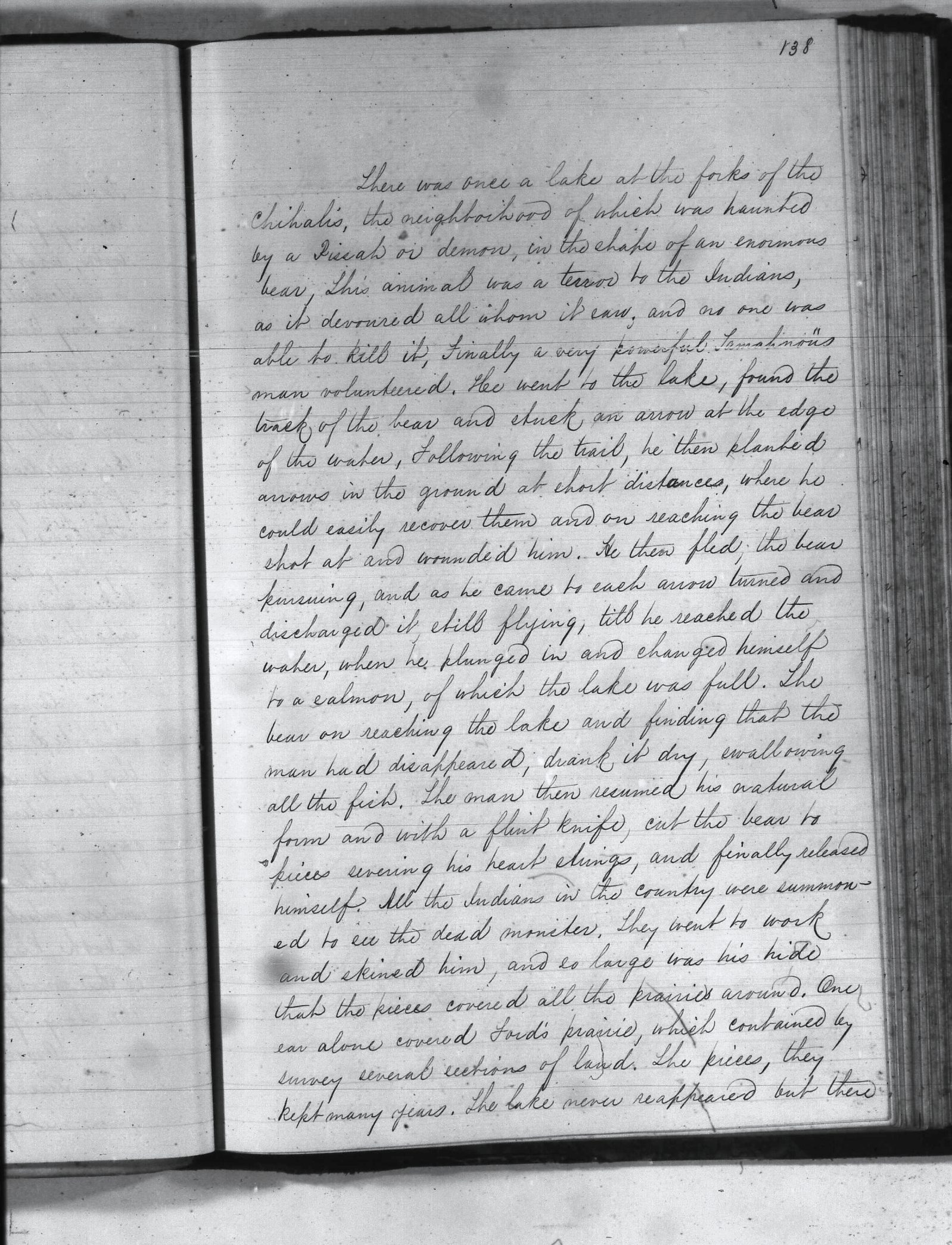
Read beside the scan
AI first transcription from the evidence pack; not independently verified. Compare with the scan.
There was once a lake at the forks of the
Chihalis, the neighborhood of which was haunted
by a Siccah[?] or demon, in the shape of an enormous
bear, This animal was a terror to the Indians,
as it devoured all whom it saw, and no one was
able to kill it; Finally a very powerful Tamahnöus[?]
man volunteered. He went to the lake, found the
track of the bear and stuck an arrow at the edge
of the water, Following the trail, he then planted
arrows in the ground at short distances, where he
could easily recover them and on reaching the bear
shot at and wounded him. He then fled, the bear
pursuing, and as he came to each arrow turned and
discharged it still flying, till he reached the
water, when he plunged in and changed himself
to a salmon, of which the lake was full. The
bear on reaching the lake and finding that the
man had disappeared, drank it dry, swallowing
all the fish. The man then resumed his natural
form and with a flint knife, cut the bear to
pieces severing his heart strings, and finally released
himself. All the Indians in the country were summon-
ed to see the dead monster. They went to work
and skined him, and so large was his hide
that the pieces covered all the prairies around. One
ear alone covered Ford's prairie, which contained by
survey several sections of land. The pieces, they
kept many years. The lake never reappeared but there
Citation and provenance
Gibbs, G., IV. (1856). [Manuscript volume, ms p. 138]. Gibbs Family Papers, 1763-1918 (U.S. Mss Y, Micro 1117, Reel 2, frame 3782). Wisconsin Historical Society Archives, Madison, WI, United States.
Citation details need editorial review.
Historical sources retain their individual rights and credits. A scan’s presence here does not establish unrestricted reuse.
People identified in the source catalog
These are catalog labels. Individual identities and relationships have not all been reviewed.
Where the book uses this document
No quotation has yet been assigned directly to this catalog record. Its individual frames may have separate connections.