
Wisconsin manuscript
George Gibbs IV (manuscript volume, ms p. 129) · 1856 (Olympia) and later additions
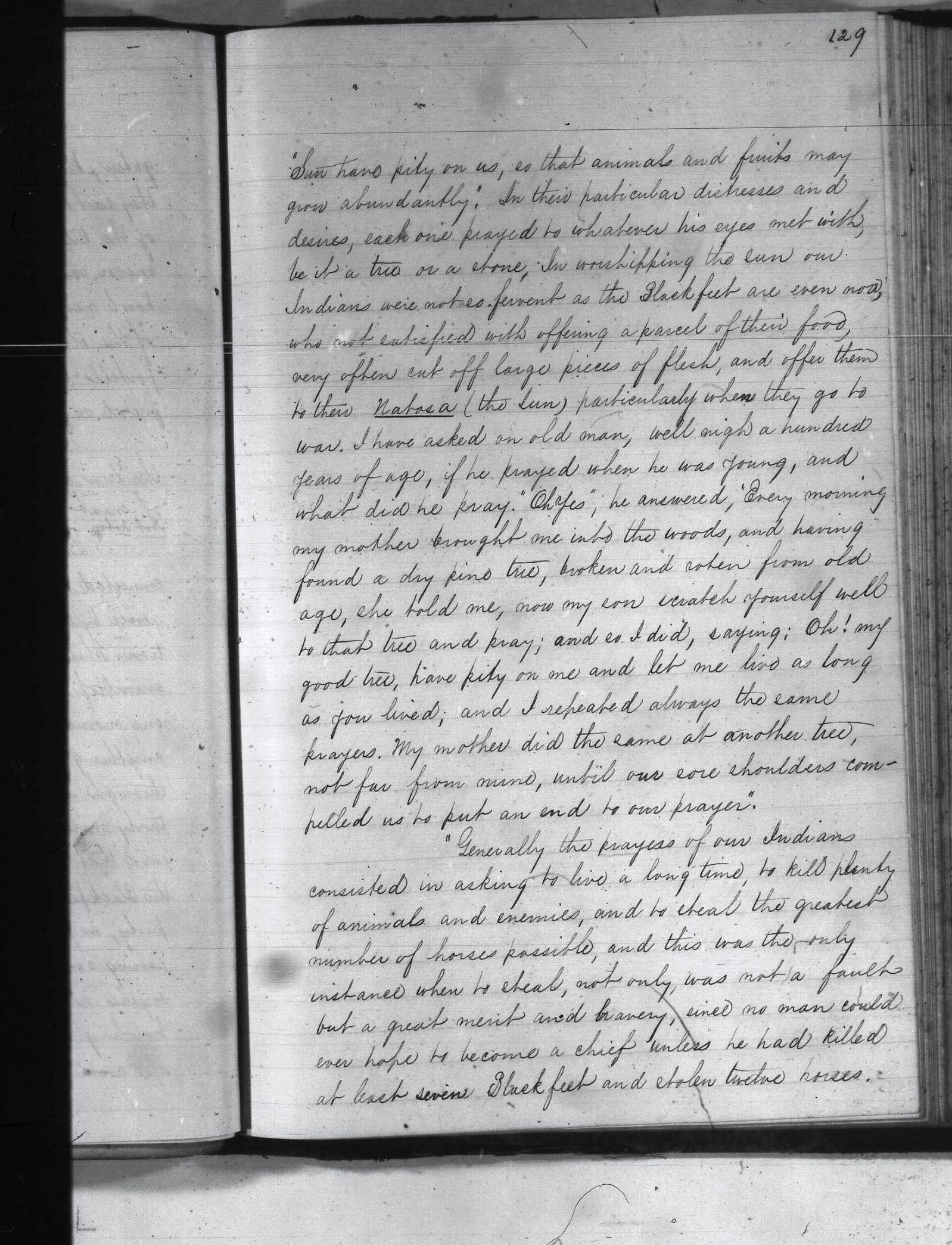
Flathead prayer and worship (Mengarini, quoted) — first of two exposures of this page. Prayer: "Sun have pity on us, so that animals and fruits may grow abundantly"; each prayed "to whatever his eyes met with, be it a tree or a stone"; Blackfeet more fervent, cutting "off large pieces of flesh, and offer them to their Natosa (the sun) particularly when they go to war"; an old man "well nigh a hundred years of age" recounts his mother taking him into the woods to "a dry pine tree, broken and rotten from old age", bidding him "scratch yourself well to that tree and pray", saying "Oh! my good tree, have pity on me and let me live as long as you lived", until "our sore shoulders compelled us to put an end to our prayer"; prayers generally "asking to live a long time, to kill plenty of animals and enemies, and to steal the greatest number of horses possible"; "no man could ever hope to become a chief unless he had killed at least seven Blackfeet and stolen twelve horses". This exposure is skewed and partly shadowed at the left; frame 3773 is a second, cleaner exposure of the identical page.
Wisconsin Historical Society, Gibbs Family Papers, U.S. Mss Y, Micro 1117
Reel 2, frames 3772
Reel 2, frame 3772
Read beside the scan
AI first transcription from the evidence pack; not independently verified. Compare with the scan.
"Sun have pity on us, so that animals and fruits may
grow abundantly". In their particular distresses and
desires, each one prayed to whatever his eyes met with,
be it a tree or a stone, In worshipping the sun our
Indians were not so fervent as the Blackfeet are even now,
who not satisfied with offering a parcel of their food,
very often cut off large pieces of flesh, and offer them
to their Natosa[?] (the sun) particularly when they go to
war. I have asked an old man, well nigh a hundred
years of age, if he prayed when he was young, and
what did he pray. "Oh yes", he answered, "Every morning
my mother brought me into the woods, and having
found a dry pine tree, broken and roten from old
age, she told me, now my son scratch yourself well
to that tree and pray; and so I did, saying: Oh! my
good tree, have pity on me and let me live as long
as you lived; and I repeated always the same
prayers. My mother did the same at another tree,
not far from mine, until our sore shoulders com-
pelled us to put an end to our prayer".
"Generally the prayers of our Indians
consisted in asking to live a long time, to kill plenty
of animals and enemies, and to steal the greatest
number of horses possible, and this was the only
instance when to steal, not only, was not a fault
but a great merit and bravery, since no man could
ever hope to become a chief unless he had killed
at least seven Blackfeet and stolen twelve horses.
Citation and provenance
Gibbs, G., IV. (1856). [Manuscript volume, ms p. 129]. Gibbs Family Papers, 1763-1918 (U.S. Mss Y, Micro 1117, Reel 2, frame 3772). Wisconsin Historical Society Archives, Madison, WI, United States.
Citation details need editorial review.
Historical sources retain their individual rights and credits. A scan’s presence here does not establish unrestricted reuse.
People identified in the source catalog
These are catalog labels. Individual identities and relationships have not all been reviewed.
Where the book uses this document
No quotation has yet been assigned directly to this catalog record. Its individual frames may have separate connections.