
Wisconsin manuscript
George Gibbs IV (manuscript volume, ms p. 121) · 1856 (Olympia) and later additions
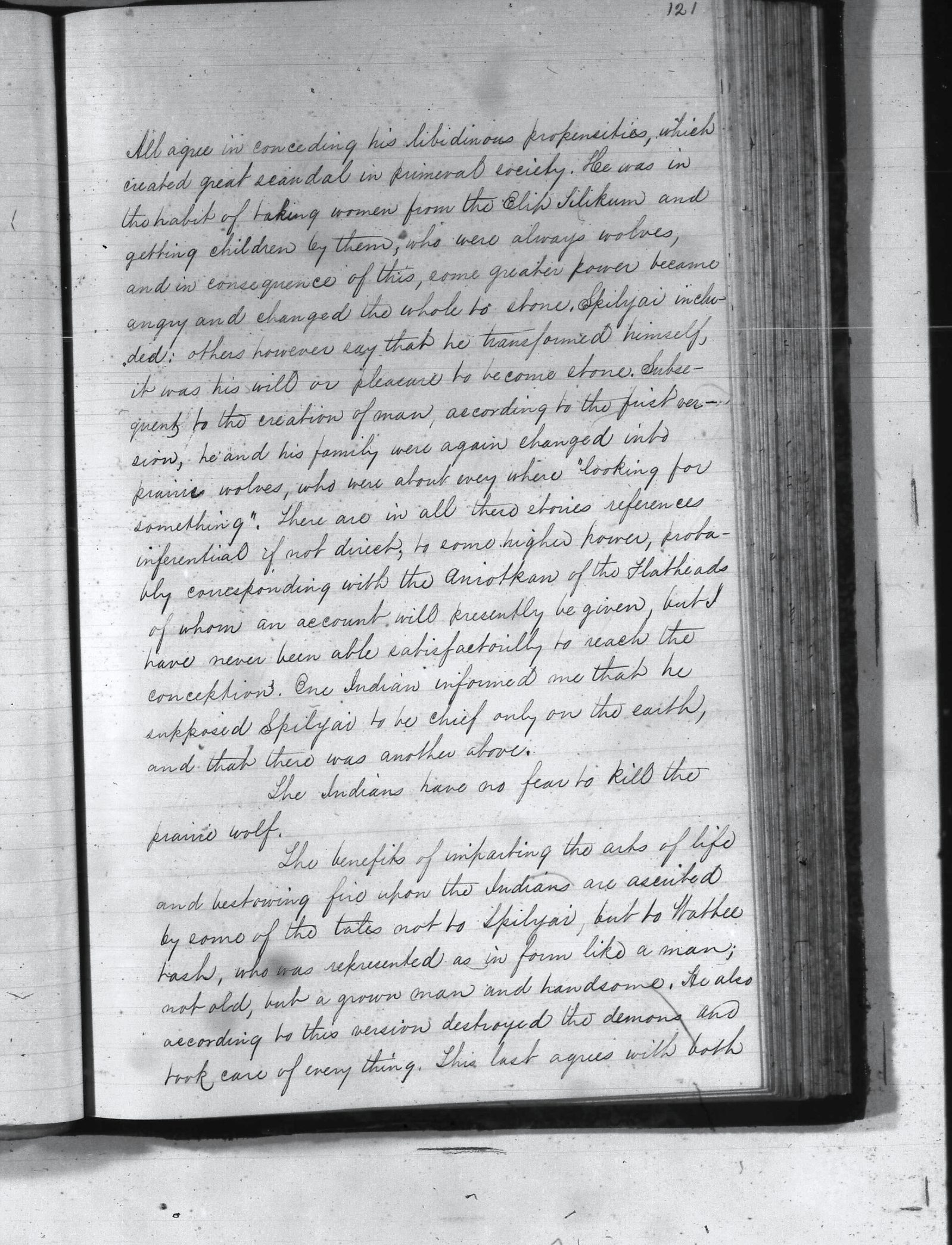
Mythology — Spilyai's vices; Watteetash as culture-hero. "All agree in conceding his libidinous propensities, which created great scandal in primeval society"; took women from the Elip Silikum, "getting children by them, who were always wolves", and a greater power changed the whole to stone, Spilyai included; in another version he and his family were changed into prairie wolves "looking for something"; sees inferential reference to a higher power "probably corresponding with the Aniotkan of the Flatheads"; one Indian "supposed Spilyai to be chief only on the earth, and that there was another above"; "The Indians have no fear to kill the prairie wolf"; some tales ascribe fire and the arts not to Spilyai but to Watteetash, "in form like a man; not old, but a grown man and handsome", who destroyed the demons.
Wisconsin Historical Society, Gibbs Family Papers, U.S. Mss Y, Micro 1117
Reel 2, frames 3764
Reel 2, frame 3764
Read beside the scan
AI first transcription from the evidence pack; not independently verified. Compare with the scan.
All agree in conceding his libidinous propensities, which
created great scandal in primeval society. He was in
the habit of taking women from the Elip Tilikum[?] and
getting children by them, who were always wolves,
and in consequence of this, some greater power became
angry and changed the whole to stone. Spilyai inclu-
ded: others however say that he transformed himself,
it was his will or pleasure to become stone. Subse-
quent to the creation of man, according to the first ver-
sion, he and his family were again changed into
prairie wolves, who were about every where "looking for
something". There are in all these stories references
inferential if not direct, to some higher power, proba-
bly corresponding with the Amotkan[?] of the Flatheads
of whom an account will presently be given, but I
have never been able satisfactorily to reach the
conception. One Indian informed me that he
supposed Spilyai to be chief only on the earth,
and that there was another above.
The Indians have no fear to kill the
prairie wolf.
The benefits of imparting the arts of life
and bestowing fire upon the Indians are ascribed
by some of the tales not to Spilyai, but to Wathee
tash, who was represented as in form like a man;
not old, but a grown man and handsome. He also
according to this version destroyed the demons and
took care of every thing. This last agrees with both
Citation and provenance
Gibbs, G., IV. (1856). [Manuscript volume, ms p. 121]. Gibbs Family Papers, 1763-1918 (U.S. Mss Y, Micro 1117, Reel 2, frame 3764). Wisconsin Historical Society Archives, Madison, WI, United States.
Citation details need editorial review.
Historical sources retain their individual rights and credits. A scan’s presence here does not establish unrestricted reuse.
People identified in the source catalog
These are catalog labels. Individual identities and relationships have not all been reviewed.
Where the book uses this document
No quotation has yet been assigned directly to this catalog record. Its individual frames may have separate connections.