
Wisconsin manuscript
George Gibbs IV (manuscript volume, ms p. 120) · 1856 (Olympia) and later additions
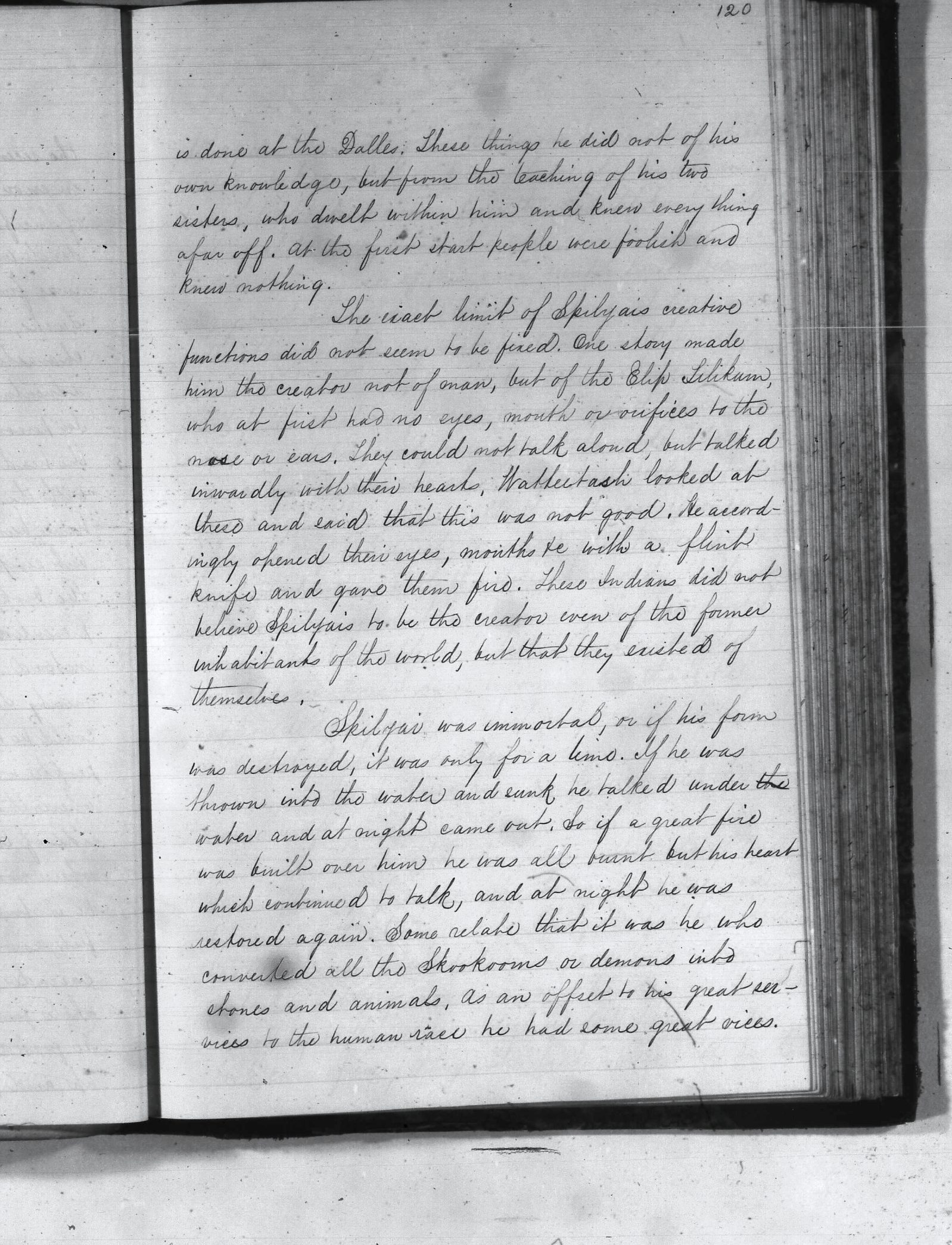
Mythology — Spilyai continued; Watteetash and the Elip Silikum. "is done at the Dalles"; Spilyai acted from "the teaching of his two sisters, who dwelt within him and knew every thing afar off"; "At the first start people were foolish and knew nothing"; one story makes him creator not of man but of the Elip Silikum, who at first "had no eyes, mouth or orifices to the nose or ears" and "talked inwardly with their hearts"; Watteetash opened their eyes and mouths "with a flint knife and gave them fire"; Spilyai immortal — burned or drowned, his heart continued to talk and at night he was restored; some say he converted "all the Skookooms or demons into stones and animals".
Wisconsin Historical Society, Gibbs Family Papers, U.S. Mss Y, Micro 1117
Reel 2, frames 3763
Reel 2, frame 3763
Read beside the scan
AI first transcription from the evidence pack; not independently verified. Compare with the scan.
is done at the Dalles. These things he did not of his
own knowledge, but from the teaching of his two
sisters, who dwelt within him and knew every thing
afar off. At the first start people were foolish and
knew nothing.
The exact limit of Spilyais creative
functions did not seem to be fixed. One story made
him the creator not of man, but of the Elip Tilikum[?],
who at first had no eyes, mouth or orifices to the
nose or ears. They could not talk aloud, but talked
inwardly with their hearts. Watleetash[?] looked at
these and said that this was not good. He accord-
ingly opened their eyes, mouths &c with a flint
knife and gave them fire. These Indians did not
believe Spilyais to be the creator even of the former
inhabitants of the world, but that they existed of
themselves.
Spilyais was immortal, or if his form
was destroyed, it was only for a time. If he was
thrown into the water and sunk he talked under the
water and at night came out. So if a great fire
was built over him he was all burnt but his heart
which continued to talk, and at night he was
restored again. Some relate that it was he who
converted all the Skookooms or demons into
stones and animals. As an offset to his great ser-
vices to the human race he had some great vices.
Citation and provenance
Gibbs, G., IV. (1856). [Manuscript volume, ms p. 120]. Gibbs Family Papers, 1763-1918 (U.S. Mss Y, Micro 1117, Reel 2, frame 3763). Wisconsin Historical Society Archives, Madison, WI, United States.
Citation details need editorial review.
Historical sources retain their individual rights and credits. A scan’s presence here does not establish unrestricted reuse.
People identified in the source catalog
These are catalog labels. Individual identities and relationships have not all been reviewed.
Where the book uses this document
No quotation has yet been assigned directly to this catalog record. Its individual frames may have separate connections.