
Wisconsin manuscript
George Gibbs IV (manuscript volume, ms p. 119) · 1856 (Olympia) and later additions
Mythology — Spilyai (prairie wolf) of the Klikatak. Corrects "the recent translation of Franchere's work" for supposing Ecannum "to be the representation of Lucifer"; likens Spilyai's history to "the German Reinecke Fuchs, than whom he is hardly a more reputable character"; describes him as having "the head of a man past middle age, his hair grizzled, with the body of a prairie wolf"; not creator of the earth in Klikatat ("Seechahm" (?)) but fitted it for man; broke down obstructions blocking salmon and made rapids and cascades so fish could be taken, "presently there would be people who would take fish"; assigned tribes to opposite sides of the falls and ordained where roots should grow; taught fishing modes — "the seine at Chinook, the dip net at the cascades" — first built fishing scaffolds and smoke-houses, and first dried salmon unsmoked, pounding them into "bales covered with rushes".
Wisconsin Historical Society, Gibbs Family Papers, U.S. Mss Y, Micro 1117
Reel 2, frames 3762
Reel 2, frame 3762
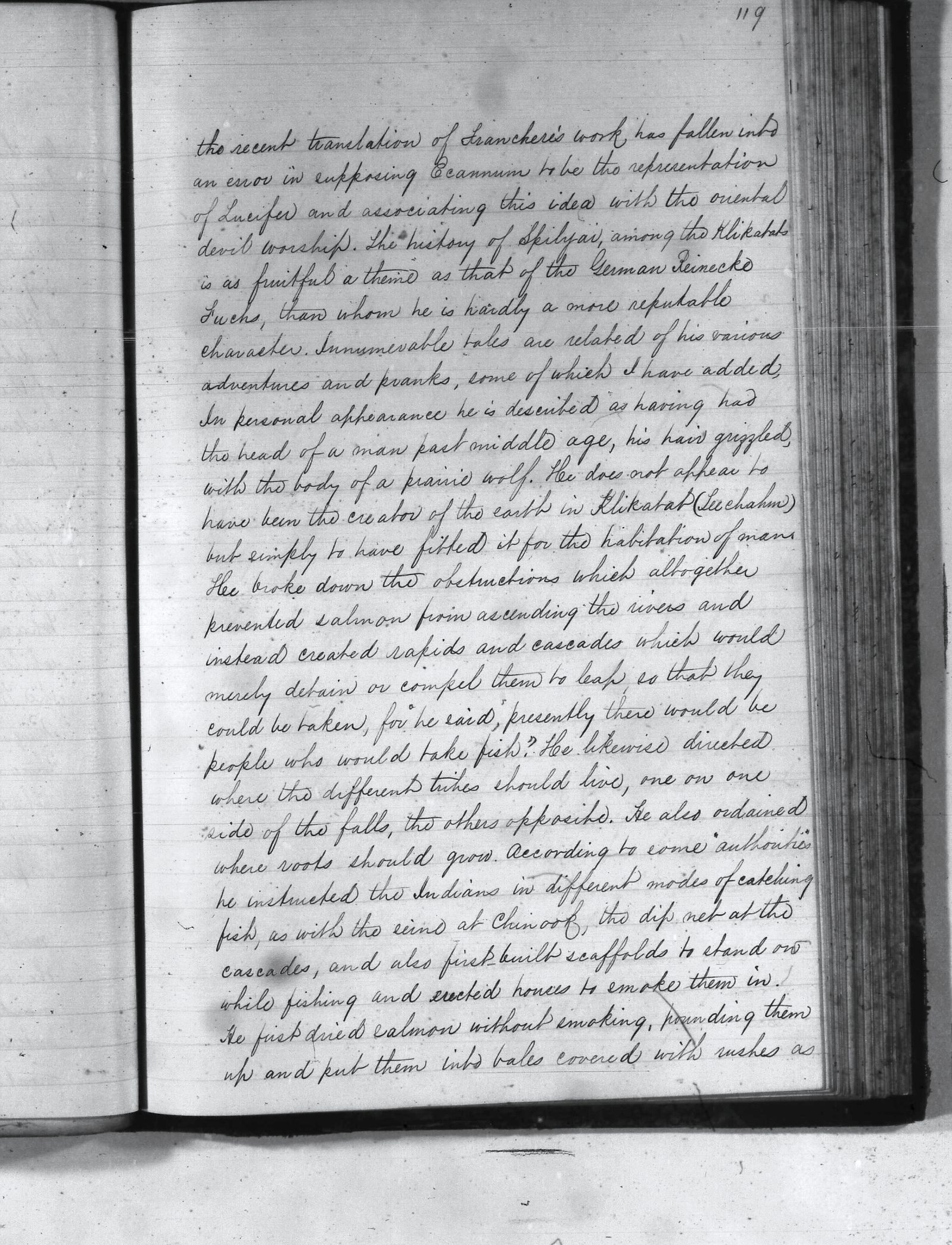
Read beside the scan
AI first transcription from the evidence pack; not independently verified. Compare with the scan.
the recent translation of Franchere's work has fallen into
an error in supposing Ecannum to be the representation
of Lucifer and associating this idea with the oriental
devil worship. The history of Spilyai, among the Klikatats
is as fruitful a theme as that of the German Reinecke
Fuchs, than whom he is hardly a more reputable
character. Innumerable tales are related of his various
adventures and pranks, some of which I have added.
In personal appearance he is described as having had
the head of a man past middle age, his hair grizzled,
with the body of a prairie wolf. He does not appear to
have been the creator of the earth in Klikatat (Tee chahm[?])
but simply to have fitted it for the habitation of man.
He broke down the obstructions which altogether
prevented salmon from ascending the rivers and
instead created rapids and cascades which would
merely detain or compel them to leap, so that they
could be taken, for "he said, presently there would be
people who would take fish". He likewise directed
where the different tribes should live, one on one
side of the falls, the others opposite. He also ordained
where roots should grow. According to some "authorities"
he instructed the Indians in different modes of catching
fish, as with the seine at Chinook, the dip net at the
cascades, and also first built scaffolds to stand on
while fishing and erected houses to smoke them in.
He first dried salmon without smoking, pounding them
up and put them into bales covered with rushes as
Citation and provenance
Gibbs, G., IV. (1856). [Manuscript volume, ms p. 119]. Gibbs Family Papers, 1763-1918 (U.S. Mss Y, Micro 1117, Reel 2, frame 3762). Wisconsin Historical Society Archives, Madison, WI, United States.
Citation details need editorial review.
Historical sources retain their individual rights and credits. A scan’s presence here does not establish unrestricted reuse.
People identified in the source catalog
These are catalog labels. Individual identities and relationships have not all been reviewed.
Where the book uses this document
No quotation has yet been assigned directly to this catalog record. Its individual frames may have separate connections.