
Wisconsin manuscript
George Gibbs IV (manuscript volume, ms p. 107) · 1856 (Olympia) and later additions
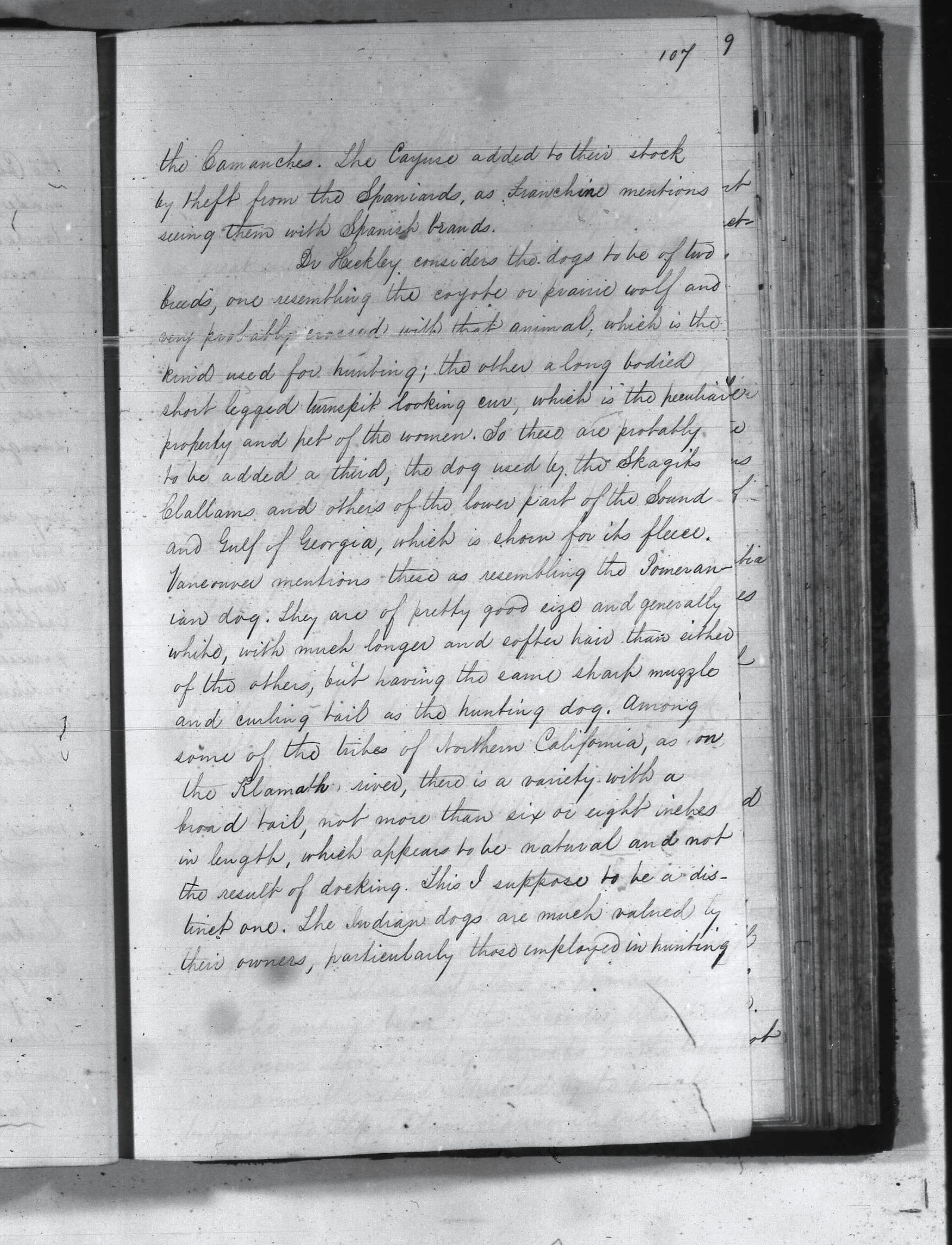
Domestic Animals (horses and dogs). The Cayuse "added to their stock by theft from the Spaniards, as Franchere mentions seeing them with Spanish brands"; "Dr Suckley(?) considers the dogs to be of two breeds, one resembling the coyote or prairie wolf and very probably crossed with that animal, which is the kind used for hunting; the other a long bodied short legged turnspit looking cur, which is the peculiar property and pet of the women"; a probable third, "the dog used by the Skagits Clallams and others of the lower part of the Sound and Gulf of Georgia, which is shorn for its fleece", Vancouver's Pomeranian-like dog, of good size, generally white, longer and softer hair but the same sharp muzzle and curling tail as the hunting dog; among tribes of Northern California, "as on the Klamath river", a variety with a broad tail six or eight inches long "which appears to be natural and not the result of docking", supposed a distinct one; hunting dogs much valued by their owners
Wisconsin Historical Society, Gibbs Family Papers, U.S. Mss Y, Micro 1117
Reel 2, frames 3749
Reel 2, frame 3749
Read beside the scan
AI first transcription from the evidence pack; not independently verified. Compare with the scan.
the Camanches. The Cayuse added to their stock
by theft from the Spaniards, as Franchere[?] mentions
seeing them with Spanish brands.
Dr Suckley[?] considers the dogs to be of two
breeds, one resembling the coyote or prairie wolf and
very probably crossed with that animal, which is the
kind used for hunting; the other a long bodied
short legged turnspit looking cur, which is the peculiar
property and pet of the women. To these are probably
to be added a third, the dog used by the Skagits
Clallams and others of the lower part of the Sound
and Gulf of Georgia, which is shorn for its fleece.
Vancouver mentions these as resembling the Pomeran-
ian dog. They are of pretty good size and generally
white, with much longer and softer hair than either
of the others, but having the same sharp muzzle
and curling tail as the hunting dog. Among
some of the tribes of Northern California, as on
the Klamath river, there is a variety with a
broad tail, not more than six or eight inches
in length, which appears to be natural and not
the result of docking. This I suppose to be a dis-
tinct one. The Indian dogs are much valued by
their owners, particularly those employed in hunting
Citation and provenance
Gibbs, G., IV. (1856). [Manuscript volume, ms p. 107]. Gibbs Family Papers, 1763-1918 (U.S. Mss Y, Micro 1117, Reel 2, frame 3749). Wisconsin Historical Society Archives, Madison, WI, United States.
Citation details need editorial review.
Historical sources retain their individual rights and credits. A scan’s presence here does not establish unrestricted reuse.
People identified in the source catalog
These are catalog labels. Individual identities and relationships have not all been reviewed.
Where the book uses this document
No quotation has yet been assigned directly to this catalog record. Its individual frames may have separate connections.