
Wisconsin manuscript
George Gibbs IV (manuscript volume, ms p. 105) · 1856 (Olympia) and later additions
Clothing, Utensils, &c. (mats, baskets, wooden and horn vessels). "Very pretty capes edged with the sea otter skin"; this tribe (the Makah) "are the principal manufactures of the Cedar mats, which are used on the Sound", entirely of bark formed into narrow strips and woven on the floor, thin and perfectly even in texture; other tribes use two kinds of rushes for mats, "the flat or common cat tail, and the round or tule", used to line their canoes, for beds, coverings for goods, temporary huts; "In fact an Indian's roll of mats is his constant travelling companion"; baskets of "an almost endless variety, many of them beautiful texture, tasteful shape and ornamented with colored figures", some used as pails "and even to boil in being filled with water and heated stones thrown in"; "Cups, dishes and platters were carved from wood by the Makahs in a very neat manner"; large bowls holding over a quart "made from the horns of the big horn sheep, and spoons from that material and those of the mountain goat", probably from the North but traded down the coast "even into California"; nets and seines made from grass imported from beyond [the Cascade Mountains]
Wisconsin Historical Society, Gibbs Family Papers, U.S. Mss Y, Micro 1117
Reel 2, frames 3747
Reel 2, frame 3747
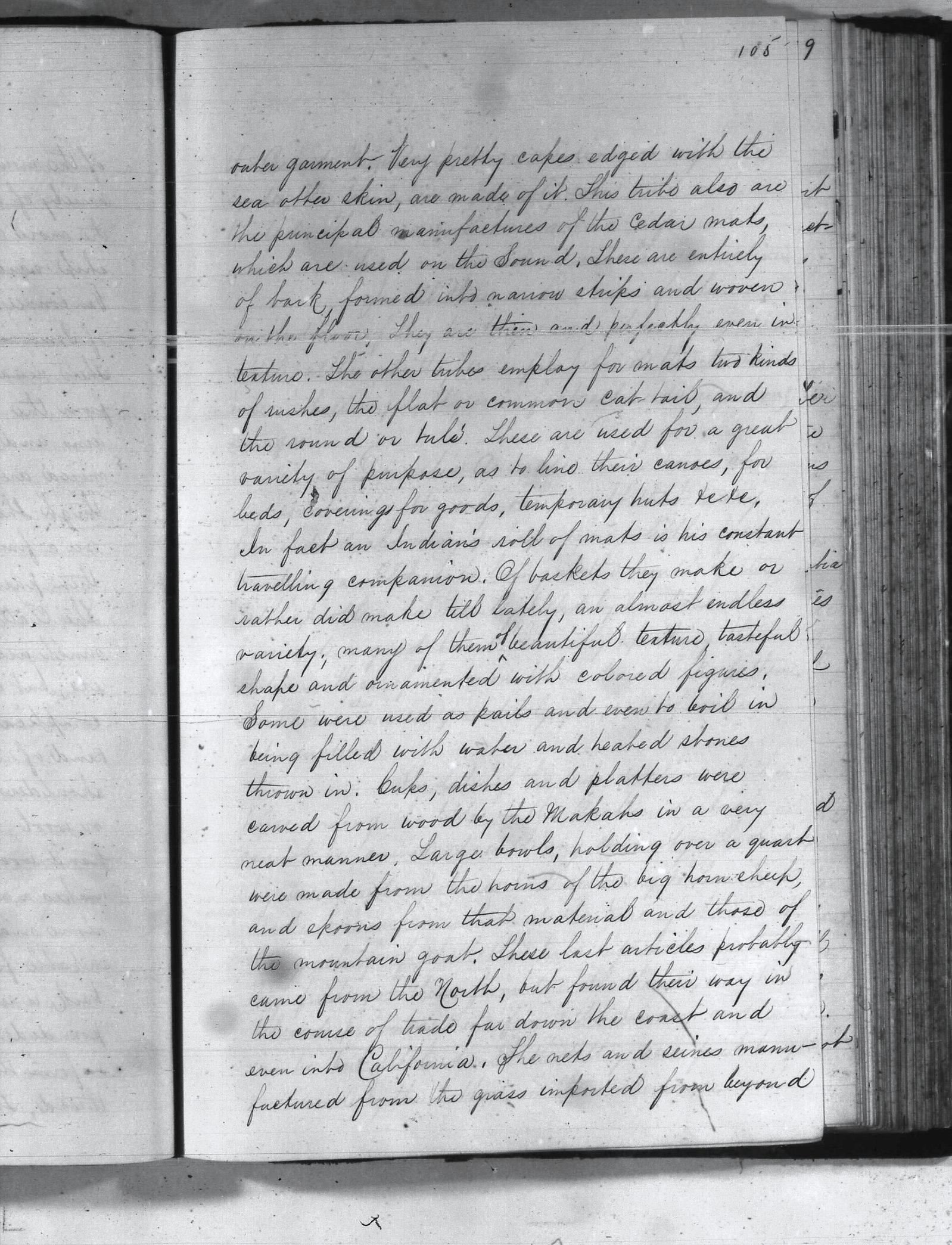
Read beside the scan
AI first transcription from the evidence pack; not independently verified. Compare with the scan.
outer garment. Very pretty capes edged with the
sea otter skin, are made of it. This tribe also are
the principal manufactures of the cedar mats,
which are used on the Sound. These are entirely
of bark, formed into narrow strips and woven
on the floor. They are thin and perfectly even in
texture. The other tribes employ for mats two kinds
of rushes, the flat or common cat-tail, and
the round or tulé. These are used for a great
variety of purpose, as to line their canoes, for
beds, coverings for goods, temporary huts &c &c,
In fact an Indian's roll of mats is his constant
travelling companion. Of baskets they make or
rather did make till lately, an almost endless
variety, many of them [inserted: of][?] beautiful texture, tasteful
shape and ornamented with colored figures.
Some were used as pails and even to boil in
being filled with water and heated stones
thrown in. Cups, dishes and platters were
carved from wood by the Makahs in a very
neat manner. Large bowls, holding over a quart
were made from the horns of the big horn sheep,
and spoons from that material and those of
the mountain goat. These last articles probably
came from the North, but found their way in
the course of trade far down the coast and
even into California. The nets and seines manu-
factured from the grass imported from beyond
Citation and provenance
Gibbs, G., IV. (1856). [Manuscript volume, ms p. 105]. Gibbs Family Papers, 1763-1918 (U.S. Mss Y, Micro 1117, Reel 2, frame 3747). Wisconsin Historical Society Archives, Madison, WI, United States.
Citation details need editorial review.
Historical sources retain their individual rights and credits. A scan’s presence here does not establish unrestricted reuse.
People identified in the source catalog
These are catalog labels. Individual identities and relationships have not all been reviewed.
Where the book uses this document
No quotation has yet been assigned directly to this catalog record. Its individual frames may have separate connections.