
Wisconsin manuscript
George Gibbs IV (manuscript volume, ms p. 103) · 1856 (Olympia) and later additions
Clothing, Utensils, &c.. Skins smoked over green twigs to prevent shrinking or hardening from wet; robes of small animals "such as the rabit, sewellel (aplodontia leporina) muskrat &c., or of large ones as the cougar and beaver"; fur caps; "the most noticeable covering was a broad conical hat, with an inner rim fitting the head, made of a tough grass resembling hemp, which came from the interior. This was made waterproof and painted with figures"; the women "universally wore a breech clout of strouds gathered round the waist and falling nearly to the knees, which served the purpose of concealment. With the men, no idea of modesty existed. Decency had not even its figleaf."; the clout sometimes of twisted grass, at others "of cedar bark, hackled and split into a fringe"; white dress now adopted except in remote districts or among old people, so that one rarely sees "this pristine type of the petticoat" - quoted as "A garment of a mystical sublimity"; the Indians of the Sound and the Straits of Fuca skilled in making "a species of blanket from a mixture of the wool"
Wisconsin Historical Society, Gibbs Family Papers, U.S. Mss Y, Micro 1117
Reel 2, frames 3745
Reel 2, frame 3745
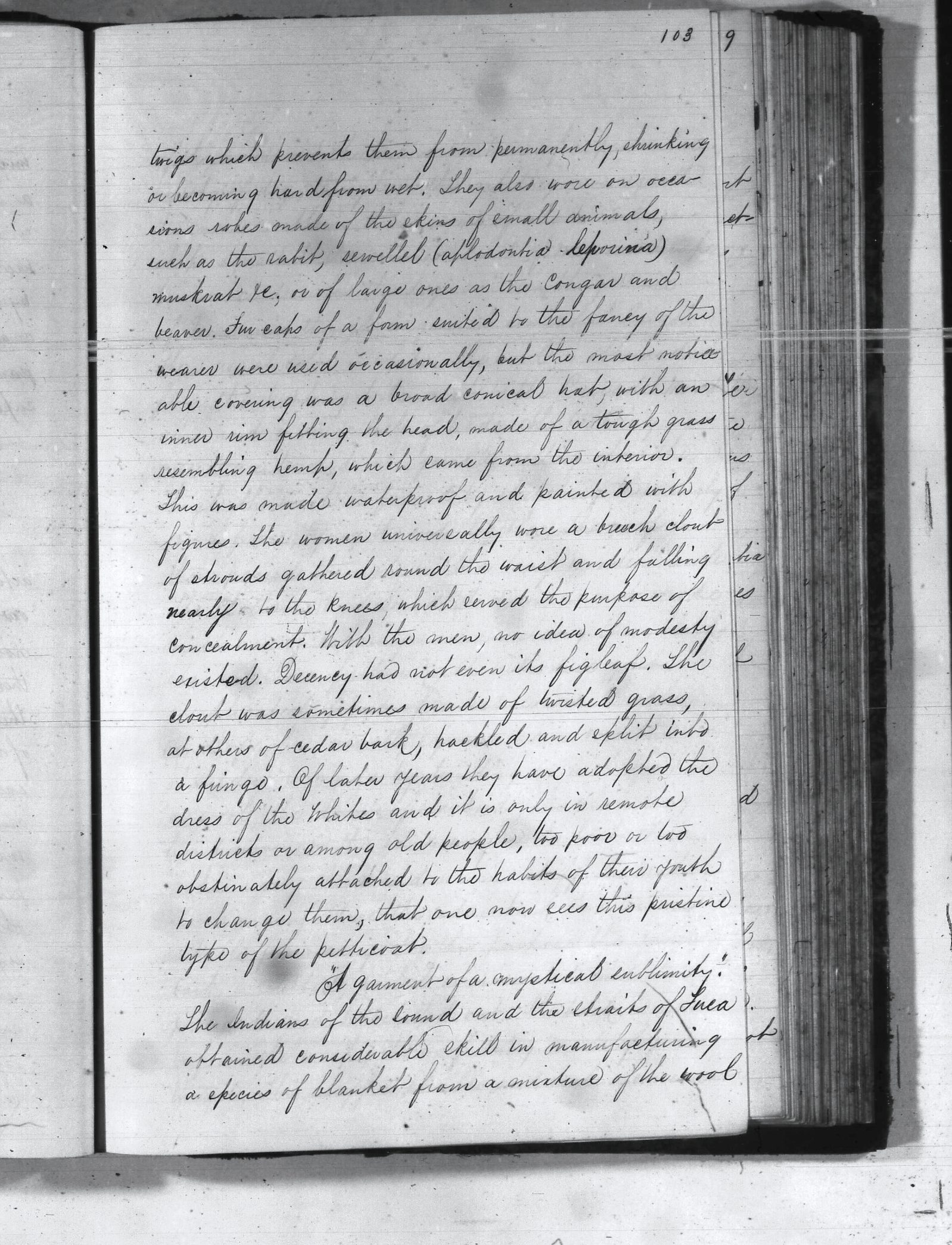
Read beside the scan
AI first transcription from the evidence pack; not independently verified. Compare with the scan.
twigs which prevents them from permanently, shrinking
or becoming hard from wet. They also wore on occa-
sions robes made of the skins of small animals,
such as the rabit, sewellel (aplodontia leporina)
muskrat &c, or of large ones as the cougar[?] and
beaver. Fur caps of a form suited to the fancy of the
wearer were used occasionally, but the most notice-
able covering was a broad conical hat, with an
inner rim fitting the head, made of a tough grass
resembling hemp, which came from the interior.
This was made waterproof and painted with
figures. The women universally wore a breech clout
of strouds gathered round the waist and falling
nearly to the knees, which served the purpose of
concealment. With the men, no idea of modesty
existed. Decency had not even its figleaf. The
clout was sometimes made of twisted grass,
at others of cedar bark, hackled and split into
a fringe. Of later years they have adopted the
dress of the Whites and it is only in remote
districts or among old people, too poor or too
obstinately attached to the habits of their youth
to change them, that one now sees this pristine
type of the petticoat.
"A garment of a mystical sublimity".
The Indians of the sound[?] and the straits of Fuca
obtained considerable skill in manufacturing
a species of blanket from a mixture of the wool
Citation and provenance
Gibbs, G., IV. (1856). [Manuscript volume, ms p. 103]. Gibbs Family Papers, 1763-1918 (U.S. Mss Y, Micro 1117, Reel 2, frame 3745). Wisconsin Historical Society Archives, Madison, WI, United States.
Citation details need editorial review.
Historical sources retain their individual rights and credits. A scan’s presence here does not establish unrestricted reuse.
People identified in the source catalog
These are catalog labels. Individual identities and relationships have not all been reviewed.
Where the book uses this document
No quotation has yet been assigned directly to this catalog record. Its individual frames may have separate connections.